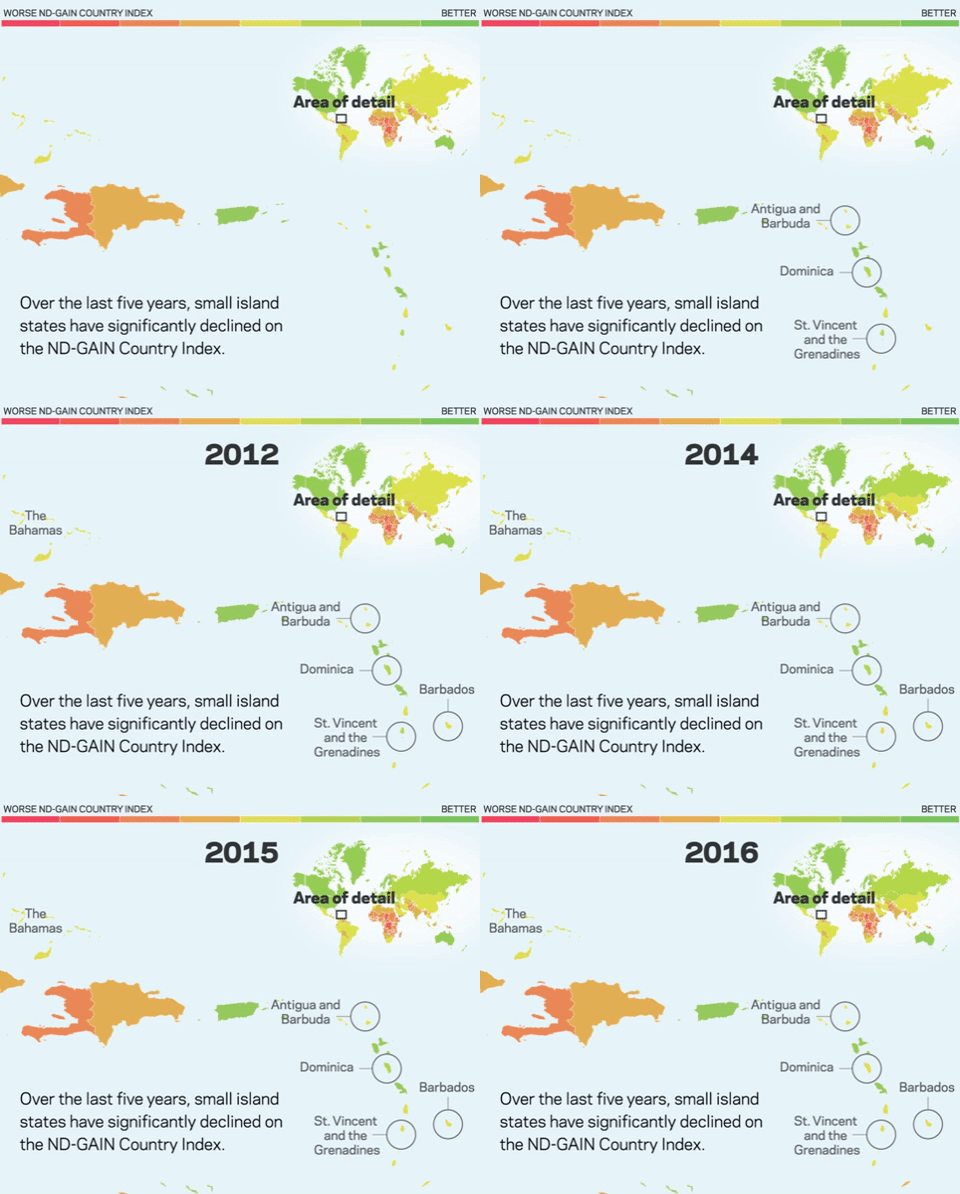
This year’s record-breaking hurricane season in the Caribbean has exacted a serious toll on island nations. In the Pacific, most small islands have shown increasing vulnerability on the ND-GAIN Index over the last five years, including Fiji, Maldives, Samoa, Tonga and Vanuatu. For small island states, superstorms paired with rising sea levels pose particularly daunting hazards.

“This data suggests islands continue to suffer significant setbacks from extreme weather events and a longer trend of increased vulnerability,” saidNotre Dame professor , who is associate director of the, which issues the annual index. “Ultimately, as a country’s vulnerability increases, so must their investments in adaptive capacity.”
The uses over 20years of data across 45 indicators to rank181 countries on vulnerability to extreme climate events and readiness to successfully implement adaptation solutions.
By comparison, countries that have made the biggest gains as climate adaptors on the ND-GAIN Country Index over the last five years include several larger, inland and economically developing countries, such as the Democratic Republic of the Congo, Iran, Myanmar, Russia and Vietnam.
Despite the increasing risk faced by coastal countries, island states around the world have taken action to prepare for climate threats.
Jamaica, for example, has enhanced its adaptive capacity over the past decade with improvements in sanitation facilities and access to reliable drinking water. The country has simultaneously become less dependent on imported energy and now fares considerably better than the global average change in vulnerability.
A full country ranking, as well as country profiles and visualization tools, is available at to help public and private sectors as they make investments for the common good. Extensive online tools allow users to compare climate risks and opportunities.
Contact: Jessica Sieff, assistant director of media relations, 574-631-3933, jsieff@nd.edu
]]>While the previous camera was popular, with 100,000 live feed views, its low angle prevented viewers from seeing eagles when in the nest and made it hard to see them when leaves were present in summer.
With the new high-definition camera, viewers will see the nest being built, eggs being laid and incubated, and the eaglets as they hatch and reach the fledging stage.
“The eagles are a wonderful symbol of how we can integrate scientific research with care for the environment,” said Diogo Bolster, associate director of the and associate professor of the. “The other day I showed my kids some images from the eagle cam and the looks on their faces were amazing. It’s wonderful to think that around the world, kids of all ages who watch the ND-LEEF Eagle Cam can now have a similar reaction."
Recently, the eagles have added sticks to their already massive nest – nearly 8 feet across and 3 feet deep – in preparation for winter. The best time to see the eagles online is 2 to 3 hours after sunrise when they are most active in the nest.
Viewers can also rewind the live feed up to four hours to look for recent activity in the nest. The live feed is available online at .
“There’s not consistent activity in the nest yet,” said Evie Kirkwood, director of St. Joseph County Parks, “but people who watch the camera online will notice the birds visiting the nest more frequently though winter, especially as egg laying begins in February.”
Adults and kids can learn firsthand about environmental research during the 5th Annual Science Sunday. From 1 to 4 p.m., Notre Dame faculty and graduate students will lead demonstrations and hands-on activities appealing to all ages, around topics such as micro-plastic pollution, tree physiology and chemical processes in ponds and streams.
During Science Sunday, a naturalist from St. Joseph County Parks will also be on hand to share information about bald eagles. There is no entrance fee for the event and light snacks will be provided.
]]>September 2017 now holds the record for most active month ofany Atlantic hurricane season. Of the 13 named storms so far this season, eight have been hurricanes, with five of the eight — Harvey,Irma,Jose, Lee and Maria — reaching Category 3 or higher.
Supporting the need for increased understanding of natural disasters through improved modeling and forecasting, the National Science Foundation awarded a team of University of Notre Dame engineers nearly $1 million to advance accuracy in forecasting storm surge.
Storm surge — how high ocean waters rise and where flooding occurs — is often the greatest threat to life and property during a tropical cyclone. A single storm can devastate livelihoods and cause tens of billions of dollars in damage.
As a hurricane approaches land, forecasters currently determine storm surge using complex computer models that account for uncertainties in storm size, track and intensity. Existing models run for real-time forecasts use simplified representations of coastlines and oceans, which are faster for computers to process, yet less accurate than models that use more detailed geographic data.
“Currently, models are able to predict storm surge reasonably well; however the problem remains that these models can take anywhere from days to weeks to run on a computer,” said study co-investigator , Frank M. Freimann Collegiate Chair in Hydrology and associate professor of the at Notre Dame. “Vice versa, there are current approaches that run in a reasonable time frame but aren’t accurate enough, thus compromising stakeholder’s abilities to make effective decisions.”
During the four-year study, researchers will work to develop improved storm surge models that incorporate fine-scale data to increase the accuracy of forecasts, while also maintaining reduced computer time and reasonable computational costs.
“By the end of this study, we hope to bridge the speed-accuracy tradeoff that now exists in surge prediction, said , co-investigator of the study and associate professor of the Department of Civil and Environmental Engineering and Earth Sciences at Notre Dame. “These results will enable more accurate simulations of surge in real time to assist policymakers, emergency management personnel and coastal residents.”
This award is one of 15 new grants fromNSF'sPREEVENTS (Prediction of and Resilience Against Extreme Events) program, which funded $18.7 million in awards this year. Research supported by PREEVENTS aims to improve predictability and risk assessments of natural hazards, increase resilience to these events, and reduce their effects on human lives, societies and economies.
The study, "Collaborative Research: Subgrid-Scale Corrections to Increase the Accuracy and Efficiency of Storm Surge Models" will collaborate withNorth Carolina State Universityand is affiliated with the. Research Assistant Professor, from the Department of Civil and Environmental Engineering and Earth Sciences at Notre Dame,is also a co-investigator of the work.
While recreational fisheries are culturally and economically valuable, freshwater ecosystems are vulnerable to degradation and collapse.
In response, the National Science Foundation recently awarded$1.5 millionto a team of ecologists to investigate the connections between people, fishand lakes in the Northern Highland Lake District of Wisconsinand also assess the dynamics involved in the governance of fisheries systems.
The four-year project aims to enhance understanding about the interactions between social and ecological processes, which affect both fish and human populations. Researchers will work to identify problems in these open-access systems and determine how angler preferences and available information affect fishing efforts.
“Lakeshore residents and local angler groups have the potential to leverage their local knowledge to inform and improve fisheries management," said , a co-principle investigatorof the study, and associate professor in the at the University of Notre Dame. “Through this research, we are exploring how the flow of information and knowledge amongst residents, anglersand managers impact decisions about recreational fisheries. We expect these decisions made within the social systems to interact with aspects of the natural system and dictate the sustainability of these regional recreational fisheries.”
The study will engage an interdisciplinary team of 15 collaborators representing nine research institutions and conservation agencies. Researchers plan to interview local organizations about investments in fisheries quality and develop new models with both ecological and economic implications.
The award is co-led by Christopher Solomon of the Cary Institute of Ecosystem 91Ƶ, Marco Janssen of Arizona State University, Stuart Jones of the University of Notre Dame, Olaf Jensen of Rutgers Universityand Sunny Jardine of the University of Washington.
Jones is also the associate director of aquatic research for the and an affiliate of the.
Originally published by at on September 21, 2017.
]]>The leadership role involves a three-year commitment to the society. She will spendthis year“getting her feet wet” as a member of the society’s executive committeebefore assuming the presidency in May 2018 from current president, Colden Baxter. In her final year, she will serve in the past-president role to advise and ease the transition to new leadership.
SFS is an international scientific organization dedicated to studying and promoting further understanding of freshwater organisms and ecosystems, connections between freshwater ecosystems and surrounding landscapesand the physical processes that affect them. Today the society is approaching 1,800 members of varying disciplines across seven regional chapters.
Tank was raised by a biology teacher along the shores of the Great Lakes and freshwater has long held a special place in her life. While attending Michigan State University, a Stream Ecology course and mentorship by senior scientists first led her to the society. “I’m fortunate to have found SFS in the early stage of my career; it is my professional home and my extended scientific family,” said Tank.
Inspired by the past and present leadership of SFS, Tank hopes to expand membership by attracting more disciplines, backgroundsand regions with a special focus on growth in graduate student members and early career scientists. “I think that sustained membership engagement can create positive momentum to grow our numbers,” said Tank. “Strategic thinking, communicationand leadership training workshops can be game changers.”
AtNotre Dame, Tank also leads the (IWI) where researchers are exploring how conservation practices like cover crops and restored floodplains can mitigate the influence of agricultural land use on freshwaters. The project engages key partners like local farmers and natural resource managers, conducts watershed-scale experiments on working landsand quantifies the water quality benefits in a real-world setting.
Tank’s experience conducting ecological research on working lands has influenced how she sees the future role of SFS moving forward. “I believe the society and its members are a key source of information for science-based decision making around freshwater management and conservation, which builds on historic strengths in promoting freshwater science through education and outreach,” said Tank.
“The collective experience at SFS, coordinated with other aquatic societies, can serve as a clearinghouse for knowledge that supports efforts by the private sector, NGOsand government agencies to sustain the future of our freshwaters,” said Tank. It is her hope that her service in the SFS leadership role will help the society flourish in these and other efforts.
Originally published by at on Sept. 11, 2017.
]]>
The University of Notre Dame’s (ND-GAIN) has announced it will assess the climate vulnerability and readiness of every U.S. city with a population over 100,000 – more than 250 in all – in an effort to help inform decisions by city officials on infrastructure, land use, water resources management, transportation and other adaptive strategies.
The Urban Adaptation Assessment (UAA), a 24-month project funded by the , will also integrate a social equity analysis, which will investigate how vulnerable groups are disproportionately harmed by climate hazards, such as extreme heat, flooding and extreme cold.
“Today policy choices regarding how to spend scarce resources to adapt to our changing climate must be articulated without the benefit of seeing how alternative choices will influence local inequities,” said , associate director of Environmental Change Initiative and professor of political science at Notre Dame. “Our data-driven tool will help leaders understand the implications of alternative policy choices and pursue decision-making that builds resilient communities.”
ND-GAIN will collaborate with the University of Minnesota’s to compile and analyze each city’s data and produce assessments that focus on urban geographies’ vulnerabilities and how ready cities are to successfully implement adaptation solutions. The project will also examine adaptation patterns among coastal, drought-prone and single-industry cities, among other subsets.
“Protecting those least able to withstand climate impacts is a critical part of good adaptation policies,” said Lois DeBacker, managing director of the Kresge Foundation’s , which funded ND-GAIN’s pilot study assessing five U.S. cities in 2015. DeBacker said the equity analysis is a particularly important component of adaptation planning. “We’re pleased to be able to support Notre Dame’s work in this area, and thrilled to see it expand to more than 250 municipalities.”
ND-GAIN will build upon its advisory committee of leading U.S. adaptation and social equity experts to include input from city stakeholders and community groups. An online dashboard will also be generated, allowing government, corporate and nonprofit leaders to view the assessments and manipulate the data based on their preferences.
“With the majority of our world’s population residing in cities, urban areas have a unique platform to increase the resilience of our communities, states and eventually our world.” said , program director of ND-GAIN. “It is our intention that the Urban Adaptation Assessment will cause a ripple effect of identifying key climate risks and adaptation options, calling out areas of opportunity for investment and prioritizing areas in need of adaptation resources.”
The work will complement a , “Climate Adaptation: The State of Practice in U.S. Communities,” funded by Kresge and authored by Abt Associates.
To learn more about ND-GAIN’s Urban Adaptation Assessment, visit .
ND-GAIN works to provide knowledge and human resources that help governments, businesses and communities – especially the most vulnerable – adapt to the world’s changing climate. ND-GAIN is part of the Notre Dame .
The Kresge Foundation seeks to help communities build resilience in the face of climate change. As a foundation committed to creating opportunity for low-income people and communities, Kresge is particularly concerned about the disproportionate effect climate change has on people with limited economic resources.
Contact: Alex Gumm, 219-746-5953, agumm@nd.edu
]]>
Tom Springer has been named the new managing director of the Notre Dame’s Environmental Change Initiative.
Read more: .
]]>
ND-GAIN is key to the success of the historic Paris Agreement on climate change.
Read more: http://environmentalchange.nd.edu/news/64334-cop21-success-for-adaptation/.
]]>