For years, Royer said that police had exploited his mental disability to coerce him into making a false confession in a 2002 murder case in Elkhart, Indiana. This week, the 46-year-old man was officially exonerated when a judge granted the Elkhart County prosecutor’s motion to dismiss the murder charge against him.
Royer is the first client of Notre Dame Law 91Ƶ’s new to be exonerated.
“We are not simply here to rejoice, to express our thanks for the fact that Andy has been released from prison, has regained his liberty, has been reunited with his family — that’s all wonderful, but what happens next?” said Professor , director of the Exoneration Justice Clinic. “And how can we ensure that this doesn’t happen again in Elkhart County?”
On Wednesday, Royer and his mother and stepfather, Jeannie and Michael Pennington, stood alongside the Exoneration Justice Clinic’s attorneys and students for a press conference in the clinic’s office on Howard Street in South Bend. With cameras and microphones on him, Royer seemed like a man who is finally able to set down a heavy burden.
“It’s been great,” Royer told a reporter who asked how his past year had been since leaving prison in 2020. “I had a lot of stress on me, but I’m a whole different person now.”
His parents seemed equally relieved, though the understanding that Royer had lost 18 years of his life to this wrongful conviction was a palpable undercurrent.
“We’re very thankful for the process that has taken place to bring Andy to this point today,” Michael Pennington said. “To bring his freedom back to him, and join our family and live the rest of his life in peace and comfort, and to know that he is exonerated.”
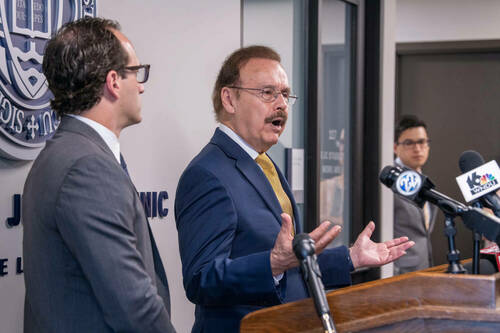
Jeannie Pennington added, “I was told right after he got in there by an attorney that he was innocent, that they could see it in his paperwork. It still took 17 years for him to be able to prove that, for him telling people, ‘I’m innocent,’ and no one listening.”
Royer spent 16 years in prison after he was wrongfully convicted in the strangulation death of an elderly woman who lived in his apartment building. Throughout his prison sentence, he maintained that Elkhart police had taken advantage of his disability in order to confuse him and pressure him into falsely stating that he committed the crime.
Royer’s confession was coerced, illegal and inadmissible, ҳܱܰésaid. He was interrogated for two days but only a small portion — 61 minutes in total — of his statement was recorded. Royer had no idea what he was doing, going so far as to ask, “Can I just go home now?” after falsely confessing to the crime.
Royer was released from prison in April 2020 when a special judge in Kosciusko County overturned his conviction and granted a petition for a new trial. The earlier this year. The opinion called officer testimony at Royer’s trial “particularly galling.” Elkhart Police Detective Carl Conway perjured himself during Royer’s trial, withholding the fact that he fed Royer details about the crime during his coerced confession. During the 2004 trial, Conway said he didn’t give Royer those details — which would be known only to someone who was at the crime scene — but in 2019 Conway admitted to doing so.
“As we have explained, when law enforcement officers lie under oath, they ignore their publicly funded training, betray their oath of office and signal to the public at large that perjury is something not to be taken seriously,” the Court of Appeals opinion stated. “This type of conduct diminishes the public trust in law enforcement and is beneath the standard of conduct to be expected of any law enforcement officer.”
In Wednesday’s press conference, Royer’s attorney and Notre Dame Law Adjunct Professor said the exoneration was about being joyful about Royer’s exoneration and reflecting on the miscarriage of justice, but also a reckoning for the Elkhart Police Department and Elkhart County Prosecutor’s Office.
“Andy and his family have waited 18 years for him to have his name back, for this nightmare to be over,” Slosar said. “When the state dismissed our case, our prayers were collectively answered.”
Slosar detailed Royer’s case, outlining that Royer didn’t have a chance at a fair trial from the very beginning — from the coerced confession, where detectives fed Royer what to say, to paying a witness an undisclosed $2,000 after she falsely testified against Royer and his co-defendant Lana Canen. Prosecutors also put a fingerprint expert on the stand who had no such training, Slosar said — something that led to the exoneration of Canen in 2012. Not only did this officer identify the fingerprint to the wrong person, but the print he claimed was a left pinky finger was in fact a right index finger print.
The June 2021 prosecutor’s motion to dismiss the murder charge, now granted by the presiding judge, marks the end of Royer’s long fight for freedom.
Notre Dame Law 91Ƶ faculty and students have worked on Royer’s case since 2017. Students have been involved at every stage of the process to overturn his conviction, including conducting early investigations, drafting a successive petition for post-conviction relief, participating in an evidentiary hearing and drafting the respondent’s appellate brief and preparing for the appellate oral argument.
“Andy would not be free, and we would not be here, but for the tireless work of Notre Dame Law students, our investigator and attorneys who were determined to correct the ultimate miscarriage of justice — the wrongful conviction of an innocent person,” Slosar said.
Royer’s conviction is the fifth person from Elkhart to be exonerated of serious criminal charges. Gurulé said that’s a shocking number for a city with a population of about 50,000 people. He and Slosar called for the firing of Conway, the officer involved in Royer’s coerced confession, as a starting point, adding that Royer was certainly entitled to compensation for his time spent wrongfully behind bars.
“It’s taken 18 years to get here, but we are confident that it’s finally come to an end. These charges should have never been filed against Andy in the first place, and we finally think this nightmare for Andy and his family has come to an end,” Gurulé said.
Originally published by at on July 22.
]]>Carozza, who also serves as director of Notre Dame’s , is known for his work in international human rights. With the Venice Commission, he will work on pressing legal issues facing Europe and the rest of the world.
“It is a privilege and an honor to be asked to serve on the Venice Commission, and to participate in its influential work to strengthen democracy, constitutionalism and the rule of law,” Carozza said. “I look forward to working with the other commission members and to bringing the commission’s work back to home to the benefit of the Notre Dame community as well.”
The Venice Commission, also known as the European Commission for Democracy Through Law, serves as the advisory body for the Council of Europe on constitutional matters. The commission consists of 61 member states, including the 47 Council of Europe members and 14 other countries. The commission works in three primary legal areas: democratic institutions and fundamental rights; constitutional justice and ordinary justice; and elections, referendums and political parties.
The members of the commission serve in their capacity as independent experts, not as governmental representatives. Carozza will continue to remain on the faculty at Notre Dame full time throughout the term of his appointment to the commission.
“I know I speak for the Law 91Ƶ in congratulating Paolo on this appointment,” said , the Joseph A. Matson Dean and Professor of Law at Notre Dame Law 91Ƶ. “Paolo’s expertise as a noted scholar of comparative constitutional law, coupled with the practical knowledge he gained on the Inter-American Commission on Human Rights, will be invaluable to the commission’s work advising Council of Europe states on important constitutional matters.”
Carozza previously served as a member of the Inter-American Commission on Human Rights, which is the principal international body responsible for the promotion and protection of human rights in the Western Hemisphere. He was a member of the commission from 2006 to 2010, and served as its president in 2008-2009.
Originally published by at on March 13.
]]>
Clockwise from top left: Matt Knecht, Eric McCartney, Dan Manier, Christopher Radabaugh, Scott Hengert, and Clint Brown make up the Law 91Ƶ’s dedicated information technology staff.
National IT Professionals Day falls on the third Tuesday of every September – that’s Tuesday, Sept. 19, this year. The dedicated Information Technology staff at the Law 91Ƶ keeps computers whirring, projectors lit, and video connections crisp at our main campus, while also connecting classrooms, students, faculty, and staff to people all over the world.
Get to know a little bit more about our IT staff through brief profiles below.
Dan Manier, director of law school technology, began work with Notre Dame Law 91Ƶ in May 1998, but started working at Notre Dame in information technology in August 1989.
“We get to learn about all the great things that our law students, faculty, and staff do, and occasionally we find a way to help them do it better,” Manier said about his position.
Manier studied at Notre Dame for his undergraduate degree, during which his 1984 Bookstore Basketball team made it into Sports Illustrated. Stop by his office if you’d like to hear the story.
For much of the past 30 years, Manier has played and coached soccer locally. However, he’s recently returned to his “first love”: baseball, and joined the South Shore Liners, which is part of the Sappy Moffitt Baseball League.
“There are five teams in the league and it’s great fun. For me, there’s nothing like standing in the box with a wood bat waiting on a fastball,” Manier said. “Okay, knocking it into the gap feels pretty good, too!”
Eric McCartney has served as the Law 91Ƶ’s student computing manager since December 2008.
McCartney said he likes interacting with the law students and helping them make their technology last longer – a drive that he didn’t see often in undergraduates. He also likes having fun with student workers, who could use the laugh during the trials of law school.
“Several years ago, I challenged one of the students who worked for me to a bowling competition. Every week he would lose the challenge,” McCartney said. “The next week he would accept a new challenge. It all ended when his ‘punishment’ for losing was to carry a bowling pin around with a picture of him on it for the entire day. He decided he didn’t want any more challenges from that point on. The pin is still in my office.”
Outside of the Law 91Ƶ, McCartney dabbles in photography – much to his son’s chagrin.
“I have over 15,000 photos of him, and he’s not even 5 yet,” McCartney said.
Clint Brown has served as IT engineering specialist for the Law 91Ƶ for five years, though initially he began in IT services for the Main Building.
“My first week that I worked at ND in the Dome, I set off the silent alarm in the executive vice president’s office while testing network jacks,” he recalls. “I was greeted at the door by two NDSP officers who wanted identification. No one in the president’s office knew who I was yet. I had to get my manager to vouch for me!”
Outside of the Law 91Ƶ, you might find Brown in Crowley Hall taking guitar lessons.
“I ended up in a class with all undergrads. I am old enough to be their dad,” he joked. “Interestingly, no one really cares. They treat me like a classmate.”
Scott Hengert has served as an audio/visual engineer for nine years at the Law 91Ƶ, where he says it feels “more like a creative outlet than a job.”
He still recalls a sense of unease with campus shortly after he began working here, but one snowy evening changed all of that.
“I had my first late night just a few weeks after starting at the Law 91Ƶ. It was November during midterms, and it had just started to snow,” he said. “I set out for my walk across campus in the dark – a little hesitant, to be honest – but as soon as I exited the north doors of Eck Hall, I saw perfect snowflakes, heard carolers on the quad, and was stopped by an international student asking me to take their picture in their first snowfall. I walked across campus with no hesitation after that evening.”
Outside of the Law 91Ƶ, Hengert says he’d like to have his pilot’s license someday.
Matt Knecht has served as audio/video assistant since August 2011. He enjoys working with the rest of the IT and greater Law 91Ƶ staff the most.
“It would be just another job if it weren’t for the people I am fortunate to work with,” Knecht said.
Knecht remembers his first day, when someone came into the back room of the IT department asking for tape – any tape. He explains that it’s only funny in context, as he was sitting with office supplies, archival mending and labeling materials, gaffer tape, duct tape, packing tape, shipping tape, and even analog audio and video recording “tape” within arms reach.
Outside of the Law 91Ƶ, Knecht is an avid veteran player of table-top, board, card, and vintage video games since 1998. He loves to read and recommends “Catch 22,” “1984,” and all 5 volumes of “The Hitchhiker’s Guide to the Galaxy” trilogy. (Yes, it’s a trilogy.)
Christopher Radabaugh has served as audio/visual assistant at the Law 91Ƶ for five years this October.
“My favorite part of my duties is helping out the students with setting up, recording, and distributing their deposition and trial ad skills recordings,” he said.
You might spot Radabaugh at other spots around campus.
“I also work at the DeBartolo Performing Arts Center on the weekends during the school year and with NDSP during the summer months,” he said. “On occasion, it will surprise a faculty or staff member to see me while working at one of the other departments. It definitely makes for a great conversation starter – ‘Oh, you work here, too?’ ‘Wow, you are everywhere on campus!’”
For Radabaugh and his wife’s fifth anniversary, they took a trip to Los Angeles for a taping of “The Price is Right” to see Bob Barker before he retired later that year.
“We were able to get in the audience – not as a contestant, though – and got to see the man, the myth, the legend himself,” Radabaugh said. “Also, an audience member that was sitting right in front of me got on the show and won the whole thing!”
Originally published by at on September 18, 2017.
]]>