tag:news.nd.edu,2005:/news/authors/arienne-calingo tag:news.nd.edu,2005:/latest Notre Dame News | Notre Dame News | News 2024-03-21T09:00:00-04:00 Notre Dame News gathers and disseminates information that enhances understanding of the University’s academic and research mission and its accomplishments as a Catholic institute of higher learning. tag:news.nd.edu,2005:News/160653 2024-03-21T09:00:00-04:00 2024-03-21T12:01:01-04:00 Oak Flat under threat: Stephanie Barclay leads discussion on urgency of protecting Indigenous sacred site The Native American Law Students Association (NALSA) at the University of Notre Dame, in collaboration with Notre Dame Law 91Ƶ’s , hosted the event “Sacred Lands: Apache Stronghold v. United States of America” earlier this month. The discussion, led by Professor , centered on the importance of upholding religious liberty protections for Oak Flat, a site in Arizona that has been sacred to the Apache people for centuries and is being threatened by a massive copper mining operation.

Barclay, who serves as the faculty director of the Notre Dame Law 91Ƶ Religious Liberty Initiative, participated in oral argument before the en banc Ninth Circuit in Pasadena, California, last March, where she represented as amici the National Congress of American Indians, an Apache tribal elder and other groups that protect Native American cultural heritage and rights.

was one of the first cases that the Notre Dame Law 91Ƶ supported when the clinic was newly established in 2020. For the past three years, faculty and students from the clinic have worked with members of the Apache tribe to protect Oak Flat.

“It is always great to learn about the ways in which the Law 91Ƶ supports freedom of religion, especially with regard to Native American sacred lands, which Professor Barclay explained have had the least success in legal protection,” said Katie DePaola, president of NALSA. “Part of NALSA’s mission is to educate students on Native American legal issues, and having ties to these issues through Notre Dame Law 91Ƶ’s Religious Liberty Initiative is very meaningful to our student organization.”

Apache Stronghold v. United States involves a proposed mining project that would turn the sacred site at Oak Flat into a massive 2-mile-wide, 1,000-foot-deep crater, ending Apache religious practices at Oak Flat forever.

At the event, Barclay spoke in depth about the Religious Freedom Restoration Act (RFRA) and its relevance to the case. RFRA establishes rights beyond those protections afforded by the Free Exercise Clause by creating a heightened standard of review for government actions that substantially burden a person’s exercise of religion.

The Religious Liberty Clinic argues that the destruction of Oak Flat constitutes a substantial burden under RFRA on Native American religious exercise, as Native American religious identity, expression and practices are inextricably tied to the sacred land.
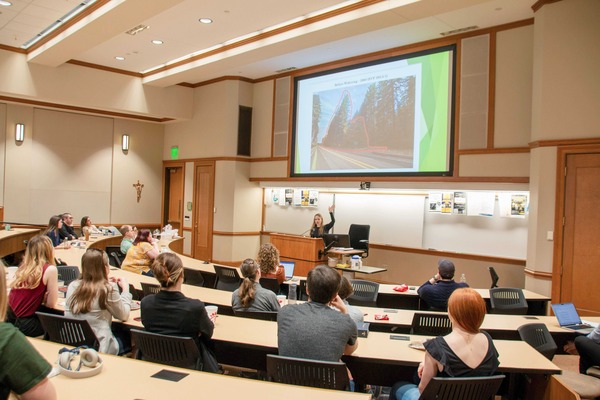
Stephanie Barclay classroom

“Since time immemorial, [Oak Flat] has been sacred to multiple tribes including the Western Apache, and they believe it is the direct corridor to their Creator,” Barclay said. “The physical destruction the government anticipates at Oak Flat will take away any choice the Western Apache has to continue performing their religious exercise at this sacred site.

“They face the elimination of plants, natural resources, shrines with religious significance, and religious ceremonies,” she added. “They face their places of worship being inaccessible simply because those places will cease to exist, making religious exercise physically impossible.”

Barclay also stated that, whether they are directly or indirectly affected by government actions, Native American tribes tend to be particularly vulnerable to ongoing government interference and violations of their religious liberty.

Bre Gruber, a Navajo undergraduate student at the University of Notre Dame, corroborated this and shared that the persisting challenges that Native American tribes face extend beyond the desecration and destruction of sacred lands.

“Indigeneity, whether it be the spiritual practices, language or other cultural practices, has consistently been challenged,” Gruber said. “These challenges threaten the existence of indigeneity as it is intrinsically tied to the land, the people and the language. These issues being discussed on the Notre Dame campus are crucial to emphasizing their importance.”

On March 1, a divided en banc Ninth Circuit issued its decision in Apache Stronghold, affirming the district court’s denial of Apache Stronghold’s motion for a preliminary injunction. The Ninth Circuit’s ruling clears the way for the destruction of Oak Flat, and Notre Dame Law 91Ƶ’s Religious Liberty Clinic hopes that the Supreme Court will correct it.

“Professor Barclay’s work along with the Religious Liberty Clinic student fellows is making such a strong national impact,” said , senior associate director at the Kresge Law Library. “It was moving to hear about the students’ self-reflective approach to this work and how deeply the tribes value the clinic’s efforts.”

The event drew a diverse array of attendees from across the University. Tori Van Arsdale, an undergraduate student and tribal member of the Navajo Nation, said, “As an Indigenous student, it was uplifting to see Notre Dame Law 91Ƶ talk about the underrepresented issues faced in Indian Country, past and present, such as the Apache Stronghold vs. United States case. This type of Indigenous visibility is an essential tool for change in our communities.

“Here at Notre Dame, we continue to work toward Native American inclusivity in discussions across campus and beyond, and I am hopeful for change with events such as ‘Sacred Lands.’ I appreciate Notre Dame Law 91Ƶ for supporting the Apache and Oak Flat and for continuing to take the initiative in sharing Native American perspectives and realities.”

Originally published by Arienne Calingo at on March 20.

]]>
Arienne Calingo
tag:news.nd.edu,2005:News/152868 2023-05-03T08:00:00-04:00 2023-05-02T16:26:18-04:00 Religious Liberty Clinic participates in oral argument to defend Oak Flat Apache Stronghold v. United States was one of the first cases that the University of Notre Dame Law 91Ƶ supported when the clinic was newly established in the 2020-21 academic year. For the past two years, faculty and students from the clinic have stood with members of the Apache tribe to protect Oak Flat, a sacred site in Arizona that is threatened by a massive copper mining operation.

After a divided ruling from the U.S. Court of Appeals for the Ninth Circuit, the legal battle continued this spring when the Ninth Circuit reheard the case “en banc,” meaning in front of a full panel of 11 judges. Less than 1 percent of en banc requests are granted.

Professor , director of the , participated in oral argument before the en banc Ninth Circuit on March 21 in Pasadena, California. Barclay represented the National Congress of American Indians, an Apache tribal elder and other groups that protect Native American cultural heritage and rights. The groups were also represented in an amicus brief the Religious Liberty Clinic filed in the Ninth Circuit last fall.

involves a proposed mining project that would destroy sacred land where the Apache have gone for centuries to worship, pray and conduct religious ceremonies. The site is also sacred to various other Native American tribes, including the ancestors of today’s O’odham, Hopi, Zuni, Yavapai and Apache tribes.

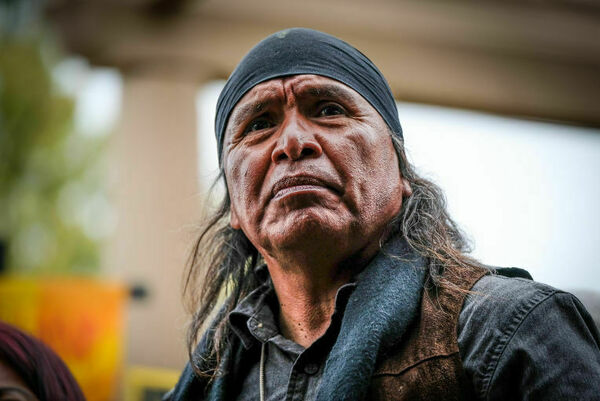
Wendsler Nosie Head Of Apache Stronghold
Wendsler Nosie, the head of Apache Stronghold, attended the proceedings in Pasadena following the en banc hearing.

Apache Stronghold — a nonprofit community organization dedicated to the defense of Native American sacred sites — has argued that the proposed copper mine at Oak Flat would violate the religious rights of many Apache and other Native Americans. Resolution Copper, a joint venture of British-Australian mining companies BHP and Rio Tinto, plans to construct a copper mine that would turn the sacred site into a massive crater.

In a previous hearing at the Ninth Circuit, a three-judge panel held in a 2-1 ruling that the federal government could proceed with the transfer of Oak Flat to Resolution Copper.

At the en banc rehearing, Barclay provided three arguments in support of Apache Stronghold to a new panel of judges: “First, this court should revisit its troubling rule under Navajo Nation. Second, the land rider did not displace RFRA (Religious Freedom Restoration Act). Third, it is government, rather than private action in this case, that imposes the substantial burden on the religious exercise of the Apache people.”

She argued alongside Luke Goodrich, vice president and senior counsel at Becket Law.

The destruction of Oak Flat would impose a substantial burden on Native American religious exercise, as Native American religious identity, expression and practices are inextricably tied to the sacred land, Barclay told the panel of judges.

Whether they are directly or indirectly affected by government actions, Native American tribes tend to be vulnerable to government violations of their religious liberty. 

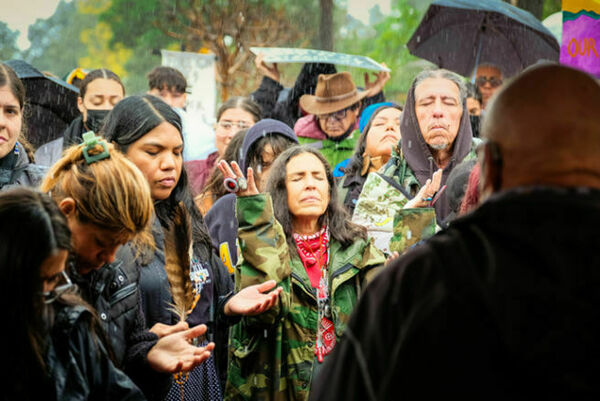
After the en banc hearing, a diverse coalition of Indigenous activists, environmental groups, religious advocates and legal practitioners convened in front of the courthouse steps, where Barclay delivered remarks.

Post Oral Argument
A group of Oak Flat supporters gathered together outside of the courthouse to call for protection of the sacred site of Oak Flat in Arizona.

“I was proud to argue in oral argument on behalf of Notre Dames Religious Liberty Clinic today. Notre Dame was proud to argue alongside Becket and our Apache friends in this fight for Oak Flat,” Barclay said.

“Although our religious beliefs are different, we see that what the government is doing is wrong,” she said. “Just as we would hope that people would defend [us] if someone wanted to destroy a sacred shrine or a pilgrimage site for Christian religious groups, so, too, should the government have to justify its actions if it wants to destroy this sacred site of Oak Flat.”

Barclay reiterated her support for Apache Stronghold and saving Oak Flat following the oral argument: “Im optimistic that, after argument today, the Ninth Circuit will issue a ruling that will make clear that our religious freedom laws apply equally to people of all faith and to all sorts of places of worship whether were talking about a synagogue or a mosque or a Native American sacred site.”

Established in 2020, the Notre Dame Law 91Ƶ Religious Liberty Initiative promotes and defends religious freedom for all people through advocacy, formation and thought leadership. The initiative protects the freedom of individuals to hold religious beliefs as well as their right to exercise and express those beliefs and to live according to them.

The Religious Liberty Initiative has represented individuals and organizations from an array of faith traditions to defend the right to religious worship, to preserve sacred lands from destruction, to promote the freedom to select religious ministers and to prevent discrimination against religious schools and families.

Learn more about the Religious Liberty Initiative at .

To read this story in full, visit .

Originally published by Arienne Calingo at on April 28.

]]>
Arienne Calingo