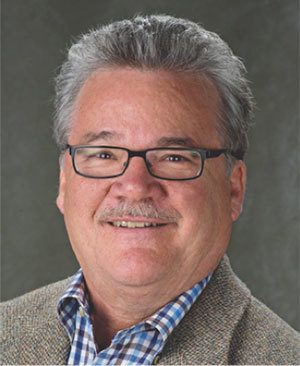
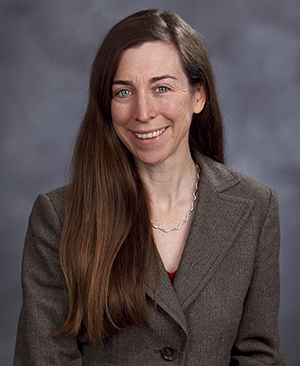
A member of the Notre Dame faculty since 2012, she served for several years as head of the Graduate Conducting Studio in the program and was the first to lead its doctoral program in choral conducting. At Notre Dame, she conducted and designed a series of musical works with new modes of interdisciplinary presentation.
“Professor Tellez spent her final days doing what she loved — teaching, composing and performing,” said , head of SMND’s Graduate Conducting Studio and associate professor of the practice in conducting. “Her uncompromising artistic vision and her own gifts as a visual artist took her beyond the bounds of choral music into performance art and dramatic theater. She touched the lives and careers of students for more than 30 years. Her indomitable spirit will be missed.”
A Venezuelan American conductor and scholar who had been called “a quiet force behind contemporary music in the United States today,” Téllez took a co-creative approach to new music performance, devoting special attention to vocal-instrumental and staged genres.
She earned a doctorate in music in 1989 from Indiana University and was the winner of the American Choral Directors Association’s . She pioneered new modes of classical music presentation through the exploration of the relationship of music with other arts and technology.
Téllez delved into the work of underrepresented composers, especially women and Latin American artists, with her performances of contemporary music for chorus, orchestra and opera. She advocated for the reconsideration of the concept of art music, and she proposed the co-creative role of the listener in the value of music as art.
A frequent composer, her most recent work, “A Dance for Seurat,” will be premiered by the South Bend Symphony Orchestra on Jan. 9 at the DeBartolo Performing Arts Center at Notre Dame.
Téllez conducted in the United States, Europe, Israel and Latin America. After her tenure as music director of the National Chorus of Spain, she joined the music faculty at the Indiana University Jacobs 91Ƶ of Music in 1992, as director of the Latin American Music Center and the Contemporary Vocal Ensemble.
She commissioned and recorded several new works, produced 14 CDs of Latin American music and organized several Inter-American Composition Workshops. During the 2001-02 period, she was the resident conductor of the pioneering Contemporary Chamber Players of Chicago and became the music director of the Pocket Opera Players in New York City. Téllez is the first woman on record to conduct Berlioz’s “Grande Messe des Morts,” at Indiana University in 2000.
She is preceded in death by her mother, Auristela Valle, and is survived by her father, Dr. Ramón Téllez; her sisters; brother; several nieces and nephews; and countless friends.
Palmer Funeral Home Hickey Chapel is assisting the family with arrangements, and condolences .
A memorial concert will be held at Our Lady of Loretto Church at Saint Mary’s College on March 4.
]]>The No. 1 ranking is based on academic reputation, employer reputationand research impact. With an overall score of 92.8, the placed ahead of Harvard University, the University of Oxford, Duke Universityand Durham University.
“This recognition is a tribute to the strength and breadth of our faculty's expertise and research, as well as the rich learning community that is created by the talented graduate students who come to study with us, combining probing intellectual curiosity with deep pastoral concern for church and world,” said , associate professor and acting chair of the department.
Guided by the ideal of “faith seeking understanding,” the department has six principal areas of research —, , , , and .
In addition to offering , Notre Dame’s theology department maintains a strong commitment to undergraduate education through the more than 500 students who in theology and in the courses all Notre Dame students take as part of the University’s .
“Our graduate students and undergraduates remind us every day of the importance of what we do,” Ashley said. “I couldn’t be prouder of my colleagues for the way they rise to the challenge.”
Originally published by at on March 11.
]]>An Evening with Joy Harjo is presented by , the new and the Native American Student Association of Notre Dame. The event is part of the University’s , which runs Feb. 22-28.
Harjo,of the Muscogee (Creek) Nation, is an internationally renowned poet, musician, performerand writer. She is the author of nine books of poetry, several plays and children's booksand two memoirs, “Crazy Brave” and“Poet Warrior: A Call for Love and Justice.”
Harjo is the executive editor of the anthology “When the Light of the World was Subdued, Our Songs Came Through — A Norton Anthology of Native Nations Poetry” and the editor of “Living Nations, Living Words: An Anthology of First Peoples Poetry,” the companion anthology to her signature poet laureate project, featuring Native Nations poets.
At the Notre Dame event, Harjo will read some of her poetry and participate in a Q&A moderated by Native American Student Association President Mikaela Murphy and , professor of English and Africana studies and director of the Initiative on Race and Resilience.
Murphy, who first started reading Harjo’s work when she was in high school, said she has been working to try to bring the poet to campus since Harjowas named poet laureate in 2019.
“Notre Dame has a long history with Native Peoples, and this is one of the ways that students and faculty can support the Native population here,” Murphy said.
“This is an excellent opportunity for people who don’t know much about Native literature to hear from a Native poet firsthand. And Joy Harjo’s poetry promotes so much strength and resilience in times of hardship, which I think the entire campus community and beyond would benefit from during this time of the pandemic.”
The Initiative on Race and Resilience is honored to host Harjo for its inaugural event, Sanders said. “Celebrating the expressive cultures of BIPOC (Black, Indigenousand people of color) communities is a vital part of our mission to challenge systemic racism and to advance racial equality through research, educationand community empowerment.”
Sanders added that the Initiative also recently announced a partnership with the Notre Dame Institute for Advanced Study to bring award-winning poetto Notre Dame as an artist-in-residence for the 2021-22 academic year. For more information on the new initiative, visit .
Originally published by at on Feb. 15.
]]>, an associate professor in the University of Notre Dame’s , has won the 's Oscar G. Brockett Essay Prize.
The award, given annually to the best essay of theater research in a scholarly English-language publication, honored Forsgren’s “'The Wiz' Redux; or Why Queer Black Feminist Spectatorship and Politically Engaged Popular Entertainment Continue to Matter,” which appeared in .
Her essay explores three different versions of “The Wiz” — a musical reimagining of “The Wizard of Oz” that features an all-Black cast — and analyzes how queer Black feminist spectators would have perceived each adaptation.
In studying the original 1975 Broadway production, the 1978 film adaptationand a 2015 TV special, she found that Dorothy consistently creates an Oz brimming with queer Black cultural references and visions of queer Black womanhood. Forsgren’s article also celebrates the pleasure that queer Black feminist spectators might experience from the critical moments wherein heterocentrism, sexismand white cultural hegemony are, intentionally or not,subverted.
“My research builds on the efforts of previous generations of Black women intellectuals who preserved and disseminated African American history and culture,” Forsgren said. “Unfortunately, many of these pioneering scholars and artists have yet to receive the recognition they deserve. Receiving this prize not only attests to the importance of queer black feminist spectatorship, but also honors the legacy of my foremothers.”
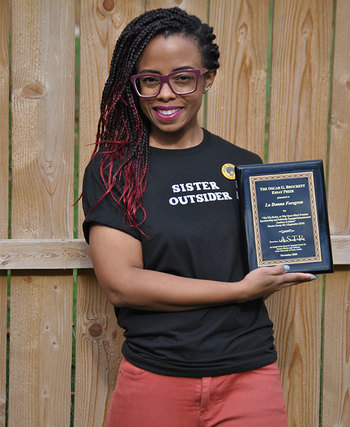
Forsgren, a concurrent faculty member in the and an affiliated faculty member in the , focuses her research on on African American theater and performance, dramaturgyand Black feminist theories.
She was also appointed this month as associate editor of Theatre Survey, which will lead to her becoming editor of the journal in two years. In that position, she said, she will strive to empower authors and amplify the works of previously marginalized voices in the field.
“As a Black woman and first-generation college student, I am intimately acquainted with the institutional barriers that impede the intellectual growth of marginalized communities,” she said. “I am incredibly honored that I was selected to serve as associate editor of this prestigious international journal.”
Forsgren’s latest book,“,” published last month by Northwestern University Press, is the first oral history to fully explore the contributions of Black women intellectuals to the Black arts movement.
Forsgren documents this vital yet under-researched chapter in African American, women’sand theater history through interviews with Black women theater artists and activists about how they disseminated the Black aesthetic and emboldened their communities.
“These women made profound contributions to Black art and helped galvanize Black Americans into action,” she said. “They produced amazing plays, but many of them were never published. So my work is recuperative —I go out and speak to these women and I ask them what their purpose for creating art was, and I put that into conversation with their activism. Because they weren’t just artists — they were activists as well.”
Originally published by at on Nov.18.
]]>The guest appearance is part of Sandoval’s “Swinging Christmas with the Arturo Sandoval Big Band” concert at 8 p.m. on Dec. 21 (Friday).
The Notre Dame Children’s Choir is joined by Notre Dame students Emily Swope, a soprano and master's student in voice, and senior music major Alexander Mansour, a pianist and arranger of seven songs on Sandoval’s album. The ensemble is led by , associate director of .
Sandoval recorded “Arturo Sandoval’s Christmas at Notre Dame” in May 2017, returning to the University after receiving an honorary doctoral degree the previous year. The 12-track album includes religious classics such as “Silent Night” and secular songs such as “Frosty the Snowman.”
The album debuted in October and has spent the past six weeks in the top five albums on Billboard’s Chart of Jazz Albums. In addition to the Notre Dame Children’s Choir, the album features the Notre Dame Jazz Ensemble and Symphonic Winds.
“This album unites a wide cross-section of the Notre Dame community, with undergraduate and graduate students, child choristers and professional musicians to create vibrant renditions of classic Christmas music,” Doerries said.
For tickets to the Walt Disney Concert Hall performance, visit.
Founded in 2013, the Notre Dame Children’s Choir provides free music education to more than 300 choristers between the ages of 1 and 17 each week. The choir has toured from Minneapolis to New York City, performed for the National Pastoral Musicians’ Association andthe Indiana Music Education Association, and led a TEDx talk, “”
In 2016, "O Emmanuel," an Advent and Christmas cantata for jazz trio and choir by composer J.J. Wright — commissioned by and featuring the Notre Dame Children’s Choir — on Billboards’ Chart of Traditional Classical Music.
Profits from the sale of “Arturo Sandoval’s Christmas at Notre Dame” will help support the Arturo Sandoval Institute Scholarship at Notre Dame, which provides access, support and inspiration to music students so they may continue their music education without economic worry.
An internationally acclaimed jazz and classical musician and composer, Sandoval, who is Cuban-American, has won 10 Grammy Awards, six Billboard Awards and an Emmy Award. He is a 2013 recipient of the Presidential Medal of Freedom, the nation’s highest civilian honor. Now an emeritus professor of music at Florida International University, he continues to tour, perform and offer clinics and seminars worldwide.
“Arturo Sandoval’s trumpet raises our spirits and gladdens our hearts as we celebrate Christmas,” said Notre Dame President “His musical expression of unbridled joy and goodwill calls us to embrace the love, charity and reconciliation at the heart of this blessed season. ‘Arturo Sandoval’s Christmas at Notre Dame’ is sure to become a holiday classic.”
The Notre Dame Children’s Choir will perform a second concert at Sts. Simon and Jude Catholic Church in Huntington Beach, California, at 12:30 p.m. Dec. 23., featuring music from “O Emmanuel.” The performance is free and open to the public.
Contact: Mark Doerries, director of the Notre Dame Children’s Choir, mdoerries@nd.edu, 574-631-6528
Originally published by at on Nov. 27.
]]>
John Welle
Two faculty members from the University of Notre Dame’s will spend time researching and writing two books after winning fellowships this year from the (ACLS).
, a professor of Italian in the and concurrent professor in the , was awarded the fellowship to complete his book “The Poet and the Diva: Print Media from the Golden Age of Italian Silent Film.”
, an associate professor in the , received the award to support her book project, “Frankenstein and the Question of Human Development.”
The ACLS awarded 70 fellowships from a pool of more than 1,000 applicants.
Welle examines discourses on stardom and celebrity from 1890 to 1920, when the Italian film industry flourished by promoting poets and divas. His interest in the golden age of Italian silent film grew from a desire to create new knowledge that expands what is possible to teach in Italian film history, he said.
“The field has been focused on contemporary films and films from the 1950s onward,” Welle said. “Scholarship should extend the range of what we know and, therefore, can teach. The particular focus I pursue — print media in relation to the flowering of film production in Italy known as the golden age — stems from my longstanding interest in the relationship between film and literature in Italy.”
By 1914, not long after the birth of silent film, Italy already had more than 100 periodicals devoted to cinema. Through analyzing print media — short stories, novels, biographies, film journals, acting manuals, and interviews with actors and actresses — Welle hopes to bring forward “the parameters of the celebrity culture of an important historical moment, just before fascism.”
“My book is a cultural history of the emergence of cinema in Italy that also puts into conversation the history of theater and of literature with politics and celebrity culture," he said. "I hope the reader will see the similarities between the period and the celebrity culture of our own moment in history, and understand the dangers when the boundaries separating entertainment from journalism and politics become blurred.”
Welle’s research informs his courses at both the undergraduate and graduate levels.
“I encourage students to explore primary documents, many of which can be located online, and to test and exercise their abilities to interpret,” he said. “I also use the poetry that I have translated to teach modern Italian literature and film history, using literary works that are relevant for the history of film and media.”
Eileen Hunt Botting
Botting’s work will examine Mary Shelley’s “Frankenstein” as a literary form of political philosophy that presses readers to consider the fundamental rights bestowed upon children at birth.
“Shelley wrote a philosophical novel that allows us to explore the issue of basic human rights,” Botting said. “She’s setting up a kind of philosophical thought experiment that enables readers to envision and justify the fundamental rights of children to care and education.”
Born in 1797, Shelley was the daughter of political philosophers William Godwin and Mary Wollstonecraft. Her mother wrote on the importance of educating children, a concept Botting believes was key to Shelley’s mode of thought when writing her novel.
Through five years of teaching a course on Wollstonecraft and Shelley in the , Botting said, she and her students have come to see the creature not as simply a warning about the dangers of overreaching science — a classic interpretation of “Frankenstein” — but as a newborn who came into the world with certain rights that were ignored by his father and, later, a society that is horrified by his crimes.
The creature’s violence stems from being misunderstood while on a quest for things that should have been guaranteed upon his “birth,” such as food, shelter and love.
“Those classes and students really pushed me to see the creature as an innocent who has been harmed by society,” Botting said. “He has to raise himself and try to become a moral being on his own. Shelley is basically asking for you, as a reader, to see the creature as an abandoned baby and feel what it would be like to be so abandoned. Most readers will see his descent into crime as a result of his abandonment by his father and his mistreatment by society.”
A fellow of both the and , Botting hopes to complete her book by 2018, the bicentennial of Shelley’s work.
Originally published at on Aug. 17.
]]>