tag:news.nd.edu,2005:/news/authors/brian-wallheimer tag:news.nd.edu,2005:/latest Notre Dame News | Notre Dame News | News 2020-10-15T14:00:00-04:00 Notre Dame News gathers and disseminates information that enhances understanding of the University’s academic and research mission and its accomplishments as a Catholic institute of higher learning. tag:news.nd.edu,2005:News/130071 2020-10-15T14:00:00-04:00 2020-10-15T13:31:22-04:00 Interdisciplinary study by Notre Dame theology and psychology faculty explores link between art and spiritual understanding Anyone interested in Michelangelo’s paintings on the ceiling of the Sistine Chapel could pull them up on a computer screen in a matter of seconds. They could take time and view details impossible for most Vatican visitors to see from afar and in the limited time they have in the chapel.

Still, a digital image of “T Creation of Adam” doesn’t tend to stir the soul in the same way as looking up at it while standing in the same room where popes have been elected and some of the world’s most famous artists have left their marks. The context matters.

University of Notre Dame theology and psychology faculty will extrapolate on that idea thanks to a $230,000 grant from the for an 18-month project titled “Understanding the Enduring Impact of Encounters with Sacred Art on Individual Spiritual Reality.”

, the Patrick O'Brien Professor of Theology; , the Joseph and Elizabeth Robbie College Professor of Psychology and the College of Arts and Letters' associate dean for research and strategic initiatives; and , professor of psychology, will explore the ways in which viewing art informs and enhances spiritual growth and how that changes based on time and place. Consultants on the project include , director of the ; , professor of American studies; and , the Michael P. Grace Professor of Art.

“Since Vatican II, we have had a variety of renovations and decorations for churches that have created different environments in which people worship,” Jensen said. “How does that change the content of their faith? They’re being strongly impacted by what’s around them, and we’re interested in how these spaces change the experiences in religious settings, but also how people are affected by religious art in more secular settings.”

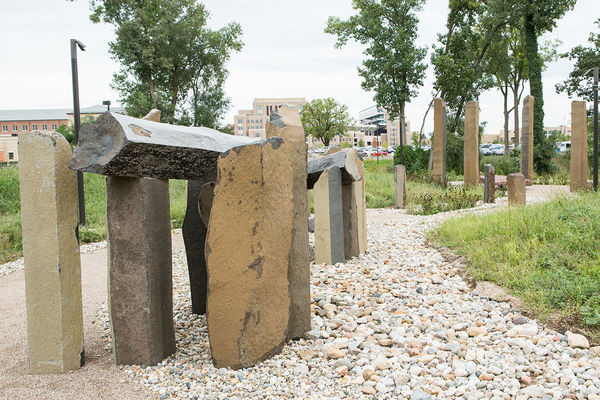
The researchers will focus on two sets of religious art on the Notre Dame campus — “” by Luigi Gregori in the Basilica of the Sacred Heart, and “” by Philip Rickey in the .

The Life Of Christ Cycle Of Life
"The Life of Christ/Cycle of Life" in the Charles B. Hayes Family Sculpture Park on the Notre Dame campus.

As part of the study, Brockmole said, viewers will take in the art in their current physical settings, but the research team will also show the same pieces digitally and change their context. They may show the piece as part of a museum display, for example, or presented against different backgrounds.

Eye-tracking technology can analyze how viewers are experiencing the art in those settings. Researchers can also question the viewers to see how they describe their experiences and how that changes based on the art’s location, the time since they’ve seen the piece or the time of the year in which they see it.

“This is sacred art, and people have to make meaning out of it,” Brockmole said. “This allows us to look at how people extract meaning and engage with the world in different ways.”

Jensen said she expects that the timing of a piece of art’s viewing could have major significance for the viewer. “T Stations of the Cross,” for example, might be pieces that some churchgoers don’t pay much attention to every week. But during Lent, when the scenes are playing out in the Gospel readings, they may make a more deep spiritual connection.

The findings of this work could be applicable to both churches and museums, Jensen and Brockmole said, including on campus. Discoveries about how art informs religious or spiritual understanding could help churches shape their messages through paintings and sculpture. And the team plans to use their deeper understanding of how people view and remember sacred art to offer a more powerful experience for Snite Museum visitors by developing an engagement booklet for the studied artworks.

“It would be interesting to know how much people attend to the physical environment of their church and how that changes what they believe and how they encounter the liturgical year,” Jensen said. “If you’re curating an exhibition at a museum, you have a story to tell. We’re really interested in the ways in which this will impact how curators will think about their work.”

Originally published by Brian Wallheimer at on Oct. 13.

]]>
Brian Wallheimer
tag:news.nd.edu,2005:News/124734 2020-04-17T11:00:00-04:00 2020-04-17T11:23:11-04:00 Notre Dame anthropologist awarded prestigious Newberry Fellowship The National Endowment for the Humanities has awarded Notre Dame anthropologist  a long-term residential fellowship at the in Chicago.

During the nine-month fellowship, Chávez will work on a second book project, tentatively titled Audible City: Urban Cultural History, Latinx Chicago, and the Sonic Commons, that explores the relationship between sound and the city of Chicago.

In particular, Chávez is focusing on the connection between aurality and Latinx claims to citizenship in urban contexts, in particular, how sound-making, hearing and listening form a nexus of  common social recognition.

“I am interested in the history of Chicago’s built environment, particularly the formation of its neighborhoods, which this project interprets as a series of auditory and cultural palimpsests; the historical emergence of Chicago’s cultural aesthetics; and the sonic dimensions of Latinx forms of cultural production that stake claims of belonging in the city,” said Chávez, the Nancy O’Neill assistant professor of anthropology and a faculty fellow at the .

The fellowship gives Chávez access to Chicago’s Newberry Library, an independent research library dedicated to the advancement and dissemination of knowledge in the humanities with 1.6 million books, 5 million pages of manuscripts and 600,000 maps in its collections.

“Chicago’s neighborhood guides, genealogies and local histories at the Newberry will be key in tracing both the complex history of Chicago’s urban development and its social aesthetic, all of which is bound up with sound in one way or another,” Chávez said.

“This project calls for an integration of sound studies and an anthropology of placemaking that works toward a perspective on Latinx urbanism. This disciplinary crossing is what access to the Newberry Library collections will make possible at this stage in my research.”

Chavez’s first book, , took an in-depth look at Mexican migrants’ cultural expression through music. It received , including winning the Society for Latin American and Caribbean Anthropology Book Prize, the Association for Latina and Latino Anthropologists Book Award and the Alan P. Merriam Prize from the Society for Ethnomusicology.

Originally published by Brian Wallheimer at on April 15, 2020.

]]>
Brian Wallheimer
tag:news.nd.edu,2005:News/96183 2019-01-24T15:00:00-05:00 2019-01-24T15:49:09-05:00 Anthropologist’s exploration of migration, music and poetics wins trio of book awards University of Notre Dame ’s first book, "," has certainly caught the eye of his peers.

The in-depth look at Mexican migrants’ cultural expression through music has earned three prestigious awards in the fields of anthropology and ethnomusicology.

Chávez’s work has earned the 2018 Society for Latin American and Caribbean Anthropology Book Prize and 2018 Association for Latina and Latino Anthropologists Book Award, and now the Alan P. Merriam Prize from the Society for Ethnomusicology. The latter is rarely awarded to a junior scholar, making it a pleasant surprise for Chávez, an assistant professor in the Department of Anthropology.

“That this type of scholarship is being recognized in a wide range of fields says something about the importance of academic work — in this case, anthropological work — focused on Latinos in the United States and, moreover, that it is being undertaken by Latino scholars,” he said. “That’s a bit of a watershed moment, especially with the Alan P. Merriam Prize. It’s a unique experience for me, given that it is my first book. To have it received in this way is both humbling and exciting.”

While today’s headlines and political climate can cast Mexican migrants as people perpetually outside of American society, Chávez’s book traced the flows of a style of music — huapango arribeño — to show how Mexicans on either side of the border assign meaning to their migration and enact forms of belonging within this context.

“Within contemporary politics and discourse about migrants, we see and witness the construction of narratives concerning Mexican migrant illegality that attempt to render this community policable, racialized subjects,” he said. “Migrants are clearly aware of this. It’s the kind of language they experience in their daily lives.

“I wanted to explore the ways in which migrants speak about themselves. What are the vehicles for collective witness through which they manifest different narratives about who they are, how they belong, how the U.S. is home to them, and how multiple places can in fact be home. One way they do it — through music and poetics — tells us a particular story that reveals much about contemporary forms of social citizenship and the politics of race.”

Chávez, the son of Mexican migrants, grew up listening to huapango arribeño, a type of traditional music from north-central Mexico known for its poetic style. As a musician himself, Chávez was reintroduced to the style while earning his bachelor’s, master’s and doctoral degrees at the University of Texas at Austin.

“I came across musicians who played this music, and I was intrigued. I had a vivid cultural memory of this music such that when I encountered it in Austin, my mind latched onto it, wanting to find out more,” Chávez said. “A lot of things revealed themselves to me — particularly how performance was bound up with the politics of the migrant experience.”

A musician trained in classical and jazz, Chávez immersed himself in huapango arribeño throughout the course of his research, from informal family get-togethers to large festivals on both sides of the border. By learning to play the music and spending time with its practitioners, he decoded the nuanced aspects and meanings of performance that detail the complex emotions and experiences of people who are most impacted by the contemporary politics of immigration in the United States.

Notre Dame’s , of which Chávez is a faculty fellow, has supported his work.

ILS has been a great community to be a part of throughout my tenure at Notre Dame. They have been supportive of my scholarship, teaching and publicly engaged work,” Chávez said. “ILS has proven a vital part of intellectual life on campus and now counts itself among the top Latinx studies programs in the country. They advocate for and share in the accolades of their faculty, both of which are key in fomenting a vibrant scholarly community that enriches the lives of our students and campus as a whole.”

Going forward, Chávez will co-chair an advanced seminar at the 91Ƶ for Advanced Research in Santa Fe, New Mexico, this spring focused on Latinx activism in the United States.

He is also now working on a new ethnographic project that integrates sound studies and urban anthropology to contextualize the sounds of contemporary Latinx Chicago.

Originally published by Brian Wallheimer at on Jan.24.

]]>
Brian Wallheimer
tag:news.nd.edu,2005:News/75540 2017-04-17T13:00:00-04:00 2021-09-03T21:08:00-04:00 Four Arts and Letters faculty members win ACLS fellowships Four faculty members in the University of Notre Dame’s have been awarded 2017 fellowships from the .

The pre-eminent representative of American scholarship in the humanities and social sciences, the ACLS offers up to a year of funding for in-depth exploration of a topic that expands the understanding of the human experience.

Three historians — , and — were among the 71 ACLS fellows selected from a pool of nearly 1,200 applicants. , a professor of philosophy, is a member of one of nine teams to win a collaborative research fellowship.

The awards continue a string of major successes for Notre Dame’s in the past year — including and .

“It’s extremely gratifying to see our department being honored by our peers,” said , the Madden-Hennebry Professor of History and chair of the department. “We have made a point of hiring ambitious scholars, encouraging them to do the best work they can and providing an intellectual community that can foster this kind of achievement. We’re poised to take off as a top-notch department, and these awards are harbingers of that potential.”

Candido, whose research focuses on west-central Africa during the transatlantic slave trade, will study accounts of African women who accumulated wealth during the 19th century. Tor, a scholar of medieval Islamic history, will write about the Seljuq Dynasty, which reshaped Islamic society in the 11th and 12th centuries. Ragland, who studies the history of science and medicine, will explore how experimentation first became integral to the practice of science in the 17th century.

Brading will work with Marius Stan of Boston College on a project assessing the parting of the ways between philosophers and physicists during the Enlightenment.

African women and wealth

Mariana CandidoMariana Candido

While the South Atlantic slave trade legally ended in 1850, people from southwestern Africa were still bought and sold for another 15 years as European and North American demand for cotton, ivory, rubber and sugarcane continued. As slave plantations formed in west-central Africa, in the modern country of Angola, the dynamic of wealth and power in the region shifted.

Candido, an associate professor of history, will spend her fellowship year examining the region’s economic and social histories, especially how women accumulated wealth during the 19th century.

It has long been thought that African women weren’t able to own and bequeath land during the era, but Candido has found documents indicating many women became quite wealthy.

“I have located of records of women buying land in the 19th century — and donating land to other women,” Candido said. “I find that a little bit surprising, because previous scholarship suggests that land was not privatized before the end of the 19th century, and African women never had access to land ownership.”

Even more curious, Candido said, is that the dynamic somehow later changed during the 20th century to limit or eliminate the ability of women to own land and accumulate wealth.

“What happened to them? Why were they so powerful in the 19th century and not now?” she said. “This is important because it will be a contribution to the scholarship not only on Angolan history and African history but Atlantic history as well, and allow me to examine how the gendered nature of economics changes.”

Changing Islam

Deborah TorDeborah Tor

The Seljuq Dynasty, which began in 1040 and extended from Syria to Central Asia, fundamentally changed the religious, social and political institutions of Islamic society over about 150 years, but little is known about the period, especially after 1092.

That’s partly because few scholars were able to read texts written in both Persian and Arabic, and those texts used flowery metaphors that were difficult to understand.

Tor, an associate professor of history, will use her fellowship year to study those texts and write a book about the period.

“Tse complex medieval sources take a lot of time to work with,” she said. “When you get a source, you have to translate it, understand it and cite it.”

Tor, whose research on the Seljuq Dynasty from the Institute for Advanced Study and the National Endowment for the Humanities, will use a thematic approach to explore different issues that arise during that period. The Seljuqs conquered Islam’s caliphs, who had served as both political and religious rulers. The Seljuqs named themselves sultans and widened the chasm between political and religious power and authority.

“T Seljuqs were the first Sunnis to conquer Baghdad and rule over the caliph, keeping them holed up in their palaces,” Tor said. “Ty called themselves ‘the authority,’ and fundamentally changed the relationship between Sunni ruling powers and the caliph.”

The dynasty also co-opted the Sunni clerics into the structures of government, essentially subordinating the once-independent religious clerics and making them subservient to the rulers. This is an aspect of Islam that persists today, with organizations such as al-Qaida and ISIS pushing to restore not only a caliphate, but also an independent clerisy.

Experimenting culture

Evan RaglandEvan Ragland

During the 17th century at Leiden University in the Netherlands, a new culture rooted in experimentalism sprouted. This experimentalist culture, along with and medical investigators elsewhere, formed a significant and increasingly widespread force for the development of experimental practices.

“I want to understand how experimentation came to be so widespread and came to be a norm of science,” said Ragland, an assistant professor of history who will spend his fellowship creating a monograph of the period. “Tre are deep roots to this, and we have universities of the time teaching hundreds of students to do this.”

Created by professors and students alike, the new experimenting culture saw friendships formed and fall apart over credit for findings and accusations over errors or malfeasance.

“It’s a really productive time, a really violent time,” he said. “It’s really messy. It gives us a different picture of experimentalist culture than we’re used to looking at.”

Most historians of science have assumed that universities had little to do with the origination and spread of experimentation, concentrating instead on the new scientific societies. Ragland said the fellowship time will allow for thorough research and writing about a critical time in the evolution of science.

“It’s going to give me a chance to bring in new and exciting material I’ve been itching to include,” he said.

Philosophy and physics

Katherine BradingKatherine Brading

In the 17th century, there was no distinction between physics and philosophy. Philosophers worked on questions about what soil was made from, the nature of planets and elements and how it all related to God.

Sometime in the 18th century, however, that changed and the disciplines drifted apart, but it’s unclear why. That’s the question Brading will explore during her fellowship.

“When did the split occur, and why? Was it for philosophical reasons? Was it social or political?” she said.

Brading knows that the split hadn’t happened by 1740, so she will continue to explore documents from thinkers of the time. But she laments that it happened at all, since her work tends to look at questions of physics and philosophy as dependent on each other, rather than as independent fields of enquiry to be pursued in separate departments of a university.

“I’m trying to write the book I wish I’d found on the shelf when I was an undergraduate where physics and philosophy never came apart,” Brading said.

]]>
Brian Wallheimer
tag:news.nd.edu,2005:News/72657 2017-01-16T12:55:00-05:00 2018-11-29T13:13:52-05:00 Notre Dame astrophysicists discover dimming of binary star Sarah L. Krizmanich Telescope Sarah L. Krizmanich Telescope

A team of University of Notre Dame astrophysicists led by , professor of physics, has observed the unexplained fading of an interacting binary star, one of the first discoveries using the University’s .

The binary star, FO Aquarii, located in the Milky Way galaxy and Aquarius constellation about 500 light-years from Earth, consists of a white dwarf and a companion star donating gas to the compact dwarf, a type of binary system known as an intermediate polar. The system is bright enough to be observed with small telescopes. Garnavich and his team started studying FO Aquarii, known as “king of the intermediate polars,” a few years ago when NASA’s Kepler Telescope was pointed toward it for three months. The star rotates every 20 minutes, and Garnavich wanted to investigate whether the period was changing.

“I asked Erin Aadland, an REU student, to precisely measure the spin rate of a white dwarf. Does it speed up or slow down?” he said. “We can do that by looking at the interval between flashes from the star just like we use the ticks in a clock to tell time. The star turned out to have other plans for the summer.”

Intermediate polars are interesting binary systems because the low-density star drops gas toward the compact dwarf, which catches the matter using its strong magnetic field and funnels it to the surface, a process called accretion. The gas emits X-rays and optical light as it falls, and we see regular light variations as the stars orbit and spin. Graduate student Mark Kennedy studied the light variations in detail during the three months the Kepler Space Telescope was pointing at FO Aquarii in 2014. Kennedy is a from University College, Cork, in Ireland who spent a year and a half working at Notre Dame on interacting binary stars. “Kepler observed FO Aquarii every minute for three months, and Mark’s analysis of the data made us think we knew all we could know about this star,” Garnavich said.

Peter Garnavich Peter Garnavich

Once Kepler was pointed in a new direction, Garnavich and his group used the Krizmanich Telescope to continue the study.

“Just after the star came around the sun last year, we started looking at it through the Krizmanich Telescope, and we were shocked to see it was seven times fainter than it had ever been before,” said Colin Littlefield, a member of the Garnavich lab. “T dimming is a sign that the donating star stopped sending matter to the compact dwarf, and it’s unclear why. Although the star is becoming brighter again, the recovery to normal brightness has been slow, taking over six months to get back to where it was when Kepler observed.”

“Normally, the light that we’d see would come from the accretion energy, and it got a lot weaker when the gas flow stopped. We are now following the recovery over months,” Garnavich said.

One theory is that a star spot, a cool region on the companion, rotated into just the right position to disrupt the flow of hydrogen from the donating star. But that doesn’t explain why the star hasn’t then recovered as quickly as it dimmed.

Garnavich and his team also found that the light variations of FO Aquarii became very complex during its low state. The low gas transfer rate had meant the dominant, 20-minute signal had faded and allowed other periods to show up. Instead of a steady 20 minutes between flashes, sometimes there was an 11-minute signal and at other times a 21-minute pulse.

“We had never seen anything like this before,” Garnavich said. “For two hours, it would flash quickly and then the next two hours it would pulse more slowly.”

The Sarah L. Krizmanich Telescope, installed on the roof of the Jordan Hall of Science in 2013, features a 0.8-meter (32-inch diameter) mirror. It provides undergraduate and graduate students cutting-edge technology for research and is used to test new instrumentation developed in the at Notre Dame.

The Notre Dame team that studied FO Aquarii included Littlefield, Aadland and Kennedy. The team’s findings have been published in the . Institutions that contributed to the work include The Ohio State University, University Cote d’Azur (France), University de Liege (Belgium) and the American Association of Variable Star Observers (AAVSO).

Contact: Peter Garnavich, 574-631-7262, Garnavich.1@nd.edu

]]>
Brian Wallheimer
tag:news.nd.edu,2005:News/71880 2016-12-06T15:00:00-05:00 2021-09-03T21:09:44-04:00 Second-generation stars identified, giving clues about their predecessors Figure 1 The figure shows a sub-population of ancient stars, called carbon-enhanced metal-poor stars. The unusual chemical compositions of these stars provides clues to their birth environments. A( C) is the absolute amount of carbon, while the horizontal axis represents the ratio of iron, relative to hydrogen, compared with the same ratio in the Sun. Click for larger size.

University of Notre Dame astronomers have identified what they believe to be the second generation of stars, shedding light on the nature of the universe’s first stars.

A subclass of carbon-enhanced metal-poor (CEMP) stars, the so-called CEMP-no stars, are ancient stars that have large amounts of carbon but little of the heavy metals (such as iron) common to later-generation stars. Massive first-generation stars made up of pure hydrogen and helium produced and ejected heavier elements by stellar winds during their lifetimes or when they exploded as supernovae. Those metals — anything heavier than helium, in astronomical parlance — polluted the nearby gas clouds from which new stars formed.

, a postdoctoral research associate in the ; , the Notre Dame Chair in Astrophysics; and , a research professor at Notre Dame, along with their collaborators, show in findings published in the this week that the lowest metallicity stars, the most chemically primitive, include large fractions of CEMP stars. The CEMP-no stars, which are also rich in nitrogen and oxygen, are likely the stars born out of hydrogen and helium gas clouds that were polluted by the elements produced by the universe’s first stars.

“T CEMP-no stars we see today, at least many of them, were born shortly after the Big Bang, 13.5 billion years ago, out of almost completely unpolluted material,” Yoon says. “Tse stars, located in the halo system of our galaxy, are true second-generation stars — born out of the nucleosynthesis products of the very first stars.”

Beers says it’s unlikely that any of the universe’s first stars still exist, but much can be learned about them from detailed studies of the next generation of stars.

“We’re analyzing the chemical products of the very first stars by looking at what was locked up by the second-generation stars,” Beers says. “We can use this information to tell the story of how the first elements were formed, and determine the distribution of the masses of those first stars. If we know how their masses were distributed, we can model the process of how the first stars formed and evolved from the very beginning.”

The authors used high-resolution spectroscopic data gathered by many astronomers to measure the chemical compositions of about 300 stars in the halo of the Milky Way. More and heavier elements form as later generations of stars continue to contribute additional metals, they say. As new generations of stars are born, they incorporate the metals produced by prior generations. Hence, the more heavy metals a star contains, the more recently it was born. Our sun, for example, is relatively young, with an age of only 4.5 billion years.

A , titled “Observational constraints on first-star nucleosynthesis. II. Spectroscopy of an ultra metal-poor CEMP-no star,” of which Placco was the lead author, was also published in the same issue of the journal this week. The paper compares theoretical predictions for the chemical composition of zero-metallicity supernova models with a newly discovered CEMP-no star in the Milky Way galaxy.

Contact: Timothy Beers, 574-631-4088, tbeers@nd.edu

]]>
Brian Wallheimer
tag:news.nd.edu,2005:News/69448 2016-09-06T11:45:00-04:00 2021-09-03T21:09:30-04:00 Detailed age map shows how Milky Way came together Age structure of the Milky Way’s halo

Using colors to identify the approximate ages of more than 130,000 stars in the Milky Way’s halo, University of Notre Dame astronomers have produced the clearest picture yet of how the galaxy formed more than 13.5 billion years ago.

Astrophysicist , research assistant professor in the at the University of Notre Dame, and , Notre Dame Chair of Astrophysics, along with research assistant professor and their colleagues, in Nature Physics, including a chronographic (age) map that supports a hierarchical model of galaxy formation. That model, developed by theoreticians over the past few decades, suggests that the Milky Way formed by merging and accretion of small mini-halos containing stars and gas, and that the oldest of the Milky Way’s stars are at the center of the galaxy and younger stars and galaxies merged with the Milky Way, drawn in by gravity over billions of years.

“We haven’t previously known much about the age of the most ancient component of the Milky Way, which is the Halo System,” Carollo said. “But now we have demonstrated conclusively for the first time that ancient stars are in the center of the galaxy and the younger stars are found at longer distances. This is another piece of information that we can use to understand the assembly process of the galaxy, and how galaxies in general formed.”

Using data from the , in which Notre Dame is a partner, the scientists identified more than 130,000 blue horizontal-branch stars, which burn helium in their cores, and exhibit different colors based on their ages. They are the only type of star whose age can be estimated by color alone. The technique they employed is one that Beers helped develop about 25 years ago when he was still a postdoctoral fellow.

Daniela Carollo Daniela Carollo

The mapped stars show a clear hierarchy, with the oldest stars near the center of the galaxy, and younger stars further away.

“T colors, when the stars are at that stage of their evolution, are directly related to the amount of time that star has been alive, so we can estimate the age,” Beers said. “Once you have a map, then you can determine which stars came in first and the ages of those portions of the galaxy. We can now actually visualize how our galaxy was built up and inspect the stellar debris from some of the other small galaxies being destroyed by their interaction with ours during its assembly.”

Carollo explained that initial gas clouds containing primordial material, such as hydrogen and helium, formed the first stars. Clouds with various masses and gas content behaved differently: The smaller clouds formed one or two generation of stars (older objects) and then merged with other clouds and ended in the center of the galaxy pulled in by gravity, while larger mass clouds formed multiple generation of stars (younger objects) before they merged.

Still larger galaxies, such as the Milky Way, grew as their gravity pulled in and forced mergers with these smaller galaxies.

Today, it is only possible to use these techniques in our own galaxy and in the dwarf satellite galaxies that surround the Milky Way. However, the James Webb Space Telescope, set to be launched in 2018, is expected to gather much more data from distant galaxies, including the first glows from the Big Bang. Using the aging method that Beers’ Galactic Archaeology group at Notre Dame employed, those data can fill in pieces of the puzzle on our own galaxy’s formation, as well as questions about how the universe came into being.

Contact: Daniela Carollo, 574-631-8653, dcaroll1@nd.edu; Timothy Beers, 574-631-4088, tbeers@nd.edu

]]>
Brian Wallheimer
tag:news.nd.edu,2005:News/66526 2016-04-27T12:00:00-04:00 2021-09-03T21:09:10-04:00 Guggenheim Foundation awards fellowships to two Arts and Letters professors Stephen Fallon Stephen Fallon

The has awarded two of its prestigious 2016 fellowships to faculty in the University of Notre Dame’s .

The fellowships, which fund a diverse group scholars, artists and scientists, will go to , a professor in the , and , the Rev. John J. Cavanaugh, C.S.C., Professor of the Humanities in the and the .

They were among the 175 scholars awarded fellowships from a pool of more than 3,000 applicants in the foundation’s 92nd year. Arts and Letters faculty have won 17 Guggenheim fellowships in the past 16 years.

“T Guggenheim is one of the world’s most prestigious and competitive fellowships,” said , I.A. O’Shaughnessy Dean of the College of Arts and Letters. “We’re thrilled that Anjan and Stephen have continued our strong tradition of excellence with these awards.”

Fallon will use his fellowship to complete a comparative study of what happens when the poet and theologian John Milton and the scientist and theologian Isaac Newton — towering figures in 17th-century England — address some of the world’s biggest questions and come up with parallel answers.

His book, tentatively titled “Milton, Newton, and the Making of a Modern World,” will argue that the two thinkers, who never met, came to strikingly similar conclusions about the nature of the world and its relation to God.

“Milton and Newton considered themselves prophets, in the literal sense,” Fallon said. “Both argue that all matter, from stones to souls, is alive. This vitalist, alchemical conception connected to their unorthodox position on the Son of God.”

Their revolutionary thinking, Fallon argues, had influence on later writers and scientists — and through them, on our understanding of the world.

Anjan Chakravartty Anjan Chakravartty

Chakravartty, who directs the , will explore how people should think about the rationality of their beliefs in the face of disagreement among experts.

When scientists, for example, interpret data in different ways and form different understandings of the natural world as a result, he said, it raises questions about how and whether such disagreements can be resolved. In some cases, these questions have consequences for how we think about making policy on the basis of our best science.

“I want to understand what it is rational to do in the face of this kind of disagreement,” Chakravartty said. “If two people disagree, should they stick to their guns? Or be conciliatory and adjust their beliefs accordingly? Non-experts also face the challenge of deciding how to interpret these disagreements and form their own opinions.”

Fallon and Chakravartty both said they are honored and humbled by the awards.

“I’m thrilled and grateful for the Guggenheim fellowship,” Fallon said, “which will give me the precious resource of time to focus on work that I hope will benefit my students here at Notre Dame and the larger scholarly community.”

Chakravartty said, “It’s a wonderful recognition, which I think all of us know comes along with an understanding that a great deal of support from a great many people goes into getting to this place. It feels pretty darn good.”

]]>
Brian Wallheimer
tag:news.nd.edu,2005:News/66175 2016-04-14T10:30:00-04:00 2021-09-03T21:09:08-04:00 Two Arts and Letters faculty win ACLS Fellowships Christopher Ball, Left, And Kathryn Kerby-Fulton Christopher Ball, left, and Kathryn Kerby-Fulton

Two faculty members from the University of Notre Dame’s have won 2016 fellowships from the .

, the Notre Dame Professor of English, will pursue a book project that explores the notes that medieval readers made in the margins of historic texts and books in order to rediscover sophisticated early reading practices for understanding the self.

, an assistant professor of anthropology, will spend time with an indigenous tribe in Brazil studying local history and culture through connections between language and nearby rivers.

The ACLS, the pre-eminent representative of American scholarship in the humanities and social sciences, conferred just 69 fellowships from a pool of more than 1,100 applicants.

Kerby-Fulton said the awards, which provide funding for up to one year for research in the humanities or social sciences, are invaluable for helping large-scale projects become reality.

“T only time that any of us can get away and write a long book is when you have that kind of sustained time,” Kerby-Fulton said. “It’s a great gift and an honor.”

“T ACLS is such a great fellowship because it represents the professional organizations of scholars throughout the humanities and social sciences,” Ball said. “I feel honored to be chosen to represent one of the many different points of view across the human sciences.”

While such a practice is discouraged in shared books today, medieval readers often made notes in the margins of texts — which proved invaluable for others who struggled with some of the concepts or references.

Now, Kerby-Fulton mines those notes for clues about how people of the time read and understood the texts.

“Today when you borrow a library book, you’re not supposed to mark it up, but in the Middle Ages, marking up a text was seen as a public duty,” Kerby-Fulton said. “You get layers and layers of response.”

The Middle Ages is one of the most candid of literary periods on this subject. Endlessly analyzing the self with forensic accuracy (and with remarkable parallels to modern mapping of the brain), medieval writers and annotators probed the inner workings of the mind via classical, Arabic and biblical models.

Kerby-Fulton, whose project is tentatively titled “Medieval Interiorities and Modern Readers: Recovering Medieval Reading Practices for Understanding the Self,” is especially interested in texts that analyze the self, such as St. Augustine’s Confessions, which outlines the internal struggle of a saint before and after his conversion to Christianity.

“Tse writings were all different methods for understanding the self and understanding how the mind works to solve during meditation, contemplation and spiritual experiences, including dreams and visions,” Kerby-Fulton said.

Kerby-Fulton also studies religious and political censorship, apocalypticism, visionary writing, women’s mysticism, and dance history and contemporary dance criticism. She is author or co-author of four books, including “,” which won the Medieval Academy of America’s Haskins Gold Medal and the North American Conference on British 91Ƶ’ John Ben Snow Prize.

Ball, a linguistic and cultural anthropologist, will spend time next year on and around the Xingu River in northern Brazil with the Wauja, an indigenous tribe that lives in a protected part of the rainforest.

Ball is one of fewer than 400 people who speak the Wauja language. He is interested in documenting the stories, in their native tongue, that are most important to the tribe’s history and culture.

His project, “Language and Riverscape in Indigenous Brazil: Mapping Cosmology and Politics of Place,” will involve working with older tribal members to map the important spiritual and historical places along the Xingu River while collaborating with Wauja youth to take photographs and record audio and video of the stories associated with those places.

“Talking about the river is important on a number of levels, in terms of the practicalities — such as fishing as a means of sustaining life — to where their ancestors lived, to what kind of beings and non-human spirits they believe inhabit the river,” he said. “People want to talk about and explore the spiritual importance of the river.”

The final product of his work will include an interactive map in which tribal members can access the videos, audio recordings and photos, preserving the Wauja culture and history.

“It’s something they can use in the community to engage in the stories,” Ball said. “Ty can access these stories years from now after the storytellers have passed away.”

Originally published by Brian Wallheimer at on April 13.

]]>
Brian Wallheimer
tag:news.nd.edu,2005:News/65993 2016-04-07T14:45:00-04:00 2021-09-03T21:09:06-04:00 Astrophysicists find triple star system with 'hot Jupiter' Artist's rendition of the view from a hypothetical moon in orbit around a three-star system Artist’s rendition of the view from a hypothetical moon in orbit around a three-star system. Credit: NASA/JPL-Caltech

Crisp, clear images of a “hot Jupiter” system captured by a University of Notre Dame physicist were vital in determining that a newly found planet inhabits a three-star system, a phenomenon documented only a few times before.

, Freimann Assistant Professor of Physics, was part of the team that discovered KELT-4Ab, a so-called “hot Jupiter” because it is a gas giant that orbits extremely close to one of the stars in its solar system. The discovery was published in .

While the KELT, or Kilodegree Extremely Little Telescope, detected the likely presence of the planet now called KELT-4Ab about 685 light years from Earth, Crepp was able to capture crisp, clear images of the system, discovering that the planet was in fact a member of a triple star system — one of only a few found to date.

The KELT monitors bright stars in large sections of the sky, searching for planets that orbit extremely closely. When the star KELT-A dimmed every few days, scientists believed they were witnessing an orbiting planet. Crepp was then asked to use the Keck Telescope to investigate and capture photos, and he wound up finding two additional stars in the process.

“I found that there was a dot nearby, which we believed to be a star, making this a binary system,” Crepp says. “And then upon further review, I found that it was two dots. We wouldn’t have realized that without these photos.”

KELT-4Ab, about one and a half times the size of Jupiter, orbits the system’s main star every three days. But the other two stars Crepp helped identify orbit each other once every 30 years while simultaneously orbiting the main star — and the planet — once every 4,000 years.

KELT-4 system featuring a 'hot Jupiter' planet with three suns KELT-4 system featuring
a “hot Jupiter” planet with three suns
Click for larger image

Four planets have been found in systems containing three stars, and Crepp has been involved with three of those discoveries. He and his students discovered the first two.

“We are trying to learn how planets get to their final resting places in orbits around stars,” Crepp says. “This discovery has implications for our understanding of planet formation and evolution.”

Crepp says that until the mid-1990s, scientists believed that gas giants like Jupiter would be found far from the stars they orbit, much like Jupiter in our solar system. But when the first hot-Jupiter was discovered in 1995, it turned those assumptions on their heads.

Since then, Crepp and others have been looking for these “hot Jupiters” to determine how they got there. The researchers believe the presence of multiple stars in a system could be a clue as to how planets finally settle into their orbits.

“We still think they formed far from their star, but then somehow migrated close to their stars. We also don’t know how they stop migrating,” Crepp says. “It is possible that companion stars drive the dynamics of planets such as to move the planets closer to the star.”

With another gas giant found so close to its star and in a triple star system, Crepp says he and others can now start comparing and contrasting what they’re seeing in other solar systems.

“When you first find these, you’re hunting and gathering. Once you have enough objects, we can start looking for patterns,” Crepp says.

In a related project, Crepp is developing a tool that would be able to measure the “wobble” of stars as they gravitationally interact with their planets. He is also part of a NASA team that will soon be using the Transiting Exoplanet Survey Satellite (TESS) to find Earth-like planets orbiting in or near the habitable zone of their stars. TESS is expected to launch in fall 2017.

Contact: Justin Crepp, 574-631-4092, jcrepp@nd.edu

]]>
Brian Wallheimer
tag:news.nd.edu,2005:News/61758 2015-10-13T10:00:00-04:00 2021-09-03T20:55:01-04:00 Hope and Optimism Project awards nearly $2M to 18 research projects Golden Dome at dusk

An interdisciplinary research collaborative between the University of Notre Dame and Cornell University has awarded nearly $2 million to 18 projects in five countries. The researchers will examine the theoretical, empirical and practical dimensions of hope and optimism.

The project, , is funded through a grant from the and additional money from Notre Dame and Cornell.

The initiative is bringing together philosophers, social scientists and theologians for residential and non-residential fellowship programs, conferences, writing projects by the co-directors, and creative stage and screen competitions.

“Hope is a concept that we talk about every day, but we don’t understand it all that well,” said , the William J. and Dorothy K. O’Neill Collegiate Associate Professor of Philosophy in Notre Dame’s , co-director of the and co-director of the Hope and Optimism Project. “Tre is an incredible range of topics being explored, and that shows us just how ubiquitous hope is in our lives.”

Among the projects recently funded:

  • “What Should I Hope From You?” by Adrienne Martin, a Claremont McKenna College professor of philosophy, politics and economics. Martin will examine how hope is invested in people, as opposed to objects. She will argue that through interpersonal hope and emotions such as disappointment, gratitude and appreciation, people encourage each other to meet challenging standards.
  • “Are There Any Advantages to Racializing Hope?” by Andre Willis, an assistant professor of religious studies at Brown University. Willis will look at how practical hopes linked to citizenship — inclusion, recognition, membership and success — have framed the African-American religious experience. He will explore religious narratives of hope that African-Americans have built through a history in the United States that has often been marked by dehumanizing political conditions.
  • “How Does Optimism Help Incarcerated Individuals Return to Their Communities, Overcome Barriers, and Become Positive Productive Members of Society?” by George Mason University psychologists Jeff Stuewig and June Tangney. The pair will explore the role optimism plays in the lives of incarcerated individuals and those reintegrating after being released. They will determine how optimism becomes a form of resilience among those in the criminal justice system and how that optimism changes over time based on types of experiences in that system.

In addition to an original grant of $3.8 million, the John Templeton Foundation is adding another $350,000 to expand public engagement, including the production of a documentary chronicling the process and findings of the Hope and Optimism project.

“It’s great to be able to bring some of the results of this rarified academic research and put it into the public on screen and stage,” said , associate professor of philosophy at Cornell’s and co-director of the Hope and Optimism Project. “We think we’ve found a fantastic group of interdisciplinary scholars and topics to explore.”

The collaborative venture will total more than $4.7 million.

Researchers from University of Colorado Boulder, University of Oxford, Carnegie Mellon University and several other schools will lead additional projects receiving funding. A full list is available at .

Additional phases of the Hope and Optimism Project will include a playwriting contest and a filmmaking contest. Hope on Stage will award $10,000 to the writer of an original play that explores the nature, role, sources or risks and benefits of hope and/or optimism in human life. Additional award funding will support the production of the play in professional theaters in Ithaca, New York, and Los Angeles in spring 2017. Hope on Screen will give $10,000 in prizes to amateur filmmakers who explore hope and optimism in a short video, including $2,500 for first prize.

For more information about the project, visit .

]]>
Brian Wallheimer
tag:news.nd.edu,2005:News/60738 2015-09-08T11:30:00-04:00 2021-09-03T21:07:55-04:00 The Experience Project awards $1.7 million to 22 research projects O'Shaughnessy Hall sunrise

A research collaboration that aims to build new understanding about how religious and transformative experiences occur and shape people’s lives is awarding its first round of funding with more than $1.7 million going to 22 projects.

, a $5.1 million project supported by a grant from the , looks to answer questions about how religious experiences affect a person’s concept of God; how transformative experiences can affect a person’s identity, values, belief system and behaviors; and how religious and other types of transformative experiences differ.

The project is co-directed by , a professor of philosophy, and , the William J. and Dorothy K. O’Neill Collegiate Associate Professor in Philosophy — both of the University of Notre Dame’s — and , a professor of philosophy at the University of North Carolina at Chapel Hill’s .

One component of the project, Rea said, focuses on the nature and significance of religious experiences.

“We’re trying to figure out what we can and should conclude about God and God’s love for us through the patterns and varieties of religious experiences throughout the world,” he said.

Another component focuses on ordinary but momentous events people face every day, Paul said.

“T project takes a bold new approach to understanding some of life’s deepest existential questions by exploiting the resources of analytic philosophy and empirical social science to try to get a better sense of the importance and meaning of lived experience, self-realization and our understanding of our place in the world,” she said.

The project offers non-residential funding and residential fellowships at Notre Dame’s and the University of North Carolina at Chapel Hill, and also funds a series of collaborative workshops.

Project funding falls into one of three research categories — social science, philosophy and philosophy of religion.

Among the projects receiving non-residential funding are:

  • “Receptivity of God through Ritual,” by Terence Cuneo, a University of Vermont professor of philosophy. Cuneo will investigate the connection between religious experience and religious activity, especially liturgical activity in the Christian tradition. Through four essays, Cuneo will explore the ways in which people come to appreciate rituals and the crucial role they play in developing an ability to experience God in the ordinary.
  • “Transformative Understanding,” by Tania Lombrozo, a University of California, Berkeley, associate professor of psychology. Lombrozo will develop the claim that gaining understanding — as opposed to simply gaining knowledge — is a transformative experience that can change beliefs, values and attitudes. Through a series of studies, she will investigate the nature of transformation people undergo when coming to understand something new and how that understanding can change worldviews.
  • “Shifting Bodies, Shifting Feelings: Birth Transforms Positive Emotions from Self-Relevant to the Selfless,” by June Gruber and Sona Dimidjian, psychology faculty members at the University of Colorado Boulder. The pair will test folk theory assumptions that birth radically transforms one’s experience of emotions in ways that cannot be understood without having had the experience. They will examine how birth enhances emotional diversity, specifically selfless emotions.

Nineteen additional projects, including researchers at institutions such as University of Oxford, Princeton University, Harvard University and Massachusetts Institute of Technology, will receive funding in the first round. For a complete list, visit .

In an upcoming funding cycle, the Experience Project will award additional grants for work in philosophy, theology and religious studies. For more about the project, visit .

]]>
Brian Wallheimer