The Superintendence oversees Rome’s archaeological sites and historic monuments, including the entire perimeter of the city walls that represent the various ages of the city’s urban development. Several of these protected sites are also an integral part of the city’s historic infrastructure, including some bridges, fountains and the ancient components of the Roman aqueducts.
The first phase of the collaboration will include access to the newly opened , a park overlooking the Colosseum that preserves significant archaeological artifacts. The park is one block away from via Ostilia, where Notre Dame Rome and the ’s Rome 91Ƶ campus is located, and hosts the Museo della Forma Urbis. This new museum displays the Forma Urbis Severiana, a marble map of Rome from the third century, as well as numerous epigraphs and other archaeological artifacts. The fragments of the map offer extraordinary insights into the urban landscape of ancient Rome and are superimposed on Giovanni Battista Nolli’s renowned 1748 map of the city.
The collaboration between Notre Dame Rome and the Superintendence allows students the opportunity to visit the museum as part of the foundational course All Roads Lead to Rome, taken by all Notre Dame undergraduate students studying in Rome.
In addition, at the end of August, 91Ƶ of Architecture professors Lorenzo Fei and Paolo Vitti organized a workshop on surveying and digital documentation for students enrolled in the graduate program. The workshop allowed students a unique opportunity to explore the fragments of the Forma Urbis using advanced digital tools and techniques for investigating historic heritage, provided by the engineering firm Novatest Srl.
“The workshop received highly positive feedback from students,” said Fei. “We are already considering organizing it again in future years and exploring new topics to propose to the Parco and hopefully opening up new research opportunities.”
Silvia Dall’Olio, director of Notre Dame Rome, said, “This partnership with such a premier cultural institution in the city is already making possible synergies that were unimaginable before. Moreover, the physical proximity on the Celio Hill between Notre Dame’s facilities and the Parco Archeologico strengthens and makes our reciprocal commitment to the neighborhood more visible.
“We are very grateful to Dr. Claudio Parisi Presicce, the city of Rome’s superintendent of cultural heritage, for his fundamental support of our collaboration, and to Dr. Caterina Papi, Dr. Francesca de Caprariis and Dr. Francesca Romana Bigi, the archaeologist officials responsible, respectively, for the epigraphic collections, the Forma Urbis and the architectural collections.”
As part of the collaboration, the Sovrintendenza, the Parco del Celio and Notre Dame Rome are also co-organizing a major international conference to take place in 2026 and working to strengthen the exchange of initiatives.
Contact: Carrie Gates, associate director of media relations, 574-993-9220, c.gates@nd.edu
]]>
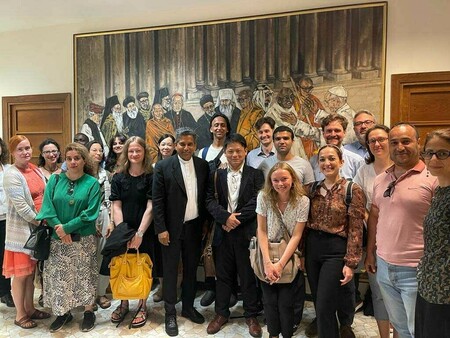
In June, the University of Notre Dame’s Rome Global Gateway co-hosted the first edition of the. The two-week program welcomed 17 graduate students and postdoctoral fellows working at the intersection of religious studies and international affairs for a full schedule of writing workshops, graduate seminars and public events. The program included visits to the many sites that have made Rome a key hub for transnational and multi-religious policymaking, including the Great Mosque and Great Synagogue of Rome, the Vatican’s Dicastery for Interreligious Dialogue, the Community of Sant’Egidio and the U.S. Embassy to the Holy See.
“The idea of the Summer Seminars was to recognize the importance that Rome as a site for religious political activity has taken over the last 20 years,” Michael Driessen, director of the program, said. “Rome’s transnational nature has turned it into a central hub for religious political activity with many different resources, an incredible network of people, ideas and institutions at the intersection of religion and politics, and our hope was to take advantage of those resources, share them with the students and connect scholars and students who are working on similar projects.”
“Rome is a city of great history and very impressive architecture,” added Mahan Mirza, executive director of the Rafat and Zoreen Ansari Institute for Global Engagement with Religion in the Keough 91Ƶ of Global Affairs at Notre Dame. “Just being in this city gives you a real gravitas of both tradition and a central place of religion in the life of communities and of the world; coming to Rome inspires students to think about the role of religion in global politics.”

The students in the program represented 15 different nationalities, including Georgia, the Gambia, Iran, Taiwan, Lebanon, Algeria, Romania, the U.K., India and Pakistan, and hailed from a diverse array of universities such as Stanford, McGill, Göttingen, Notre Dame, Bouira and St. Andrews. Leading scholars in the field, such as Olivier Roy of the European University Institute, Kristina Stoeckl of LUISS, Jonathan Laurence of Boston College, Anna Rowlands of Durham University and Scott Appleby, the Marilyn Keough Dean of the Keough 91Ƶ of Global Affairs, provided lectures and seminars for the students. Public events were held at the Pontifical Gregorian University and John Cabot University, as well as at the Rome Global Gateway.
Rowlands said: “I think we are currently living in a moment, in terms of the academy and the world, where there is a deep need for interdisciplinary conversations about the role of religion and global politics. The Rome Summer Seminars in Religion and Global Politics has therefore been a fantastic opportunity to work with a group of junior and senior scholars together, covering a really wide and appropriately global context.”
The University of Notre Dame’s Keough 91Ƶ of Global Affairs and Rome Global Gateway were founding partners of the program, along with the Pontifical Gregorian University, John Cabot University in Rome, the Hanns Seidel Stiftung of Germany, the Adyan Foundation of Lebanon and the Royal Institute for Inter-Faith 91Ƶ. The program was also held under the high patronage of the Italian Ministry of Foreign Affairs, with special support from Andrea Benzo, the Italian special envoy for religious freedom and interreligious dialogue.

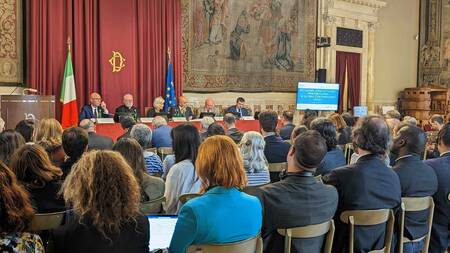
The program ended with a two-day international policy dialogue hosted by the , a leading Italian think tank for international politics, and the Italian Ministry of Foreign Affairs on the theme. The conference’s opening session and keynote address by Archbishop Paul Gallagher, the Holy See’s secretary for relations with states, were held at the Italian Parliament and in Palazzo Montecitorio’s Sala della Regina, and institutionally hosted by the Italian Parliament’s permanent Committee for Foreign Affairs. Notre Dame’s Appleby also participated in a roundtable panel at the Italian Parliament following Archbishop Gallagher’s speech and to students participating in the Rome Summer Summers.
Driessen said that he was deeply impressed by the commitment of the students attending the seminars and the quality of their research and projects. For more information about the 2024 Rome Summer Seminars and how to apply, visit the
Contact: Tracy DeStazio, assistant director of media relations, 574-631-9958 or tdestazi@nd.edu
Originally published by at on July 17.
]]>The first grant has been awarded to Denis Robichaud, the John and Patrice Kelly Associate Professor of Liberal 91Ƶ and director of PHYSIS, and his team, composed of Thérèse Scarpelli Cory, the John and Jean Oesterle Associate Professor of Thomistic 91Ƶ and director of the History of Philosophy Forum, and Robert Goulding, associate professor of liberal studies and director of the Reilly Center for Science, Technology and Values.
The grant will support a collaborative program titled PHYSIS Summer Convivium, a week-long advanced summer research seminar and a two-day public conference held at the Rome Global Gateway. Eight graduate students and eight researchers or faculty members, half from Notre Dame and half from Rome, will be invited to participate in the convivium, the first of which will take place in the summer of 2024 on the topic of Elements of Nature/Elements of Reasoning.
“A distinctive feature of premodern philosophy and science is the organization of nature, reasoning and methods into elements (στοιχεῖα),” explainedRobichaud.
“On the one hand, countless thinkers from the pre-Socratics to medieval philosophers either reduced nature into a small number of elements (earth, water, air, fire and aether) or developed atomistic models, whether materialist or mathematical. On the other hand, philosophers, scientists and mathematicians in the premodern world also conceived of elements of reasoning as they developed axiomatic methods of demonstration and argumentation. These two threads in the premodern history of philosophy and science are often studied independently, but careful examination identifies commonalities and attempts to connect the phenomena.”
The second grant has been awarded to Claire Jones, the William Payden Associate Professor of German, for a project titled The Ritual Cultures of Medieval Religious Women.
Jones’ project will also be developed in a three-year time frame that will include research time in Rome and collaboration with colleagues and scholars at the Vatican Library, the Dominican Order Archives, the Angelicum and the Pontifical Institute of Mediaeval 91Ƶ’ Toronto-Rome Programme in Manuscript 91Ƶ.
“Scheduled to coincide with the end of the Toronto-Rome courses, we will organize a small conference (eight to 10 speakers) at the Rome Global Gateway tentatively on the topic The Ritual Cultures of Medieval Religious Women,” said Jones.
The final grant has been awarded to Jeremy Phillip Brown, assistant professor of theology. His Rome Kabbalah Symposium is planning on renewing an interreligious research collaboration dating back a half millennium, when Jews and Catholics studied kabbalah together in Rome during the Renaissance.
“With this project, the University of Notre Dame has the opportunity to renew this venerable tradition of interreligious scholarship in an irenic spirit,” Brown said, “and to make Rome the international destination for researching the rabbinic science of divinity it once was in the 16th century. Indeed, recent advancements in historical criticism demonstrate the formative contribution of Rome to the fluorescence of the earliest kabbalistic literature dating back to the High Middle Ages.”
The project will be developed in association with Avishai Bar-Asher of Hebrew University of Jerusalem andthe Cardinal Bea Centre for Judaic 91Ƶ at the Pontificia Università GregorianaԻ will launch a symposium dedicated to advancing collaborative research into kabbalah’s Italian history and its complex relationship with the Church. Participants will include a small cohort of international researchers and a selection of doctoral students in Rome who will present and exchange work on these topics in a setting that attracts both local Italian and international scholars and facilitates direct contact with the archives.
“Our goal is to create a model that could be reproduced once during every three-year funding cycle,” Brown said, “such that the initial year would be dedicated to planning and engagement with invitees. We would convene the symposium at some time during the first half of year two and, during the second half of the same year, we would solicit submission of participants’ publishable manuscripts. Year three would see the proceedings to printing.”
about funding opportunities at the Rome Global Gateway.
Originally published by at on June 8.
Contact:Tracy DeStazio, assistant director of media relations, 574-631-9958 ortdestazi@nd.edu
]]>Benigni joined a conversation on Dante and Cinema, organized by the Rome Global Gateway in collaboration with the Notre Dame , the G. D’AnnunzioUniversity of Chieti and Pescara, and Dante 2021 — the national committee for the commemoration of the seven hundred years since the death of Dante Alighieri. He also took part in the presentation of three volumes commenting on his readings of Dante Alighieri’s "Inferno," edited by Franco Musarra and published by Franco Cesati.
Benigni is one of Italy's most beloved and popular actors, directorsԻ screenwriters. He is known to the public for his film"La vita è bella" ("Life is Beautiful," 1997), which he wrote and directed. The movie received the Grand Prize of the Jury at the Cannes Film Festival and three Academy Awards.
Benigni has also proven to be an extraordinarily talented popularizer of high culture, performing and interpreting "The Divine Comedy" by Dante Alighieri, one of the fathers of the Italian language and the Italian literary tradition.
The panel that opened the event included Vittorio Montemaggi (King's College London), Michelangelo Zaccarello (University of Pisa), Rodney J. Lokaj (Kore University of Enna), Claudio Di Felice (Leiden University), director Marc WagenaarԻ Sperello di Serego Alighieri, author of "The Sun and the Other Stars of Dante Alighieri." The discussion was moderated by Ulla Musarra Schroeder and Antonio Sorella from the University of Chieti-Pescara.
Benigni made his appearance during the presentation of the last of the three volumes dedicated to"Il mio Dante" (“His Dante”) on the occasion of the commemoration of the 700th anniversary of the death of the supreme poet. He thanked all the people present, live and virtual, and all the people who dedicated their lives to Dante, reading and loving him. Benigni would have loved to be a Dantist himself, but, he compared himself to the musician sending his music to Rossini who received a letter in response saying “in your music there are both some new and some beautiful things, but the beautiful ones are not new and the new ones are not beautiful.” In this way he humbly thanked all the extraordinary scholars who dedicated their time to him and his readings about Dante.
Benigni then introduced his recital of Inferno 5, one of the most iconic cantos Dante wrote. “The world would be different if Inferno 5 did not exist. It is like the air we breathe, it is part of us” he commented. “Even if it is the loudest of the cantos, everything said is whispered, because of the presence of a gentle soul. Each verse has its own sense, and as Flaubert said, God is everywhere but we can’t see him.”
He then started a brilliant, moving recital of the canto, or as Robert Hollander (University of Princeton) once said: “moving, but not too much.” Benigni provided an exceptional reading with a noticeable suspension between sense and sound of the enjambements and a profound respect for the hendecasyllable verses.
The loud silence in the aula was broken by a thunderous, spontaneous applause at the recital of the last tercet: "Mentre che l'uno spirto questo disse, l'altro piangëa; sì che di pietade io venni men così com'io morisse. E caddi come corpo morto cade." “And all the while one spirit uttered this, the other one did weep so, that, for pity, I swooned away as if I had been dying. And fell, even as a dead body falls” (translation by ).
Click the video below to watch part of Benigni's presentation.
Originally published by at on Sept. 29.
]]>The platform aims to make academic events accessible to a wider audience and to further the research of students and scholars residing in or passing through the Eternal City. By gathering scheduled events in a large common calendar, the platform facilitates access to the city’s extraordinary resources such as academic institutions(universities, libraries, archives), seminars and conferences, and their international reach.
Other collaboratinginstitutions includePontificia Università Gregoriana, the Pontificio Istituto di Studi Arabi e d’Islamistica, the Pontificio Ateneo S. Anselmo, the Libera Università Maria Ss. Assunta, the Pontificia Università S. Tommaso d’Aquino and Pontificia Università Urbaniana. The project is coordinated by the Georgetown University Representative Office in Rome and the University of Notre Dame Rome Global Gateway, which will host the platform on its website.
With the creation ofthe new platform,the participating institutions provide an answer to a shared need of unity and collaboration for the sake of a unique objective, by working together for a better and more successful cultural and academic proposal.
For more information, visit.
Originally published by at on Dec. 16.
]]>This new designation allows the gateway to sponsor research visas and permits of stay for a period of over three months. It will therefore give graduate students, facultyԻ fellows coming from Notre Dame and beyondthe opportunity to conduct research in Rome for an extended period of time. Additionally, the designation would allow the University to be more competitive when applying for European grants that are also open to non-E.U. institutions.
Heather Hyde Minor, academic director of the gateway, said supporting the innovative research of Notre Dame faculty, postdoctoral fellowsԻ graduate students is one of the key missions of the gateway and Notre Dame International.
“This designation serves asan acknowledgment of the tremendous work of the Notre Dame community of scholars here in Italy,” said Hyde Minor. “It also opens the door for richer and more sustained research projects.”
“The Rome Global Gateway joins the Johns Hopkins University SAIS as the only American universities in Italy to be recognized as research institutions,” said Silvia Dall’Olio, executive director of the gateway. “This is a great acknowledgment of the research footprint that the gateway has in Rome and one that will concretely make it deeper and more extended, allowing researchers to spend a substantive amount of time in Rome to conduct their work.”
The Rome Global Gateway supports the University’s international mission by hosting institutes and projects engaged in research and graduate education. The gateway collaborates with universities, educational foundations and organizations in Italy, EuropeԻ the Mediterranean, as well as with the Holy See.
Notre Dame International and departments across the University offer funding opportunities for international research that can be used toward work at the Rome Global Gateway. Applications are available for the Global Gateway faculty research award, the short-term faculty research fellowships, the short-term graduate research fellowships, the Sciola grants and the Biblioteca Ambrosiana research awards.
Research grants are available to facultyas well asgraduate and undergraduate students. about research opportunities at the Rome Global Gateway.
Contact: Silvia Dall’Olio, executive director, Rome Global Gateway, Notre Dame International,Silvia.Dall'Olio.1@nd.edu
Originally published by at on June 28.
]]>