By now, most people are aware of the environmental effects of air or water pollution. University of Notre Dame philosopher and scientist has devoted herself to bringing to light a less known concern: the inequitable distribution of pollution’s human toll.
“Polluters ‘target’ poor and minority communities to locate noxious facilities because they know that residents often are unable to defend themselves,” she says.
For her efforts, Shrader-Frechette was recently awarded the from Tufts University’s Institute for Global Leadership. The honor recognizes her lifetime body of work, including research and pro bono service related to both global public-health problems and pollution-related environmental justice.
Shrader-Frechette, O’Neill Family Professor of in Notre Dame’s and a concurrent professor of in the , says she sees the Mayer award as an opportunity to get the word out about environmental justice, an issue that remains poorly understood by the general public. Many are often shocked, she says, to discover that race and class can play a role in exposure to pollution and the resulting impact on individual health.
Each year, Shrader-Frechette and her team of student researchers conduct as many as 12 pro bono projects, producing health-risk assessments in low-income or minority communities that typically don’t carry enough political heft to keep out polluters or contain their excesses.
“Frequently our work begins after I receive a phone call from someone who says, ‘Many of our children are getting sick, and we think the pollution here is one of the reasons for their illnesses,’" she says.
For example, Shrader-Frechette recalls working with a group of Notre Dame students at a housing project on the south side of Chicago, where, she says, “dozens of children had been born with cancer.”
Her research suggested that cancer cluster could be partly attributed to the toxic-waste dumps that surrounded the projects. “Finally, those housing units are being closed and the residents are being moved to a safer area,” she says.
Pollution effects on children have always concerned Shrader-Frechette, she says, “because children are completely dependent on us to make the world safe for them.” And the impact of pollution on children can be especially devastating.
“If pollution interferes with their physical and neurological development, children will bear the burden of environmental injustice forever.”
Environmental-justice investigations have taken Shrader-Frechette and her Notre Dame students sometimes far afield, reviewing the health effects of a toxic-waste dump in a Latino community in Kettleman City, Calif., or examining the impact of radiation releases from a nuclear facility near an African-American community in Louisiana.
Her research teams then produce detailed assessments about health threats. These reports, she says, in turn empower the members of the affected communities so they can, for example, “force noxious facilities to clean up and obey the law.”
Shrader-Frechette says she is impressed and gratified by the commitment and energy of her students.
“Notre Dame is an amazing place,” she says. “I don’t know of any other university that does what we do here, probably because no other university has such a critical mass of students who are both brilliant and scientifically astute, as well as committed to social justice.”
Shrader-Frechette, who received her Ph.D. in philosophy of science from Notre Dame, also has a mathematics degree, as well as three post-docs, in biology, economics and hydrogeology. She has written 16 books, most recently “What Will Work: Fighting Climate Change with Renewable Energy, Not Nuclear Power” in 2011. In 2004 she became only the third American and the first woman to win the World Technology Award in Ethics. In 2007, Catholic Digest named her one of 12 “Heroes for the U.S. and the World.”
The Church’s preferential option for the poor is a prime motivation for her work, Shrader-Frechette says, and a personal inspiration is the martyr Ignacio Ellacuría, S.J., a liberation theologian. As rector of the University of Central America in El Salvador, he advocated for peace and justice during the country’s long civil war and spoke out against oppressive socioeconomic conditions. But activism proved deadly for Ellacuría, who was murdered in 1989 by a military death squad, who also killed five Jesuit colleagues, their housekeeper and her daughter.
In a 1982 address at Santa Clara University, Ellacuría said that a truly Christian university must take into account the gospel preference for the poor — to be a voice for those who are prevented from promoting their legitimate rights and “to provide science for those who have no science.”
“We often call our work ‘liberation science,’” Shrader-Frechette says, “because we try to use science and ethics to help free vulnerable people from life-threatening, environmentally unjust burdens.”
Originally published by at on January 25, 2012.
]]>
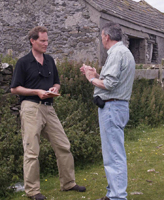
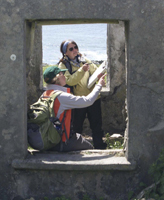
The last 24 human inhabitants of the island of Inishark off the coast of Galway, Ireland, departed together on October 20, 1960—a beautiful, sunny day which marked a solemn end to a steady decline that began in the mid 19th century.
That’s when a more robust population of 300 or so first began to drift away from Inishark—many sought a new life in America. By 1960, life on the island had become too remote, too hard, too dangerous, says , a professor in Notre Dame’s . “They never had electricity,” he says. “They never had phones.”
On the Connemara mainland nearby, these modern marvels were finally becoming commonplace. For most of the Irish, life was changing rapidly, and the people on Inishark realized they were being left behind. During medical emergencies the islanders were often reduced to signaling for help with hillside bonfires, and in 1959, stormy weather cut them off from the mainland for more than a month. “But the final straw was just the lack of young people,” says Kuijt.
The life on Inishark could not go on.

This small community’s collapse more than 50 years ago now offers a unique opportunity to contemporary anthropologists like Kuijt—not just a freeze frame of island life in 1960 but “a window” to Irish life in the 19th century. “These people were living little differently than they were in the 1860s,” he explains.
Kuijt and his team of students, academics and technicians from Notre Dame and Ireland are in a race to understand island life and capture the stories of the last 12 survivors of Inishark to preserve a portrait of their way of life before it disappears for good. The research is part of “Cultural Landscapes of the Irish Coast,” Kuijt’s six-year, multidisciplinary, inter-institutional study of coastal western Ireland.
Over the last four years, Kuijt and his team have made multiple field trips to Inishark, staying for up to 10 days at a time. They lug in enough equipment—computers, GPS, and video and audio gear—to quickly assemble a “rustic lab,” he says. Because of the site’s remoteness they must transport all their food and water.

Notre Dame anthropology student Claire Brown has roughed it on the island with Kuijt’s project for the past three summers and says the fieldwork has been one of the most compelling parts of her research experience.
“When we work on the island and survey the houses, I feel like I am seeing history come alive,” she says. “To be on the island and look at these houses that we have heard so much about during our interviews with the islanders is an incredible experience. It helps us understand history from a personal perspective.”
During these expeditions, students do a little bit of everything—from interviewing former island residents to constructing a detailed map of the village to participating in an archaeological excavation around abandoned houses.
Over the years Kuijt and his team have taken five of Inishark’s last inhabitants back to the island to tour the village and record their reminiscence. For the islanders and Kuijt’s students, the visits are profoundly bittersweet. The islanders are deeply moved to be back but heartbroken that this life could not go on. “Several of them tell me that when they dream,” says Kuijt, “they always dream that they are young children back on ‘Shark.’”
The survivors’ willingness to share their lives and commitment to getting the story told is all the encouragement Kuijt needs. He knows time is not on his side. “These are rich personal histories that help us to understand the past,” he says, stories the abandoned stone ruins of Inishark seem almost to tell. “If it doesn’t get written down now,” says Kuijt, “it will be lost forever.”
Like her professor, Brown says trying to capture the unique experience of the Inishark islanders has become more than just an anthropological challenge. “The project is certainly important in an academic sense but almost more so at the personal level,” she says. “We are in contact with those who lived on Shark who are still alive, and our research is very important to them. We are dealing with their histories and their lives, and they have been on the whole very appreciative of our efforts.”
This sense of mission has led Brown to continue working on aspects of the project beyond what is required for her coursework. “I feel a deep connection to the place and the people.”
Originally published by at on April 25, 2011.
]]>
Deb Rotman is in a race against time.
, director of undergraduate studies for Notre Dame’s , is keenly aware that the generation of Irish immigrants who can still share memories of the Irish Civil War and their experiences in early 20th century America will soon be lost forever.
“Those generations have some really great stories that we’re trying to capture, but we can only do so much,” she says.
Unable to personally interview every surviving immigrant, Rotman and a group of her students are working with Kevin Abbott in the University’s office to construct an to help collect and preserve as many of these valuable tales as possible before it’s too late.
The database’s Web interface, intended to be user-friendly for casual visitors and professional researchers alike, will take advantage of the latest technology to offer an experience that is wholly contemporary yet distinctively Irish. “This is a storytelling people,” Rotman says, and the database will play to that strength and allow users to upload personal histories in whatever format they prefer.
Senior Rhiannon Duke is one of the students helping Rotman develop the online project, which will incorporate audio, text, photographs, and possibly video.

“It will be a place for those of Irish descent to share their stories and information with others and develop a dialogue of sorts,” she says. “A space to share these kinds of stories is incredibly important, and I’m excited that I’ve been able to be a part of it thus far. I can’t wait to see how it grows and develops in the future.”
In addition to soliciting oral histories online, Rotman and her students are making their own contributions to the database by conducting field research on Lake Michigan’s Beaver Island. There, a group of 19th century Irish—most from the island of Árainn Mhór off the coast of Donegal—recreated something of the communal, agrarian lifestyle they had left behind.
“Most of what the general public knows about Irish-American history comes from the stories of urban immigrant populations in places like New York, Boston, Chicago and Philadelphia,” Duke says.
In these cities, she says, the Irish lived among other large immigrant groups and families who had been in America for generations. “Beaver Island offers a unique chapter of the Irish-American story since the Irish were in the majority there for about 40 years,” Duke says. “It will be fascinating to see to what extent this community was able to transfer their social and cultural environment from Árainn Mhór to Beaver Island and how that environment changed through time.”
Much of the fieldwork involves meeting with descendants of the original Irish settlers there. “My favorite part of the experience was interviewing residents about their family history on the island as well as their personal experiences of island life and identity,” Duke says. “I had read a good amount about Beaver Island before arriving, but I learned so much more from speaking with residents than I could have in a book.”
While on Beaver Island, Rotman’s students also get their hands dirty in archaeological digs of old homesteads. They have uncovered rich material not just within the one-time walls of family homes, but outside them as well. “Think about it,” Rotman says, “in the 1860s you didn’t have waste management coming to your curb side.” Remnants of the refuse that collected behind homes now offers compelling clues about the way life was actually lived in 19th century immigrant America, she says.
By combining this traditional fieldwork with innovative technology, Rotman and her students hope to provide a broader perspective on the Irish diaspora in America.
“The archaeological record and the historic documents work together telling different parts of the same story,” she says, “and oral history is the third leg of that stool.”
Originally published by at on March 28, 2011.
]]>