tag:news.nd.edu,2005:/news/authors/kevin-fye tag:news.nd.edu,2005:/latest Notre Dame News | Notre Dame News | News 2020-07-10T15:45:00-04:00 Notre Dame News gathers and disseminates information that enhances understanding of the University’s academic and research mission and its accomplishments as a Catholic institute of higher learning. tag:news.nd.edu,2005:News/127456 2020-07-10T15:45:00-04:00 2020-07-10T15:45:29-04:00 New initiative will tackle racism’s core concepts Prompted by recent killings and the social upheaval arising in their aftermath, our nation has awakened to the brutality of institutional racism and the violence to human dignity it has wrought in communities of color, now and throughout America’s history. Many who had previously failed to recognize and understand the structures of racism are now seeking to educate themselves.

In response, the has announced a year-long initiative entitled “Building an Anti-Racist Vocabulary.” The project seeks to educate students and members of the broader Notre Dame community, helping them explore and deconstruct concepts that undergird racism. The initiative confronts these core issues through three interconnected projects.

Educating students and the wider community

The initiative features a one-credit course for Notre Dame students that will engage concepts and events necessary to understand the ways in which racism has infected our nation. The course is designed to help students gain a deeper and more nuanced understanding of the social, historicaland moral structures that support racial injustice.

A weekly lecture-and-dialogue series will be central to the curricular program andopen to the public. This part of the initiative will feature guest speakers — academics, authors, government officials, policymakers and Church officials — who will engage with a specific term or concept in order to open it up to deeper understanding. Included will be broad, relatively familiar terms such as “institutional racism” and “intersectionality,” as well as specific topics and events like “voter suppression,” “health disparities,” “Tulsa,” “mass incarceration” and so on. Following a TED-style presentation, each speaker willtake questions submitted by audience members and offer resources for further exploration.

A third element of the initiative is a program of events and study groups on policing and racial justice to support students seeking intensive study on this topic. The program will include guest lecturers, book clubs, support for field experiencesand graduate student-led discussion groups that delve deeply into the subject.

Addressing a singular moment in history

Acknowledging a radically changed social climate, Klau Center director sees the initiative as particularly vital now. “We know that when we return to campus in the fall, students will be highly engaged with questions of racial justice, and will seek an educational entry point to engage with this national crisis,” she explained. “We believe it is our obligation to meet these students where they are, and to invite them into deeper dialogue and reflection on issues of race.”

“Building an Anti-Racist Vocabulary” will be made possible through a generous gift from the Klau family, who offered support for expanded outreach in this critical moment. “The incredibly painful times in which we find ourselves demand a response,” said Rick Klau, “and the mission of the Klau Center is to respond through education.”

“We are so grateful to have this opportunity to help shape a more enlightened and compassionate community,” addedMolly Klau.

Still in early planning, a schedule of weekly speakersand course registration detailswill be available at as soon as details are confirmed.

Originally published by Kevin Fye at on July 10, 2020.

]]>
Kevin Fye
tag:news.nd.edu,2005:News/107564 2020-02-04T08:00:00-05:00 2020-02-04T09:40:26-05:00 Archive on race launched with public forum Faced witha sharp rise in racial tensions and concern over seemingly intractable structural inequalities, simple acts of speaking and listening canpromoteunderstanding and open opportunities for progress. In a recent public forum, the , part of the , launched its new initiative to collect stories of race and encourage constructive dialogue at the University of Notre Dame.

Conceived as a response to student interest inproactive ways to address concerns with race, With Voices True received its campus debut Tuesday, Jan. 21, in the Navari Family Center for Digital Scholarship at Hesburgh Library. The project is a collaboration between the Klau Center;the Gallivan Program for Journalism, Ethicsand Democracy; and University Archives.

Klau Center Associate Director Dory Mitros Durham described the project as a hopeful step taken at an opportune time.

“It seemed to us that we had arrived at a moment when there was a renewed openness to talking about race and its implications in American society today,” Mitros Durham told those gathered. “People were reading Robin DiAngelo’s'White Privilege' and JD Vance’s 'Hillbilly Elegy' and trying to make some sense out of the modern implications of racial identity. It struck us that this moment presented a unique opportunity. We believed that people are ready to talk and ready to listen.We wanted to set up a mechanism to let that happen — to tell and to hear real stories that give content to the concepts of race and racial identity.”

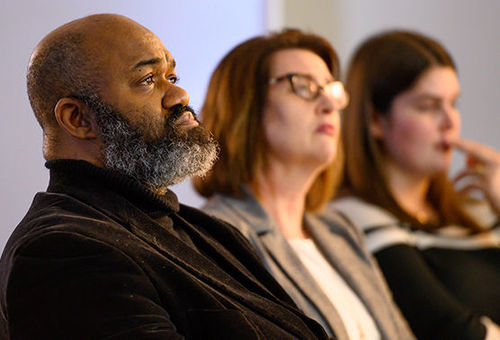
PanelRichard Jones, Angela Fritz, and Claire Rafford

Housed within University Archives, participants’ personal stories are available in their entirety for research purposes. As demonstrated at the public event, however, a curated collection of abridged narratives is also available publicly through the With Voices True website, providing classrooms and other groups a tool to spur constructive conversation around race.

A panel discussion accompanied the website launch. Participating were project partners Richard Jones, the Walter H. Annenberg-Edmund P. Joyce Director of the John W. Gallivan Program in Journalism, Ethics and Democracy;Angela Fritz, head of University Archives; and Claire Rafford, one of the student journalists responsible for collecting the narratives for the project.

Acknowledging the importance of the institutional partnerships, which helped solve technical, legal and ethical challenges to implementation, Mitros Durham summed up hopes for the project. “The collection we share with you tonight is, we think, a remarkable beginning to this effort. It engages with difficult issues and tells moving stories, and at the end of the day that’s exactly what the vision always was,” she said.

All members of the Notre Dame community are encouraged to participate in the project by telling their story. With Voices True can be accessed online at .

Originally published by Kevin Fye at on .29.

]]>
Kevin Fye
tag:news.nd.edu,2005:News/100825 2019-06-03T13:30:00-04:00 2019-06-03T13:50:59-04:00 Diane Desierto addresses UN on right to development, forthcoming treaty an expert for thehas been tasked to assist member states in drafting a new treaty declaring development as a human right.Desierto is an associate professorof human rights law and global affairs at the Keough 91Ƶ of Global Affairs at the University of Notre Dame.

She recently addressed the international working group when it met at U.N. headquarters in Geneva this May. In a public event organized by the U.N. Office of the High Commissioner for Human Rights titled “Leaving No One Behind: A Right to Development Perspective,” members of the, prominent academicsand representatives of Catholic nongovernmental organizations gathered to discuss key issues that confront the U.N.’s effort to realize its development goals.

Desierto pointed to fundamental problems arising from the current design of international development systems, and she outlined current ineffective and unfair practices and systems to be corrected in the treaty process.

Anchoring her remarks on the promise of integral human development, Desierto questioned the ability of systems — as currently conceived — to deliver the broad range of benefits that the idea implies.

“It’s a question of whether the development decisions that are being taken by states, whether in the space of trade, in the space in international lending, in the space of international investment … whether or not these are actually people-centered,” she proposed. “Populations are seeing that there’s a dissonance between the promises of trade, the promises of investment, the promises of financial assistance, of development lending, and the actual outcomes. These are, at their heart, human rights challenges.”

Of primary concern, Desierto said, is the need for vulnerable populations to be recognized by international economic dispute systems, which are designed to protect foreign investors over local communities. “We have a system that was highly developed and privileges a particular group of constituencies,” she said. “In the human rights space and particularly in environmental rights, those who are most directly impacted by tragedies that are perpetuated by the private sector have to search tirelessly for a jurisdiction where they can possibly gain redress.”

In 20 years of jurisprudence before the World Trade Organization dispute settlement system, only two cases have vindicated environmental law norms.

At the heart of the problem, Desierto said, is a failure of international economic systems to embrace the broader aims of development beyond economic growth. One indicator of this failure can be found in dispute settlement trends. “In 20 years of jurisprudence before the World Trade Organization dispute settlement system, only two cases have vindicated environmental law norms,” she pointed out. “That’s something that is of concern for every country in the world, whether the wealthiest countries or those who are highly indebted poor countries. You have a multilateral trading system which is widely perceived to be dysfunctional precisely because the gains from trade that were expected, true human rights gains, have not been realized.”

The United Nations General Assembly issued the Declaration on the Right to Development 30 years ago, where all states called for all members of society to be empowered to participate fully and freely in vital decisions affecting their political, economic, socialand cultural development. The U.N. Intergovernmental Working Group on the Right to Development has been tasked by states to draft the new legally binding instrument or treaty by 2020, to be submitted for the consideration and approval of the U.N. Human Rights Council and the U.N. General Assembly.

Desierto will assist the U.N. Office of the High Commissioner of Human Rights and the U.N. Intergovernmental Working Group in the drafting of the legally binding instrument, together with Mihir Kanade, head of the Department of International Law and Human Rights at the United Nations-mandated University for Peace (UPEACE), headquartered in Costa Rica.

More on the UN’s initiative can be found at the.

]]>
Kevin Fye