tag:news.nd.edu,2005:/news/authors/marissa-gebhardtag:news.nd.edu,2005:/latestNotre Dame News | Notre Dame News | News2020-04-20T13:00:00-04:00Notre Dame News gathers and disseminates information that enhances understanding of the University’s academic and research mission and its accomplishments as a Catholic institute of higher learning.tag:news.nd.edu,2005:News/1249342020-04-20T13:00:00-04:002020-04-20T13:14:28-04:00Notre Dame earns LEED Gold for Duncan Student Center, Corbett Family Hall and O’Neill HallThe U.S. Green Building Council has awarded the University of Notre Dame with LEED (Leadership in Energy and Environmental Design) Gold certification for the design, construction and operation of the three buildings surrounding Notre Dame Stadium — Duncan Student Center, Corbett Family Hall and O’Neill Hall.Ìý
With a total of 10 stories in each building and 830,000 square feet, the facilities bring together academics — the departments of Anthropology, Music and Psychology — as well as Athletics and Student Life with custom classroom, performance, research, media, recreation, event and hospitality space.
The University earned 60 credits in nine categories including the use of sustainable materials and resources, water efficiency, energy, innovation in design and indoor environmental quality, among several other areas. Throughout the construction of the project, more than 20 percent of the building materials consisted of post-consumer and pre-consumer recycled content and more than 20 percent of materials were manufactured or harvested regionally.ÌýÌý
Because of water efficient plumbing fixtures in bathrooms, showers and kitchens, the amount of water used is 35 percent less than in standard new construction. In total, the three buildings are 18 percent more energy efficient than standards. High-efficiency, thermal envelope insulation in the walls and roofs, a high-efficiency central fan system and high-performance window glass glazing reduces the energy consumption. In addition, by using electricity from the University’s central power plant, the facilities take advantage of the efficiencies of the co-generation plant and avoid transmission losses of a public utility grid that can be as high as 85 percent.
Boasting one of the largest green roofs in Indiana, the living roofs cover nearly all of the flat roof surfaces of the three buildings and serve to mitigate stormwater runoff, improve air quality,Ìý reduce noise, provide additional insulation and reduce heating and cooling energy loads.Ìý
The interiors were carefully and sustainably designed as well. LED lighting reduces energy consumption by up to 50 percent compared to conventional lighting, and room lighting controls combined with occupancy sensors enable occupants to control the amount of lighting used and conserve energy when possible. All paints and coatings comply with the Green Seal standard, and all carpets meet Green Label Plus standards.Ìý
In addition, much of the waste has been diverted from landfills. During the construction of the building, more than 75 percent of the waste was recycled including concrete, metals, wood, cardboard, drywall and other materials, and since the building has been in use, occupants have been encouraged to recycle.
Since 2011, the University of Notre Dame has been committed to following LEED standards for all new construction. The University has earned 10 LEED Gold certifications including this one and five LEED Silver certifications. In addition to saving energy and resources, LEED buildings contribute to a greener, more sustainable environment for generations to come.
]]>
Marissa Gebhardtag:news.nd.edu,2005:News/1047292019-10-14T10:00:00-04:002019-10-15T12:43:36-04:00Notre Dame ceases to burn coal, a year ahead of schedule
Notre Dame President Rev. John I. Jenkins, C.S.C., announced in the fall of 2015 the ambitious goal of discontinuing the use of coal by the end of 2020, and cutting the University’s carbon footprint in half by 2030. Both goals have been achieved ahead of their target dates.
“Guided by the wisdom of Pope Francis in his encyclical ‘Laudato Si’,’ we have used a multifaceted strategy to make our campus more sustainably responsible,� Father Jenkins said. “I am proud of our progress, while realizing that we have still more work to do.�
Because of combined efforts laid out in the University’s, Notre Dame has achieved a 50 percent reduction in carbon emissions per gross square foot based on 2005 levels, accomplishing the goal well before 2030. The University accomplished these goals by reducing energy consumption, diversifying its energy sources and expanding and evolving its energy infrastructure to increase efficiency and capacity.Ìý
Since 2008, the University has implemented numerous energy conservation measures including installing energy-efficient lighting, establishing, tightening building operating schedules, optimizing lighting and HVAC controls, using low-flow water devices, installing a computer-based irrigation system, applying energy analytics, applying variable-frequency drives on pumps and fans, installing the state’s largest green roof system and pursuing a minimum of LEED silver certification standards for all new construction. When aggregated, the energy conservation measures not only contribute to a reduction of carbon emissions, but also generate an annual savings of more than $2 million.ÌýÌý
Notre Dame’s implementation of technology has further increased its energy efficiency. The University began using two new natural-gas-fired combustion gas turbines with heat-recovery steam generators earlier this year. These units operate in a combined cycle with other existing systems to produce both electricity and steam. This energy production is twice as efficient as a traditional electrical plant. The steam produced through the heat-recovery steam generators, powered in part by the gas turbine exhaust, is further used to heat campus, produce hot water or drive equipment to provide air conditioning for campus.
The University is also diversifying its energy sources to include renewable and recoverable energy from geothermal, solar and hydroelectric technology.Ìý
Three geothermal well fields located under the East Quad, Ricci Fields and the parking lot south of Notre Dame Stadium provide water heating for the Walsh Family Hall of Architecture, Ricci Band Rehearsal Hall, Pasquerilla Center and Dunne, Flaherty and McCourtney halls. The new geothermal systems at the East Plant and south of Notre Dame Stadium also provide chilled water that is piped to the campus-wide chilled water distribution system to be used where it is needed on campus.ÌýÌý
Solar energy arrays at Fitzpatrick Hall, Stinson-Remick Hall and the Kenmore Warehouse in South Bend reduce carbon dioxide emissions by more than 680,000 pounds annually, the equivalent of removing more than 240 automobiles from the road, reducing over 2.5 million vehicle miles driven or planting more than 1,331 acres of trees.
By the summer of 2021, a 2.5-megawatt hydroelectric generation facility located in Seitz Park on the St. Joseph River in downtown South Bend will supply about 7 percent of the University’s electrical needs and offset nearly 9,700 tons of carbon dioxide annually. Through a partnership with the city of South Bend, the University will capture the energy of falling water and transmit the generated electricity through underground transmission lines to campus.
Looking ahead, the University’s Utilities Long-Range Plan is to continue to diversify its energy portfolio by exploring renewable and recoverable energy sources in an effort to subsequently become carbon neutral. Future facilities such as Johnson Family Hall and Raclin Murphy Museum of Art will also use geothermal energy, and some existing facilities may be converted to using geothermal energy.Ìý
Through a proposed partnership with Indiana Michigan Power that is pending approval by the Indiana Utility Regulatory Commission, Notre Dame will use 40 percent of the output of the South Bend Solar Project that is expected to be in operation by the end of 2020. The University will also evaluate large-scale regeneration to recover and produce useful energy from other low-grade energy sources.
Contact: Sue Ryan, director of media relations, 574-631-7916,sue.ryan@nd.edu
]]>
Marissa Gebhardtag:news.nd.edu,2005:News/1018272019-07-09T10:00:00-04:002019-07-09T12:11:44-04:00Notre Dame hosts Career Fair July 16The University of Notre Dame will host a career fair from 3 to 7 p.m. Tuesday (July 16) in the Monogram Room at the Joyce Center at Notre Dame. Hiring managers will interview candidates for more than 50 full-time, part-time and temporary service industry positions and will make hiring decisions immediately.
A wide variety of positions are available in ,, the , and . A complete list of job titles and job descriptions are . Positions include the following as well as many others:
Baker at the Center for Culinary Excellence — full-time
Cook at South Dining Hall — full-time
Cook at Legends — part-time
Cook at the Morris Inn — full-time, part-time and on-call
Custodian — full-time, temporary/on-call
Dining room server at the Morris Inn — full-time, part-time and on-call
Guest room attendant at the Morris Inn — full-time, part-time and on-call
Kitchen associate at Au Bon Pain, Catering — part-time
Laundry attendant at St. Michael’s Laundry — temporaryÌý
Parking attendant — temporary or on-call
Retail associates at Campus Dining — part-timeÌý
Server/bartender at Legends — part-timeÌý
All candidates who attend the fair should be prepared for interviews.Employment benefits for full-time employees of the University include job stability, growth opportunities, a generous retirement package, more than 30 days of paid vacation, sick and holiday time, medical and dental insurance, free Transpo bus transportation with a Notre Dame ID card, access to the Notre Dame Wellness Center and tuition assistance.Ìý
Free parking is available south of the Joyce Center for those attending the fair.
Contact: Matthew Blazejewski, director of talent acquisition, 574-631-7507
]]>
Marissa Gebhardtag:news.nd.edu,2005:News/1010852019-06-14T11:00:00-04:002019-06-14T09:59:04-04:00Paul Kempf appointed assistant vice president for utilities and maintenance
Paul Kempf, senior director of the University of Notre Dame’s utilities and maintenance departments, has been appointed the University’s assistant vice president for utilities and maintenance effective Friday (June 14).
“Paul’s leadership in the development of a portfolio of renewable energy sources, the expansion of the power plant and management of the utility infrastructure is exceptional,� said , vice president for facilities design and operations. “He is deeply committed to carefully stewarding the University’s resources and contributing to the efficient operation of the University.�
A Notre Dame alumnus, Kempf is responsible for the operation of the University’s power plant and heating system, the distribution of all centrally produced utilities and the maintenance of more than 11 million gross square feet of campus facilities. He directs a staff of over 100 University employees and more than 100 contractors who support the University in maintenance, repairs and utility projects across campus.
Kempf has worked closely with the Office of Sustainability to achieve a 50 percent reduction in the University’s carbon emissions based on the gross square footage of campus, compared to 2005 baseline levels. In collaboration with the Office of Sustainability, he has been responsible for envisioning and directing the implementation of numerous energy conservation measures, saving the University an average of $2 million annually and an aggregate of $20 million since 2008.
He has led the expansion of the University’s power plant, including the new East Plant that supports energy growth using efficient and renewable energy strategies. Through five geothermal heat recovery chillers, the East Plant provides campus with efficient and cost-effective heating and cooling as well as a thermal energy storage system that will meet the peak energy needs of campus. Several of the University’s new facilities, particularly McCourtney, Dunne and Flaherty halls, are designed to use heating and cooling from the University’s geothermal systems.
In support of the University's led by the Office of Sustainability, Kempf serves on the Sustainability Strategy Standing Committee and two of the six small working groups for energy and emissions, and water.
A registered professional engineer, Kempf joined the University in 1989 as an electrical engineer in the Utilities Department, following in the , who was also a Notre Dame alumnus and director of the University’s power plant. Both electrical engineering alumni, they each chose to use their talents to serve the operations of the University. Paul Kempf became director of utilities in 1999 and gained additional responsibilities as the director of maintenance in 2013.
]]>
Marissa Gebhardtag:news.nd.edu,2005:News/1009382019-06-06T10:00:00-04:002019-06-06T10:36:41-04:00Notre Dame hosts Career Fair June 13The University of Notre Dame will host a career fair from 3 to 7 p.m. Thursday (June 13) at the Stepan Center at Notre Dame. Hiring managers will interview candidates for more than 40 full-time, part-time and temporary service industry positions and will make hiring decisions immediately.
A wide variety of positions are available in ,, the , and . A complete list of job titles and job descriptions are . Positions include the following as well as many others:
Baker at the Center for Culinary Excellence — full-time
Cook at South Dining Hall — full-time
Cook at Legends — part-time
Cook at the Morris Inn — full-time, part-time and on-call
Dining room server at the Morris Inn — full-time, part-time and on-call
Guest room attendant at the Morris Inn — full-time, part-time and on-call
Custodian — full-time, temporary/on-call
Custodian crew leader — full-time
Parking attendant — on-call
Uniform program coordinator at St. Michael’s Laundry — full-time
Employment benefits for University employees may include job stability, growth opportunities, a generous retirement package, more than 30 days of paid vacation, sick and holiday time, medical and dental insurance, free Transpo bus transportation with Notre Dame ID card, access to the Notre Dame Wellness Center and tuition assistance.
Free parking is available at Stepan Center for those attending the fair.
Ìý
Contact: Matthew Blazejewski, director of talent acquisition, 574-631-7507
]]>
Marissa Gebhardtag:news.nd.edu,2005:News/1007452019-05-31T09:00:00-04:002019-05-31T09:39:54-04:00Erin Oliver appointed assistant VP for institutional equity
Erin Oliver has been named the University of Notre Dame’s first assistant vice president for institutional equity in the Office of Human Resources, effective June 1.
Ìý
A Notre Dame alumna, Oliver served as the director and Title IX coordinator at Purdue University in West Lafayette, Indiana, where she directed a team responsible for managing internal complaints of harassment and discrimination, including sexual assault and other Title IX complaints involving students, faculty and staff. Oliver also provided guidance to senior university administrators to resolve discrimination and harassment issues.
Ìý
“Erin brings extensive experience as a leader in the area of institutional equity and has proven expertise in managing harassment and discrimination issues in a university setting,� said , vice president of Human Resources. “We are proud to welcome Erin. Her experience in serving in leadership roles in handling and providing guidance regarding the Americans with Disabilities Act and creating training sessions on ADA and serving as an ADA coordinator will also be an asset to Notre Dame.�
Ìý
Oliver’s responsibilities include providing leadership, oversight and support in the areas of harassment, discrimination, affirmative action and equal opportunity. Working with the Office of the Provost and the Office of Human Resources, Oliver will develop strategies and plans for the recruitment and retention of diverse faculty and staff.
Ìý
Oliver brings more than 10 years of experience in law, conflict resolution and Title IX and ADA compliance and training. While serving as director and Title IX coordinator for the Office of Institutional Equity at Purdue, she also served as special counsel in the Office of University Legal Counsel, where she investigated legal issues and made recommendations for compliance with state and federal law as well as university policy. She chaired the Title IX stakeholder committee and ADA people and technology committee, and co-chaired the campus community response team.
Ìý
A native of Peru, Indiana, Oliver graduated from Notre Dame with a bachelor’s degree in American studies and a minor in anthropology in 2005. She earned her law degree from Michigan State University in 2012 and is a member of the Indiana state bar and the National Association of College and University Attorneys.
Ìý
Oliver also brings extensive knowledge of Native American affairs garnered in her role as director of public relations for the Miami Nation of Indians of Indiana, for which she is a tribal council member. She recently served a four-year term on the Indiana Native American Indian Affairs Commission, part of the Indiana Civil Rights Commission appointed by the governor. She currently serves on the board of advisors of the Eiteljorg Museum of American Indians and Western Arts in Indianapolis.
]]>
Marissa Gebhardtag:news.nd.edu,2005:News/1007652019-05-30T12:00:00-04:002019-05-30T13:07:30-04:00Annual Old2Gold sale to be held June 8
The University of Notre Dame’s annual Old2Gold year-end campus yard sale will take place from 7 to 10 a.m. June 8 (Saturday) at the St. Joseph County 4-H Fairgrounds, 5117 Ironwood Road, South Bend. All of the proceeds will benefit more than 15 local nonprofit organizations.
Over the past six years, the University has raised $205,500 for local charitable organizations through the annual sale. The sale will include thousands of items donated by Notre Dame students at the close of the academic year, including clothing, bicycles, furniture, refrigerators, storage bins, bedding, housewares and other items. This year, the sale will also include new, discounted apparel from the Hammes Notre Dame Bookstore and used office furniture from Notre Dame Surplus.
Notre Dame staff and hundreds of community volunteers are expected to serve an estimated 2,500 hours sorting, transporting and displaying about 60 tons of merchandise. Old2Gold is one of the University’s sustainability efforts. In addition to raising money for local organizations, Old2Gold promotes the reuse of items, keeping several tons of material out of landfills.
The sale is open to the public. Admission tickets can be purchased for $5 per person beginning at 6 a.m. the day of the sale. Children 6 and younger are admitted free. Only cash is accepted. Free parking is available at the fairgrounds. The parking lot will open at 4 a.m. on the day of the sale.
For more information, visit .
]]>
Marissa Gebhardtag:news.nd.edu,2005:News/968762019-02-21T08:30:00-05:002019-02-20T12:43:30-05:00Notre Dame Security Police to be renamed Notre Dame Police Department
The will be renamed the Notre Dame Police Department, effective March 1, to bring clarity for both the campus community and partners in law enforcement, more accurately portray the enforcement duties of the department and reinforce the department as a sworn police force.
After completing an extensive study, including discussions with campus constituents and consultations with chiefs of police at peer institutions, the University of Notre Dame has made the name change and is creating a greater distinction in the duties and uniforms of police officers and other campus security personnel. Namely, only police officers will be responsible for responding to calls, and only officers will be on patrol and drive patrol vehicles with red and blue light bars on top. Notre Dame police officers will continue to wear navy blue shirts and pants while outreach, engagement and safety inspection staff will wear green shirts and khaki pants.
“When someone calls the Notre Dame Police Department, they will be speaking with a police officer,â€� said Keri Kei Shibata, chief of police at Notre Dame. “And, only our officers will respond to emergencies and patrol campus, so our students, visitors, faculty and staff will know what they can expect from the officer.â€� Ìý
The outreach and engagement coordinators will manage community outreach and crime prevention programs, such as personal defense, sexual assault prevention and other training sessions for self-defense, while the safety and inspection technicians will perform routine checks across campus.
The Notre Dame Police Department will continue to be focused on its mission to serve the Notre Dame community and support the University’s mission by providing a safe, well-ordered environment in collaboration with local, state and federal law enforcement agencies.
]]>
Marissa Gebhardtag:news.nd.edu,2005:News/956272019-01-15T12:00:00-05:002019-01-15T12:10:03-05:00Architectural firm selected to design Raclin Murphy Museum of Art
After a rigorous national search, the University of Notre Dame has hired the firm (RAMSA) to design the Raclin Murphy Museum of Art.ÌýA leadingÌýclassical design firm with international recognition and expertise, RAMSA previously designed the Stayer Center for Executive Education at Notre Dame and numerous other academic facilities and museums in the country.
Ìý
As founder and senior partner of Robert A. M. Stern Architects, Stern has built a reputation as a modern traditionalist architect. In recognition of his influential designs that have revitalized traditional architecture, Stern received the 2011 Richard H. Driehaus Prize for Classical Architecture from the University of Notre Dame’s 91ÊÓƵ of Architecture. Stern, who served as dean of the Yale 91ÊÓƵ of Architecture until 2016, is credited with bringing classicism into the public realm and reinvigorating it for future generations. Today, RAMSA maintains an attention to detail and commitment to design quality, which has earned international recognition and awards.
Ìý
Ernestine Raclin and her daughter and son-in-law Carmen and Chris Murphy are the lead benefactors of the Raclin Murphy Museum of Art. The museum will be a prominent element of the University’s new arts district that brings art and architecture together on the south end of campus, joining the DeBartolo Performing Arts Center and O’Neill Hall in a location easily accessible for both on- and off-campus patrons.
Ìý
One of three new buildings in the district, the museum will be built on the northwest corner of the . Anchoring the north end of the arts district is the new Matthew and Joyce Walsh Hall of Architecture, and between Walsh Hall and the museum a new building will be constructed in the future to house the Department of Art, Art HistoryÌýand Design.
Ìý
A museum planner yet to be named will work with RAMSA throughout the planning process. The Raclin Murphy Museum of Art will be designed as a 132,000-square-foot complex to be constructed in two phases. The first phase is anticipated to be approximately 70,000 square feet and will house the museum galleries as well as other museum functions.ÌýConstruction is scheduled to commence in June 2020 with an anticipated completion in 2022.
Ìý
Originally published by Marissa Gebhard at on Jan.Ìý15.
]]>
Marissa Gebhardtag:news.nd.edu,2005:News/951292018-12-18T10:00:00-05:002018-12-18T09:29:12-05:00Jenkins and Nanovic Halls earn LEED Silver certification
The U.S. Green Building Council has awarded LEED (Leadership in Energy and Environmental Design) Silver certification to the University of Notre Dame’s Jenkins and Nanovic Halls, in recognition for sustainable design, construction and operation.
“Earning LEED Silver for Jenkins and Nanovic Halls exemplifies the University’s commitment to designing and building energy-efficient, environmentally conscious facilities,â€� Vice President and University Architect said.Ìý
Throughout the construction process, project managers eliminated and minimized construction waste, diverting 83 percent of waste from the landfill. More than 39 percent of the building material contained recycled content, and about 40 percent of the material was harvested or manufactured within 500 miles of the University.
During daily operation, Jenkins and Nanovic Halls conserve water and use less energy and other natural resources. With low-flow faucets in bathrooms and kitchens and high-efficiency shower heads and toilets, occupants in the building consume about 40 percent less water compared to the average amount of water consumed in standard new construction. Energy-efficient LED lighting is used throughout the building as well as occupancy sensors in nearly all of the offices and open office workspaces to conserve energy. In addition, spaces such as classrooms, conference rooms, lounges and lobbies have lighting controls with dimming capabilities, allowing for adjustability and conservation.
Because of the installation of high-efficiency heating and cooling systems, the building consumes 16 percent less energy and uses no CFC-based refrigerants, which contributes to a healthier, more sustainable atmosphere. Additionally, temperature controls in offices and workstations and all multi-occupant spaces efficiently regulate heating and cooling.
Since 2011, the University of Notre Dame has been committed to following LEED standards for all new construction. The University has earned nine LEED Gold certifications and five LEED Silver certifications including Jenkins and Nanovic Halls. In addition to saving energy and resources, LEED buildings contribute to a greener, more sustainable environment for generations to come.
]]>
Marissa Gebhardtag:news.nd.edu,2005:News/882892018-07-20T10:00:00-04:002018-11-29T13:13:52-05:00Notre Dame earns Chronicle of Higher Ed’s ‘Great Colleges to Work For’ honor for seventh year
For the seventh year, has selected the University of Notre Dame to the honor roll ofÌýits “â€� list.
The results, released Monday (July 16) in the Chronicle’s annual report on the Academic Workplace, are based on a survey of more than 53,000 people at 253 colleges and universities. The primary factor in determining whether an institution received recognition as a “Great College to Work For� was employee feedback.
Notre Dame ranked highly in nine survey categories:
Compensation and benefits
Confidence in senior leadership
Facilities, workspace and security
Job satisfaction
Respect and Appreciation
Supervisor/department chair relationship
Teaching environment (for faculty)
Tenure clarity and process (for faculty)
Work/life balance
“We are honored to be recognized for our workplace culture and the achievements of our faculty, staff and administrators,â€� said Vice President for Human ResourcesÌý. “We are proud of their diverse talents and contributions that make our University a place that values leadership in excellence, teamwork and integrity as we accomplish our mission.â€�
The honor roll recognition denotes the “best of the bestâ€� among the colleges whose employees participated in the survey. The Chronicle of Higher Ed recognized four-year colleges with honor roll status when they were among the top 10 institutions in each size grouping that were cited most often across all recognition categories.ÌýThe University of Notre Dame is included in the large institution group with enrollment of 10,000 or more.
Created in 2008, the Great Colleges program annually recognizes colleges and universities for specific best practices and policies. All accredited institutions in the U.S. with enrollment of at least 500 were invited to participate in the survey. Each participating institution submitted to a two-part assessment process: a survey taken by faculty, administrators and support staff, and an institutional audit to capture demographics, policies and practices.
]]>
Marissa Gebhardtag:news.nd.edu,2005:News/870692018-05-29T11:00:00-04:002018-11-29T13:13:52-05:00Annual Old2Gold sale to benefit 20 local charities
The University of Notre Dame’s Old2Gold sale, a “yard sale� of student donations, surplus furniture and apparel, will be held on June 9 (Saturday) at the St. Joseph County 4-H Fairgrounds, 5117 Ironwood Road, South Bend. All of the proceeds will benefit 20 local charitable organizations.
Over the past five years, the University has raised $174,000 for local charitable organizations through the annual sale. The sale will include thousands of items donated by Notre Dame students at the close of the academic year, including clothing, bicycles, furniture, refrigerators, storage bins, bedding and other items. This year, the sale will also include some used office furniture from Notre Dame Surplus.
Ìý
Notre Dame staff and hundreds of community volunteers are expected to serve a total of 2,500 hours sorting, transporting and displaying about 60 tons of merchandise. Old2Gold is one of the University’s many sustainability efforts. In addition to raising money for local organizations, Old2Gold has provided a channel for item reuse, keeping several tons of items out of landfills.
At the conclusion of the academic year, students also donated 4,700 pounds of unused nonperishable food items, which were provided to the Food Bank of Northern Indiana. A considerable amount of socks and undergarments were also collected, laundered at Notre Dame’s St. Michael’s Laundry and donated to the Center for the Homeless in South Bend.
Ìý
Admission fee to the sale is $5 per person. Children 6 and younger are admitted free. Ticket sales begin at 6 a.m. The sale begins at 7 a.m., concludes at 10 a.m. and is a cash-only sale. Free parking is available at the fairgrounds. The parking lot will open at 4 a.m. on the day of the sale. Overnight parking is not available in the fairgrounds parking lots, and attendees are discouraged from parking on nearby streets before the parking lot opens.
Ìý
For more information, visitÌý.
]]>
Marissa Gebhardtag:news.nd.edu,2005:News/855672018-04-09T13:00:00-04:002018-11-29T13:13:52-05:00Notre Dame earns LEED Gold certification for McCourtney Hall
The U.S. Green Building Council has awarded the University of Notre Dame with Leadership in Energy and Environmental Design (LEED) Gold certification for McCourtney Hall, a facility dedicated to research in the molecular sciences and engineering.
The 220,000-square-foot building, which opened in 2016, gives faculty and students space to advance knowledge in areas of and such as antibiotic resistance, renewable energy and other fields, including drug discovery, analytical sciences and engineering, and chemical and biomolecular engineering.
With the goal of earning LEED Gold certification, the architects implemented sustainable building practices from concept to completion, sourcing 33 percent of the building materials from the local region and using more than 32 percent of materials with recycled content. The University repurposed 5,954 tons of asphalt millings, and diverted 108 tons of paper and cardboard from landfills.
“Earning the distinction of LEED Gold recognizes the University’s commitment to efficient, sustainable design and operation that contributes to the good stewardship of our natural resources,� said Vice President for Facilities Design and Operation and University Architect . “We continually seek for ways to utilize technology and industry-leading green building methods to create a sustainable built environment that serves our campus community well.�
The daily operation of McCourtney Hall conserves energy and water. Throughout the interior and exterior of the building, LED lighting decreases the amount of electricity used, while occupancy sensors in the interior spaces reduce lighting power density, conserve the amount of airflow and reduce reheat energy. Notably, a heat recovery system moves heat from the exhaust air to the supply air during the winter months, and from the supply air to the exhaust air in the summer months, which reduces the consumption of chilled water and steam. Similarly, a heat recovery chiller moves heat from the chilled water return to the heating water supply, which also reduces the consumption of chilled water and steam. With high-efficiency fixtures and sensor metered lavatory faucets, the facility uses 37 percent less water than the standard new facility.
Since 2008, the University of Notre Dame has been committed to followingÌýLEEDÌýstandards for all new construction. Including McCourtney Hall, the University has earned nineÌýLEEDÌýGold certifications and threeÌýLEEDÌýSilver certifications, and is in the process of seeking three additional LEEDÌýSilver certifications. OtherÌýLEEDÌýGold-certified buildings include Flaherty Hall, Dunne Hall, Stinson-Remick Hall, the Purcell Pavilion, Geddes Hall, Ryan Hall, the renovation of the Morris Inn, and Carole Sandner Hall. In addition to saving energy and resources, the new buildings will contribute to a greener, more sustainable environment for generations to come.
Contact: Doug Marsh, associate vice president and University architect,Ìý
]]>
Marissa Gebhardtag:news.nd.edu,2005:News/848372018-03-14T15:00:00-04:002018-11-29T13:13:52-05:00Flaherty and Dunne halls earn LEED Gold certification In recognition for achieving a high level of sustainability, the U.S. Green Building Council has awarded LEED (Leadership in Energy and Environmental Design) Gold certification to Notre Dame for the construction of undergraduate residences Flaherty Hall and Dunne Hall.
When the University designed and constructed Flaherty and Dunne halls, it carefully planned and implemented green methods for saving energy, water and other resources and generating less waste in both the construction and operation of the two buildings. Compared to other newly constructed buildings, Flaherty Hall and Dunne Hall each consume 28 percent less energy for heating and cooling, which contributes to a healthier, more sustainable environment.
The buildings also utilize many other methods to save energy and other resources. With high-efficiency faucets, showerheads and toilets, both residence halls use much less water, earning one Exemplary Performance Credit for each of the new buildings. On average, Flaherty Hall uses about 45 percent less water than a similar new building and Dunne Hall uses about 51 percent less water. Throughout the construction of the facilities, both projects sourced more than 33 percent of the building materials from the local region, and used materials with more than 20 percent of recycled content. All materials, such as paints, coatings, adhesives, sealants, flooring systems and agrifiber products, were certified as low-emitting. During the construction of both residence halls, project managers eliminated and minimized waste as much as possible, and reused materials when feasible in the construction of the halls.
“The University is committed to environmentally conscious design and operations that uses its resources wisely,� said , vice president and university architect. “Earning LEED Gold certification for Dunne Hall and Flaherty Hall is a recognition of Notre Dame’s efforts to utilize technology and green building methods to create efficient, sustainable built environments that meet the needs of our students.�
Since 2011, the University of Notre Dame has been committed to following LEED standards for all new construction. Including Flaherty and Dunne halls, the University has earned eight LEED Gold certifications, three LEED Silver certifications and multiple LEED certifications, and is in the process of seeking three more LEED Silver certifications. Other LEED Gold certified buildings include Stinson-Remick Hall, the Purcell Pavilion, Geddes Hall, Ryan Hall, the renovation of the Morris Inn, and Carole Sander Hall. In addition to saving energy and resources, the new buildings will contribute to a greener, more sustainable environment for generations to come.
Contact: Doug Marsh, associate vice president and University architect,Ìý
Originally published by Marissa Gebhard at news.nd.edu on March 12, 2018.
]]>
Marissa Gebhardtag:news.nd.edu,2005:News/847482018-03-12T09:00:00-04:002018-11-29T13:13:52-05:00Flaherty and Dunne halls earn LEED Gold certification In recognition for achieving a high level of sustainability, the U.S. Green Building Council has awarded LEED (Leadership in Energy and Environmental Design) Gold certification to Notre Dame for the construction of undergraduate residences Flaherty Hall and Dunne Hall.
When the University designed and constructed Flaherty and Dunne halls, it carefully planned and implemented green methods for saving energy, water and other resources and generating less waste in both the construction and operation of the two buildings. Compared to other newly constructed buildings, Flaherty Hall and Dunne Hall each consume 28 percent less energy for heating and cooling, which contributes to a healthier, more sustainable environment.
The buildings also utilize many other methods to save energy and other resources. With high-efficiency faucets, showerheads and toilets, both residence halls use much less water, earning one Exemplary Performance Credit for each of the new buildings. On average, Flaherty Hall uses about 45 percent less water than a similar new building and Dunne Hall uses about 51 percent less water. Throughout the construction of the facilities, both projects sourced more than 33 percent of the building materials from the local region, and used materials with more than 20 percent of recycled content. All materials, such as paints, coatings, adhesives, sealants, flooring systems and agrifiber products, were certified as low-emitting. During the construction of both residence halls, project managers eliminated and minimized waste as much as possible, and reused materials when feasible in the construction of the halls.
“The University is committed to environmentally conscious design and operations that uses its resources wisely,� said , vice president and university architect. “Earning LEED Gold certification for Dunne Hall and Flaherty Hall is a recognition of Notre Dame’s efforts to utilize technology and green building methods to create efficient, sustainable built environments that meet the needs of our students.�
Since 2011, the University of Notre Dame has been committed to following LEED standards for all new construction. Including Flaherty and Dunne halls, the University has earned eight LEED Gold certifications, three LEED Silver certifications and multiple LEED certifications, and is in the process of seeking three more LEED Silver certifications. Other LEED Gold certified buildings include Stinson-Remick Hall, the Purcell Pavilion, Geddes Hall, Ryan Hall, the renovation of the Morris Inn, and Carole Sander Hall. In addition to saving energy and resources, the new buildings will contribute to a greener, more sustainable environment for generations to come.
Contact: Doug Marsh, associate vice president and University architect,Ìý
]]>
Marissa Gebhardtag:news.nd.edu,2005:News/822632017-11-16T12:00:00-05:002018-11-29T13:13:52-05:00Construction begins on new men’s residence hall
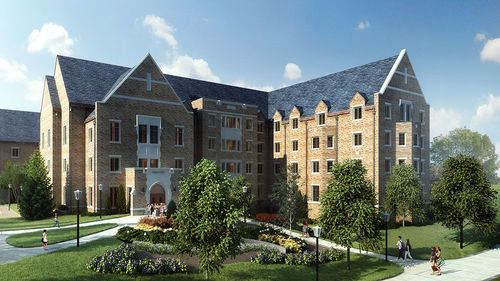
This week, construction will commence on a new, four-story men’s residence hall located west of Ryan Hall on the southwest portion of campus. Built to attain LEED silver certification, the 78,000 square-foot residence hall will be home to approximately 250 undergraduate men. The hall is expected to be ready for occupancy in August 2019, and will be named in the coming months.Ìý
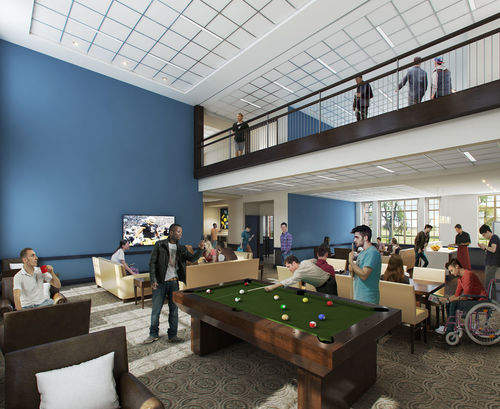
Community space will be a prominent feature of the new residence hall. With nearly 40 percent of the first floor devoted to community space, residents will enjoy a two-story lounge, a reading room, study rooms, a community kitchen, and other gathering spaces.
A core element of the residence hall will be a chapel designed with a clean, gothic architectural style utilizing wood detailing.Ìý In the lower level, residents will share space for laundry, vending, storage, exercise rooms, and food sales.
Ìý
Originally published by Marissa Gebhard at on November 16, 2017.
]]>
Marissa Gebhardtag:news.nd.edu,2005:News/814402017-11-01T11:00:00-04:002018-11-29T13:13:52-05:00Creating a culture of safety
The safety of our students, faculty, and staff is the foundation for all our goals at the University of Notre Dame. Everyone plays a role in ensuring a safe work environment.
Over the past four years, the University has made significant progress on decreasing the number of work-related, recordable safety incidents. Eric Kloss, director of Risk Management and Safety, directs two safety committees which are helping to create a culture of safety on campus. These committees focus their efforts on laboratory safety and general campus safety. The Laboratory Safety Advisory Committee, chaired by Patrick Fay, professor of electrical engineering, has been developing and revising laboratory safety standards. The committee, which is comprised of 16 members from the academic and operations units of campus, has made significant improvements in laboratory safety including improving or creating numerous lab safety programs, developing and overseeing our lab safety assessment process for approximately 600 labs, and revising the laboratory safety training process.
The Operations Safety Committee co-chaired by Heather Christophersen, director of Maintenance and Mike McCauslin, sr. associate director in Risk Management and Safety (RMS) has more than 50 members and has been focusing on revising and developing safety programs for the University.Ìý This team has also been overseeing the revision or creation of our safety assessment processes, safety training, communication, and much more.
The end result of both committees is a safer environment for all who work, study, or visit campus. Since these groups began their efforts, injuries have decreased and engagement in safety programs has increased. According to Kloss, “The results so far are significant, but much more is planned.�
What can you do to contribute to a safe environment?
Be aware of potential hazards from slips, trips, falls, cuts, burns, and repetitive motions. If you see an unsafe condition please report it immediately to your supervisor or RMS at 631-5037.
If you are injured at work, report it immediately to your supervisor. RMS needs to know, so they can work with your department to address the situation and prevent another injury. If you are unsure how to report an injury, please contact RMS.
Managers or supervisors can make safety the top priority for employees by reminding them of procedures, explaining precautions, and ensuring that all employees have completed the necessary training.Ìý
Faculty and staff can sign up for the LabÌýSafety e-newsletter and/or the General Operations e-newsletter by visiting , and clicking on communication, then newsletters. The Lab Safety newsletter is published bi-monthly, and the operations newsletter is published quarterly.
Everyone on campus can learn from the accidents at other universities. A few examples of laboratory accidents are available on .
Originally published by Marissa Gebhard at on November 01, 2017.
]]>
Marissa Gebhardtag:news.nd.edu,2005:News/798772017-09-19T17:00:00-04:002018-11-29T13:13:52-05:00Construction begins on East Campus PlantConstruction on theÌýEastÌýCampusÌýPlantÌýhas commenced and will continue through fall 2018. TheÌýplantÌýwill be located southeast of the intersection of Douglas Road and Wilson Drive.
Ìý
TheÌýplantÌýwill house heat pumps that are connected to the geothermal well fields beneath Ricci Fields along with chillers and a Thermal Energy Storage Tank. The energy production from thisÌýplantÌýis part of the University’s Comprehensive Sustainability Strategy.
Originally published by Marissa Gebhard at on September 19, 2017.
]]>
Marissa Gebhardtag:news.nd.edu,2005:News/789452017-08-23T08:00:00-04:002018-11-29T13:13:52-05:00Three new buildings surrounding stadium will seek LEED Silver certification
Duncan Student Center, O’Neill Hall and Corbett Family Hall — flanking the west, south and east sides of Notre Dame Stadium — were designed and constructed with the goal of seeking LEED (Leadership in Energy and Environmental Design) Silver certification from the U.S. Green Building Council.
With an approximate total of 800,000 square feet, Duncan Student Center, O’Neill Hall and Corbett Family Hall were built to use less water, reduce greenhouse gas emissions and be resource efficient. At least 20 percent of all of the building materials contain post-consumer and pre-consumer recycled content, including structural steel and reinforcement, concrete, metal studs, insulation, aluminum window framing, gypsum wallboard, terrazzo, spray fireproofing and ceiling tiles. Additionally, more than 20 percent of the construction materials were harvested or manufactured regionally, within 500 miles of the construction site.
The new buildings are also more energy efficient. “The mechanical systems providing heating, cooling and ventilation to the three new buildings are nearly 20 percent more efficient than that required by building code for new construction,â€� said , vice president for facilities design and operations and university architect. High-performance window glazing with a high shading coefficient will reduce potential overheating. Using direct digital controls, the campus central building automation system will control lighting and HVAC through occupancy sensors and setback controls.Ìý
The buildings also have reduced heating and cooling energy loads thanks to the addition of a living roof covering nearly all of the flat roof surfaces of the three facilities. This installation is the largest green roof in the state of Indiana. Besides serving as additional insulation, the green roof mitigates storm water runoff, improves air quality, reduces noise, conserves rainwater and releases it back into the atmosphere.
Water efficient plumbing fixtures are expected to reduce water use by 35 percent compared to standard new construction, and LED lighting is anticipated to reduce energy consumption by 30 to 50 percent compared to conventional lighting. Low Emitting Vehicle priority parking spaces and 90 bicycle racks will promote efficient transportation.
Throughout the construction process, the adhesives, sealants, paints, coatings and flooring met the green standards for the associations that set those standards, and over 75 percent of construction waste was recycled including concrete, metals, wood, cardboard, drywall and other materials.
Contact: Sue Lister, director of media relations, 574-631-7916, sue.lister@nd.edu
]]>
Marissa Gebhardtag:news.nd.edu,2005:News/788482017-08-17T12:00:00-04:002018-11-29T13:13:52-05:00New construction and Notre Dame Stadium renovations impact community
In addition to having a tremendous impact on the University of Notre Dame’s teaching, research, athletics and student life, the University’s largest construction project will also benefit the community in many ways. Community members will have an increased opportunity to earn revenue for nonprofit organizations, participate in psychology research, reap the benefits of having national and regional events in their hometown and benefit from new tiered ticket pricing.
Local nonprofit organizations have gained approximately $1.68 million over the past five years for their work at concession stands during football games at Notre Dame Stadium. Led by Levy, which manages concessions for the University, between 650 and 700 volunteers worked at concession stands at the stadium last year. About 40 nonprofit groups, including churches, local athletic teams and school groups, will participate this year.
Northridge High 91ÊÓƵ’s Science Olympiad team used to bend and cut aluminum to create robots for their robotics competitions. Now they create their own robots with 3-D printers they purchased with funds they earned volunteering at concession stands at Notre Dame Stadium. “Prior to this, it was hard for us to function. This opportunity has meant a lot to this organization,â€� says Jeremy Gerber, Northridge’s Science Olympiad coach. He estimates the team has made more than $20,000 over the last three years. “We’ve been able to offer the kids way more equipment and way more experiences.â€� The 3-D printers have allowed the group of about 55 high school and middle school students to explore new design techniques and hone their projects.
The money earned through working concessions will send the Ancilla College women’s soccer team to North Carolina this fall to prepare for the season. Head coach Justin Crew says the trip will allow team members to form strong bonds before heading into competition. “They’ll live together for a week and do workouts together,� Crew says. “They will build a family culture and a bond.� The trip is possible because of the nearly $7,000 the team raised through working concession stands at some football, basketball and hockey games. Bethel College’s softball team used its share of concession profits for a similar trip; the team started their season in Arizona. Ancilla’s cheerleading team also earned about $7,000, which they used to pay for a trip to the national championship competition.
On Notre Dame home football game days, local groups can also raise money for their organizations by volunteering with Monterrey Security to serve in guest service roles. Recently, church youth groups and local school athletic teams have raised funds for uniforms and special trips. Groups also have the potential to earn bonuses from Monterrey.
When Notre Dame’s moves into O’Neill Hall in 2018 and brings all associated laboratories together in one building, the community will be able to participate in research more conveniently as parking will be more accessible. Current research investigations address health, well-being, aging and stress, and participants receive modest stipends for their involvement in the research.
With an increase in the number of new venues on campus, the community will also benefit as new visitors come to conferences, meetings and special events that the local area was not able to host previously. , a team of sales, reservation and event specialists, will utilize spaces across campus as well as premium event space in the Duncan Student Center, O'Neill Hall and Corbett Family Hall to host national and regional conferences, weddings, corporate events and customized events.
The community will also benefit from a new for football tickets and new, fan-friendly pricing on the most popular concessions. New tiered ticket pricing beginning with the 2017 season creates greater affordability for many fans with pricing ranging from $45 to $250. The prices on some of the most popular concessions — water, hot dogs and popcorn — will decrease by $1.50 to $3 each. Ìý
Local families who are food insecure will benefit from a new collaborative program. Through the efforts of Notre Dame’s , the , Cultivate Culinary 91ÊÓƵ & Catering and Levy, fresh food that is leftover after football games in Notre Dame Stadium will be prepared into frozen meals. Cultivate Culinary will prepare and distribute the food to food-insecure families in the Michiana area.
Groups who are interested in volunteering at concession stands may contact Levy at 574-631-1761. Groups may inquire about guest service roles by calling Monterrey Security at 773-843-0434. Individuals may reach Cultivate Culinary 91ÊÓƵ & Catering at 574-440-2214, and the team at VenueND can be reached at 574-631-1400.