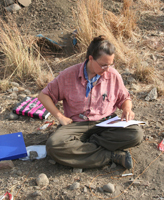
tag:news.nd.edu,2005:/news/authors/mark-shuman tag:news.nd.edu,2005:/latest Notre Dame News | Notre Dame News | News 2012-04-10T16:30:00-04:00 Notre Dame News gathers and disseminates information that enhances understanding of the University’s academic and research mission and its accomplishments as a Catholic institute of higher learning. tag:news.nd.edu,2005:News/30169 2012-04-10T16:30:00-04:00 2021-09-03T21:03:10-04:00 Notre Dame anthropologist ‘follows the pots’ Meredith Chesson in the field

An Indiana Jones-style expedition might be one way to locate 5,000-year-old Early Bronze Age artifacts like those University of Notre Dame associate professor studies.

Logging onto eBay, however, is the cheaper, easier route. On eBay and similar auction sites, Chesson says, Web surfers can all-too-easily find such artifacts using search terms such as “Early Bronze Age pots” and “holy land.”

Her ongoing project, “Follow the Pots: The Social Lives of Early Bronze Age Artifacts From the Southeastern Dead Sea Plain, Jordan,” documents the extensive looting — mostly by economically struggling local residents — that for decades has affected the area in and around the Jordanian cemetery at Fifa.

Online collectors, she says, typically pay around $250 for ancient ceramic pots traditionally linked to Old Testament figures as revered as Abraham and to locations as storied as Sodom and Gomorrah. Scholars are still debating the existence of those two infamous cities, but evidence from their era, and from the first walled urban centers of the Middle East, provides a tantalizingly authentic connection to the past for professional archaeologists, collectors and others, Chesson says.

“Looting is a huge, contentious problem in archaeology today, and it has national and international implications,” she says, adding, “I don’t think we can stop the looting as long as there’s a demand.”
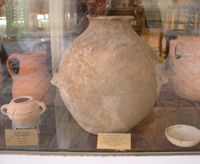
Early Bronze Age pottery vessels, likely from Fifa or one of the neighboring cemeteries, for sale in a registered antiquities shop in Jerusalem (photograph by Morag Kersel)

Chesson, an anthropological archaeologist in Notre Dame’s , has become an expert on Early Bronze Age civilizations in the Middle East, in part through her ongoing work as publication co-editor on final reports of the 40-year-old Expedition to the Dead Sea Plain.

In 2009, she and her research partner, Morag M. Kersel, an assistant professor of anthropology at DePaul University, received a grant of approximately $25,000 from the prestigious to fund “Follow the Pots.” The pair has also received logistical support from Notre Dame’s and from DePaul.

Using on-the-ground examinations and aerial photographs, their study documents the extent of the looting in the area. It also includes ethnographic interviews with various groups of stakeholders, including artifact dealers, archaeologists, museum staff, collectors, government officials, local inhabitants and the looters themselves.

The interviews, Chesson says, are designed to explore how these different stakeholders understand their connection to the past in the form of these pots and archaeological sites, how they think about these materials and how they believe the materials can and should be used.

One observation so far, she says, is that looters tend to value only whole pots they take from the tombs and generally ignore artifacts such as shell bangles, beads and stone tools that “don’t really sell.”

Future interviews with looters, museum curators, artifact dealers and middlemen, she says, may ultimately reveal a better understanding of what the cemetery at Fifa and others like it originally contained. “The vast majority of tombs opened in Fifa have been opened by looters and not archaeologists,” Chesson says.
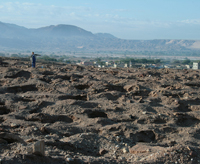
Surveyor Hugh Barnes standing amid hundreds of looters' holes at Fifa, January 2011 (Photograph by Isabelle Ruben)

Although their findings are not yet published, Chesson allows that she and Kersel have already “raised hackles” by questioning traditional ways of thinking about both archaeologists and looters.

Historically speaking, “part of what (academia has) been trying to do is establish us as the good guys, and the looters as the bad guys,” Chesson says.

“Both groups,” she cautions, “are stakeholders who value the same materials differently and do different things with them.”

Issues of right and wrong become murky, she says. “Frankly, I’m not willing to tell someone that putting a 5,000-year-old pot in a museum is more important than feeding someone’s kids,” she says.

Back at Notre Dame, Chesson says “Follow the Pots” has also sparked some interesting discussions in her classes, which include Fundamentals of Anthropology, Gender and Archaeology, and Anthropology of Everyday Life.

The project resonates with her students, she says, because the ethics of archaeological research is such a central concern within the profession.

“The ‘Follow the Pots’ project is the most exciting thing I’ve done in a long time, and it’s pushing me to think about anthropology in new ways,” Chesson says.


Originally published by Mark Shuman at on April 3, 2012.

]]>
Mark Shuman
tag:news.nd.edu,2005:News/26909 2011-10-14T15:35:00-04:00 2021-09-03T21:02:27-04:00 Students help Notre Dame archaeologist unearth ancient artifacts in Albania Discovery of the goddess figurine

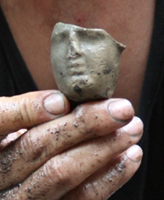
On the final day of his latest six-week excavation season in historic , University of Notre Dame Assistant Professor says “the face of a goddess appeared.”

The four assistants who had a hand in the discovery?

Suzanna Pratt, Patrick Conry, Matt Wieck and Wesley Wood—all undergraduates in Notre Dame’s .

As the sun dipped below the Ionian Sea on the last day of this summer’s visit to the site, a sense of urgency settled in with the darkness.

Their hard work had yielded a prize: Excavation team members recovered a palm-sized goddess head, later classified as an ancient votive offering. The find, a depiction of a Greek goddess like Athena or Aphrodite, lay 16 feet below the surface of present-day Butrint on what once was a rocky shoreline.

Butrint, recognized by UNESCO as a World Heritage Site in 1992, has yielded historical riches dating as far back as the 7th century B.C. In successive layers, archaeologists have found dramatic evidence of a Greek healing sanctuary of Asclepius, a Roman trading port, a medieval settlement, a Renaissance-era Venetian castle, and more.

Suzanna Pratt recording the pottery finds at Butrint, Albania

“Whenever finds turned up, it was fascinating to realize that we were digging in a place where these people actually lived,” says Pratt, a junior from the Seattle area majoring in and .

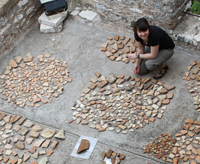
Appointed the finds manager at Butrint, Pratt marveled at the proximity of two worlds while handling and classifying objects such the goddess head or a perfectly intact—and useable—bronze spoon. Once, she examined a ceramic sculpture that still displayed its maker’s fingerprints. The connection spanned centuries, she says, but felt intimate.

Exhilarated by her experiences, Pratt says she plans to write a senior thesis related to her work on the project and is now considering a career as an archeologist. She also continues to study the Albanian language and may even pursue a Peace Corps appointment to Albania after graduation. While Pratt says she feels privileged to have worked with about 20 archaeologists, art historians, and other experts in the field as a student, she’s especially grateful to Hernández.

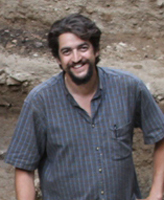
David Hernández

The professor, who has spent nine years working at the site, has an extensive knowledge of excavation methods and urban stratigraphy and is fluent in Albanian, among other languages. He is also currently project director and principal investigator at Butrint.

Co-directors of the project, funded by Notre Dame, the American Philosophical Society, and the Butrint Foundation, are Richard Hodges, director of the University of Pennsylvania Museum of Archaeology and Anthropology; and Dhimiter Condi, of the Albanian Institute of Archaeology. Funding from Notre Dame’s and the College’s helped underwrite Hernández’ research—and covered all student expenses including transportation.

When staffing his excavation team, Hernández says he looks for undergraduates who can handle responsibility.

“I consider the undergraduates as team members and certainly not newcomers assigned to minor jobs,” he says. “They’ll need to be mature and work well in a team environment, so I look for merit, intellectual curiosity and performance alongside personal drive, motivation and interest.

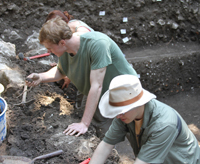
College of Arts and Letters students Patrick Conry and Wesley Wood excavating ancient artifacts in Butrint, Albania

“At the site, we’re overcoming difficult conditions, getting up early, and doing everything we can to make the project successful,” he says. “What really drives an excavation and makes it successful is having people who are passionate about the work.”

Classics major Wood is another example of the motivated and capable students Hernández invites to Albania.

Wood, who is a Crown Point, Ind., native, had never travelled internationally before Butrint. Now, he says, he considers archaeology a potential career choice and practices his Albanian language skills on campus with Notre Dame friends.

While in Albania, Wood first literally “worked in the trenches” of the excavation and later helped catalogue the site’s “bulk” finds, including pottery, animal and human bones, glass and metals. Wood says the joy of discovery propelled him through his four weeks in Albania with lightning quickness.

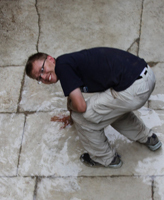
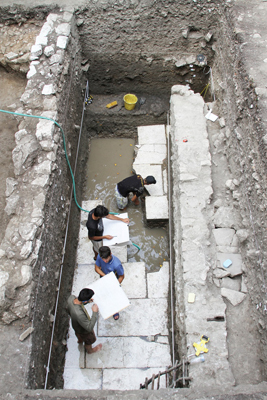
Wesley Wood touches the forum pavement in Butrint, Albania

When the excavation team made its first major discovery—the immense pavement slabs of a perfectly-preserved Roman forum—he says he knew he was hooked. “When you walk on a forum, there’s a connection,” he says.

“This is one of the best-preserved forums of the Roman Empire outside Italy,” adds Hernández, noting that the forum is “a civic space and a religious and administrative center that reflects the ideologies of its inhabitants.”

Today, the entire Butrint excavation “has allowed us to look, as if through a window, from modern times to the 5th century B.C” he says. “Through all those centuries, it has been a barometer of Mediterranean activity.”

As for Wood, if invited back to Albania a second time, he says, “I’d be there in a heartbeat.”


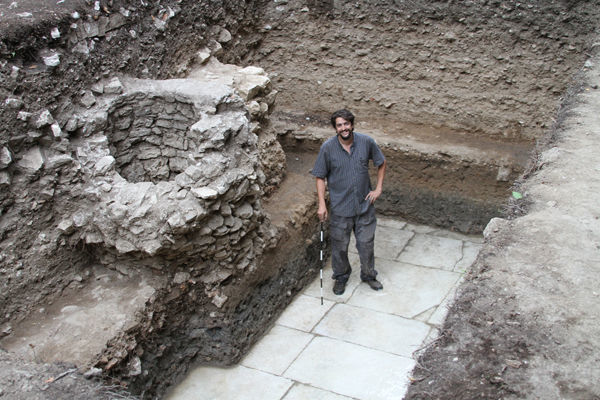
David Hernández on the pavement of the Roman forum in Butrint, Albania

David Hernández on the pavement of the Roman forum in Butrint, Albania

The medieval house (left) and late antique public building (right) above the forum pavement in trench 16, Butrint, Albania

The medieval house (left) and late antique public building (right) above the forum pavement in trench 16, Butrint, Albania

All photos courtesy of David Hernández.


Originally published by Mark Shuman at on October 12, 2011.

]]>
Mark Shuman