tag:news.nd.edu,2005:/news/authors/ndworks tag:news.nd.edu,2005:/latest Notre Dame News | Notre Dame News | News 2022-04-07T12:00:00-04:00 Notre Dame News gathers and disseminates information that enhances understanding of the University’s academic and research mission and its accomplishments as a Catholic institute of higher learning. tag:news.nd.edu,2005:News/144563 2022-04-07T12:00:00-04:00 2022-04-07T15:24:00-04:00 Douglas Road project delayed, starts April 11 According to St. Joseph County officials, the closure of Douglas Road between Twyckenham Drive and Ironwood Road will begin this coming Monday, April 11 — a week earlier than most recently projected. This is Phase 1 of the project. New information will be provided to the campus community as the University receives it, including the start date for Phase 2, which will close the intersection of Douglas and Ironwood for several weeks.

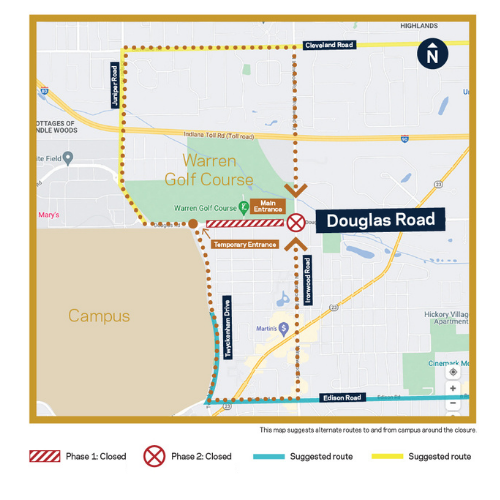
Phase 1: Douglas Road is expected to close east/west traffic from Twyckenham Drive to Ironwood Road starting on Monday, April 11.

Phase 2: In the late spring, the intersection of Ironwood and Douglas will close in all directions for several weeks to add turn lanes and upgrade the traffic lights.

Douglas Warren
Alternate route for those commuting to campus from the northeast: Take Cleveland Road west to Juniper Road. Turn south on Juniper. Proceed under the Indiana Toll Road and at the first roundabout take the second exit to Douglas Road. At the second roundabout, stay on Douglas and at Wilson Drive, turn south to enter campus.
Alternate route for those commuting to campus from the east: Take Edison Road west to Twyckenham Drive. Turn north on Twyckenham and at the first traffic light, turn west on Bulla Road to enter campus.
Alternate access to Warren Golf Course: Even though Douglas Road will be closed from Twyckenham Drive to Ironwood Drive, people can access Warren Golf Course from the west. Proceed east on Douglas past Twyckenham and enter the golf course at the first driveway immediately on the left.

The construction is likely to impact traffic patterns for major University events, including the Garth Brooks and Billy Joel concerts, two Commencements, Reunion, move-out and move-in dates and possibly three home football games.

This year’s improvements include the addition of lighting and the extension of a pedestrian pathway from the Warren Golf Course east to Ironwood Road.

When the project is completed next year, Douglas Road will be four lanes with ample turning lanes at both Ironwood and Indiana 23 — intersections that get congested during peak traffic times. The Indiana Department of Transportation is overseeing construction.

Warren Golf Course open during construction

Throughout this year's Douglas Road construction, visitors to Warren Golf Course will only be able to access the property from the west.

The main entrance to the golf course is on Douglas Road between Twyckenham and Ironwood — the stretch of Douglas closed during Phase 1. During that time, there will be a temporary entrance immediately east of the intersection of Douglas and Twyckenham.

The main entrance to Warren is expected to reopen at the beginning of Phase 2, but the golf course will still only be accessible from the west.

Originally published by NDWorks at on April 01, 2022.

]]>
NDWorks
tag:news.nd.edu,2005:News/74153 2017-03-01T13:00:00-05:00 2021-09-03T21:09:59-04:00 Venue ND launches Venuend Iandw Color Pms

The newly formed Office of Event Management, has been created to book meetings, events and academic conferences on campus. The office will initially begin booking events at the new Duncan Student Center, Corbett Family Hall and O’Neill Hall, as well as at Morris Inn and McKenna Hall.

The three new facilities, scheduled for completion in August 2017, will offer two new ballrooms, reception space and eight outdoor terraces offering breathtaking views of campus. The Dahnke Family Ballroom, located on the seventh floor on the west side in the Duncan Student Center, has a capacity of 580. The Rasmus Family Club, on the eighth floor of the Duncan Student Center, includes a balcony that will overlook the ballroom below. The Downes Club on the seventh and eighth floors of Corbett Family Hall on the east side will seat 300 people for an event.

The Office of Event Management will begin to accept bookings for events and academic meetings in the new spaces on Wednesday, March 1, 2017, for events occurring after October 1, 2017. Contact the sales and reservations team in the Office of Event Management at 631-1400 for event bookings and information.

]]>
NDWorks
tag:news.nd.edu,2005:News/72471 2017-01-06T11:00:00-05:00 2021-09-03T21:09:50-04:00 Fulcher family enjoys long history with University FulcherKathleen Fulcher, Matthew Fulcher, Nancy Fulcher and Rachel Fulcher-Dawson

Nancy Fulcher, formerly assistant director of procurement, recently retired after 25 years at the University of Notre Dame. When she applied for her first job, she didn’t even have a résumé. “A friend in physics called and said they must need people in purchasing because they’re six weeks behind. I called Bob Watkins — he was a little offended that people thought they were behind. But I went in and met him, was hired and started the next day in a temporary, entry-level job. And I worked my way up.” Notre Dame is a phenomenal place to work, she adds, “and the people are great. The mission and the people, that’s what makes Notre Dame great.”

Nancy’s son (and oldest child) Matthew Fulcher ’95, MSA ’02, assistant director of facilities and academic space in the College of Arts and Letters, has worked at Notre Dame for 18 years. His first position was in Student Activities as operations manager of LaFortune. Later he worked for eight years in the Mendoza College of Business as the first operations manager of Giovanini Commons, a creative learning center.

Matthew met his wife Kathleen Fulcher ’99, when the two were working during Commencement Weekend 2001— Matthew was working for Student Activities, Kathleen “in pigtails and overalls,” was working for catering. “When my parents moved me up here from Cincinnati in 1995, they never got me back,” Kathleen says. “Little did they know.” Kathleen is program manager for Alliance for Catholic Education teaching fellows. They’re parents to two boys and a girl.

Daughter Rachel Fulcher-Dawson, the second oldest child (and parent of four daughters), is associate director of the Wilson Sheehan Lab for Economic Opportunities in the Department of Economics and holds a concurrent teaching position in Education, 91Ƶing and Society in the Alliance for Catholic Education teaching early childhood policy. She’s a graduate of Marquette University in Maryland, and Michigan State.

“I left here thinking I would never come back, but came back 15 years later, and it’s been great for me and my family.”

Nancy has three other children, Joshua Fulcher ’03, ’05, Joanna Azar, an Indiana University grad, and
Martha Roman ’05.

]]>
NDWorks
tag:news.nd.edu,2005:News/72265 2016-12-20T13:00:00-05:00 2021-09-03T21:09:49-04:00 Putting the presidential election in perspective White House

As a member of the board of directors of the Commission on Presidential Debates, Notre Dame President Rev. John I. Jenkins, C.S.C., fielded his fair share of questions about the 2016 U.S. presidential race – not just from curious students, friends or acquaintances, but from leading journalists around the world. Jenkins, along with other Notre Dame faculty, were highly sought-after experts leading up to and following the election of the nation’s 45th commander in chief. Via television, radio and print media outlets on the international, national and local level, these experts contributed to the public discussion about the election.

These faculty members’ areas of expertise include religion and politics, politics of race and ethnicity, voting behavior, election and tax law, women and politics, journalism, and campaign ads. And they provided credible opinions on the election process, voter sentiment, top issues and the candidates themselves. Here are select excerpts from their commentary:

On the debates and the role of the Commission on Presidential Debates

“[The commission] is a remarkable group of people all interested in one thing: How do we present to the American people, a discussion, a debate that will inform our votes? In our challenging times, often polarized times, it is an honor to work with people who are so deeply patriotic and so deeply concerned about our political process. The goal of these debates is to present the candidates to the public in various ways so that the public, the voting public … [is] as educated, as knowledgeable as they can possibly be before they cast that vote. And, if we can do that, we will have a healthier republic, a healthier democracy. That’s our purpose.”
Rev. John I. Jenkins, C.S.C., University president and professor of philosophy, on C-SPAN, Oct. 9

On Trump’s surprise voter turnout

“What I think many of us did not understand was the extent to which whites who supported Trump were going to turn out and vote in substantial numbers.”
Luis Fraga, Joseph and Elizabeth Robbie Professor of Political Science, on NBC, Nov. 9

On changing voter concerns

“Voter satisfaction of the economy and a general sense of how things are going are usually the best indicators of which way an election will go, but since 9/11 foreign policy has intruded into the public consciousness and has not had greater salience perhaps since periods like the 1968 election at the height of the Vietnam War.”
Michael Desch, professor of political science, reported in Catholic News Service, Aug. 19

On the media and voter perception

“Depending on those channels, you get different facts, you can get different interpretations of those facts and just totally different realities all together. We know the way in which people consume media might be another contributing factor, because people don’t consciously watch channels or shows that contradict their political views.”
Darren Davis, professor of political science, on WSBT-TV, Sep. 27

On the Secretary Hillary Clinton campaign’s messages of hope, kindness and love

“It draws on Christian vocabulary but doesn’t appear to have overtly religious content. It seems to come from a more secular, civil kind of spirituality. But when you start using that language, maybe it does bring about a certain elevation of political discourse and insert an ideal that is deeper than the rhetoric. At least it’s better than hate language.”
John Cavadini, professor of theology, in the New York Times, Aug. 27

On the Trump and Clinton foundations

“The bottom line is that close ties between foundations, their leaders, the donors that support them and the causes they support are common. Members of the public can of course still be critical of such ties, but the law allows them.”
Lloyd Mayer, professor of law, on CNN, Sep. 21

On the feminist triumph of Clinton’s run

“The ratification of the 19th Amendment and the presidential candidacy of Hillary Clinton are consequential for how they challenged the ideology of gender difference articulated by opponents of both."
Christina Wolbrecht, associate professor of political science, Vox, Nov. 11

On the business impact of Trump presidency

“Without a doubt, the obvious beneficiaries are defense, transportation and energy. If there were more coal companies still on the market, they would be really hot right now. The transportation sector has been hit with excessive regulation. Trump should be able to fix that, too.”
Tim Loughran, C.R. Smith Professor of Finance, in the Washington Post, Nov. 9

]]>
NDWorks