The transfer was first announced by Startup South Bend-Elkhart on July 25.
IDEA Week, which celebrates innovation, entrepreneurship and the regional community, was originally launched in 2017. In its first year, the Notre Dame IDEA Center led the event along with Startup South Bend-Elkhart, the City of South Bend, enFocus, RISE and more than 15 regional partners. By 2019, IDEA Week had expanded to feature more than 50 sub-events, two concerts, two comedic acts, the involvement of more than 20 regional organizations and over 20,000 attendees.
Startup South Bend-Elkhart, a division of the that leads economic development across five counties in northern Indiana and southwest Michigan, will begin planning for IDEA Week 2025 immediately.
“IDEA Week has become a focal point to convene and celebrate the activities of the region’s strong culture of innovation and entrepreneurship,” said Shannon Cullinan, Notre Dame’s executive vice president. “Innovation thrives on collaboration, and IDEA Week would not be possible without the strong partnership with the community. That partnership, and the region’s broader innovation ecosystem, is poised to grow deeper with IDEA Week under the leadership of Startup South Bend-Elkhart.”
Bethany Hartley, president and CEO of Startup South Bend-Elkhart and the South Bend-Elkhart Regional Partnership, said that discussions about transitioning IDEA Week from Notre Dame to her organization began two years ago.
“We’ve been part of IDEA Week since its inception, planning and hosting many events,” Hartley said. “Startup South Bend-Elkhart is dedicated to advancing the South Bend-Elkhart region. One of the ways we aim to achieve this is through IDEA Week. We will build on the excellent work done by the IDEA Center and expand the event’s reach to new demographics and business types across our entire region.”
Notre Dame will continue to be involved with IDEA Week. In addition to serving on the event’s board and providing input, the University will also continue to manage the McCloskey New Venture Competition, which has been a part of the festival since the beginning. Notre Dame will also oversee at least two other events during the week, and all in full collaboration with Startup South Bend-Elkhart.
Hartley said that she plans to establish a CEO council and meet with local entrepreneurs to gather community input on future expectations for IDEA Week.
IDEA Week will also continue to host live concerts and comedy events, and its first major keynote speaker will be announced soon. Learn more at .
Originally published by at on July 30, 2024.
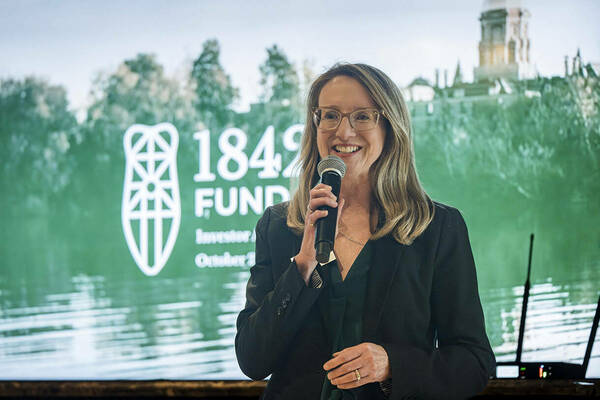
]]>Ի徱ԲDZ- has successfully closed the first $17.5 million of the named for the year Notre Dame was founded. The fund, which will support faculty research, student innovations and community startups and drive economic transformation in the South Bend-Elkhart area, will continue raising additional commitments over the next year up to the target size of $35 million.
“The launch of the 1842 Fund is an exciting moment for the IDEA Center and the University,” said Kelley Rich, the IDEA Center’s interim vice president and associate provost for innovation. “One of the reasons we partnered with High Alpha Innovation is because part of their 1842 Fund will be used to support an on-campus venture studio. The adoption of venture studios, or companies that launch, finance and incubate their own startups, in university settings is on the increase, and High Alpha Innovation is a recognized leader in this area. We’re particularly excited that the 1842 Fund venture studio team will work closely with faculty and students from across campus to help source and build startups that support Notre Dame’s mission. We believe that this will, in turn, create symbiotic relationships for sustained innovation on campus.”
The fund’s announcement coincides with the recent launch of a new that will guide Notre Dame over the next decade.
“The 1842 Fund aligns with many of the goals of the framework, including investing in our people, engaging with and enhancing our community and our region, maximizing the impact of science and engineering research for a world in need and advancing Notre Dame as the leading global Catholic research university,” said John McGreevy, the Charles and Jill Fischer Provost. “And a central mission of the fund is to launch and support new ventures specifically designed to create positive societal change in focus areas identified in the framework, including health and well-being, poverty and sustainability.”
Matt Gardner, one of the partners at the 1842 Fund, explained the fund plans to launch a series of startups over the next five years. It will accomplish this, he said, in two ways. First, it will invest in Notre Dame faculty, student and South Bend area startups born out of the IDEA Center, the fundamental resource for all commercialization and entrepreneurial activities at the University. Second, it will fund the establishment of an on-campus venture studio, the 1842 Studio, that will itself build, staff and launch new software startups from the ground up in collaboration with faculty, students and the IDEA Center.
“The high-touch venture studio will apply High Alpha Innovation’s proven startup co-creation playbook to build software startups from the ground up, targeting the key social impact areas outlined in Notre Dame’s 2033 strategic framework,” said Mike Joslin, partner at the 1842 Fund. “It will also convene leaders in industry and government to provide invaluable expertise and partnerships that can create valuable advantages for 1842 Fund portfolio companies.”
“With this fund, Notre Dame will remain at the forefront of venture in higher education. We are excited to engage with researchers, students and the community to create advantaged startups that extend the University’s mission well beyond the campus domain,” said Matt Brady, a managing director at High Alpha Innovation and a Notre Dame alumnus.
Brady said that High Alpha Innovation has already launched operations at the 1842 Fund and will continue to raise the next $17.5 million.
Originally published by at on Dec. 4.
]]>Leading the IDEA Week 2024 lineup announcement is award-winning comedian, political satirist and entrepreneur Hasan Minhaj, who will perform on April 25 (Thursday) at the Morris Performing Arts Center in downtown South Bend. Minhaj is best known for his breakout Netflix special “Homecoming King” and his critically acclaimed political satire Netflix show “Patriot Act” for which he won a Peabody, Emmy and Television Academy Honor.
A former senior correspondent for Comedy Central’s “The Daily Show with Jon Stewart,” Minhaj recently segued into the startup world by co-founding 186K Films, which is producing its first feature film, “For the Culture,” with Amazon Studios. Minhaj is co-writing the script with Prashanth Venkataramanujam and will also star in the film. Tickets to see Minhaj range from $48.50 to $118.50 and go on sale Nov. 16 (Thursday) at the Morris Box Office, by phone at 800-537-6415 and online at .
“Our goal is to celebrate and encourage all levels of entrepreneurship in our region,” said Kristopher Priemer, one of IDEA Week’s leaders and organizer of the week’s entertainment events. “Mixing in high-caliber mainstream performances gives another opportunity for individuals to connect and highlight the positive impact entrepreneurs have to our economy.”
IDEA Week 2024’s first major keynote speaker of the week is Maya French, a serial entrepreneur and alumna of the 2019 Forbes 30 under 30 class. A multiple startup founder, French is the creator of Koia, a renowned name in the plant-based nutrition industry. In 2023 she launched M.A.D. Projects, a venture studio specializing in building exceptional consumer packaged goods brands. Her aim is to transform concepts into thriving brands that resonate with underserved audiences. French will be speaking April 24 (Wednesday) at the Century Center in South Bend.
In addition to her speaking role, French will also serve as a final-round judge for the University of Notre Dame’s signature innovation event, the , on April 26 (Friday). The annual competition attracts more than 150 student, faculty, alumni and local community-led startups that prepare for months for a chance to be one of the final teams selected to compete for more than $600,000 in prize money and investor connections, up $200,000 from previous years.
Additionally, entrepreneurs and actors Lexi Hensler and Patrick Schwarzenegger will speak at IDEA Week’s “Starting Small Summit,” scheduled for April 25 (Thursday) at the Century Center in downtown South Bend.
Although Schwarzenegger is best known for his celebrity parents, Maria Shriver and Arnold Schwarzenegger, the actor starred in the HBO true crime series “The Staircase” alongside Colin Firth and in “Gen V” on Prime Video. Schwarzenegger is also an entrepreneur. In 2021, he co-founded Mosh, a startup that exists to create a conversation around brain health through food, education, research and providing tools for a “mindstyle” lifestyle. Schwarzenegger is also Mosh’s current CEO and an active investor in early-stage startup companies.
With more than 5.3 million subscribers and over 1 billion video views on her YouTube channel, Hensler is a prolific product promoter, influencer and entrepreneur. Her film credits include “Craziest Vacation Ever,” “Amp World” and “Date Takeover.” She is also the founder of Hugz, a line of therapeutic weighted plush animals designed to relieve symptoms from stress, anxiety and depression.
“We are truly excited to announce this diverse group of individuals who have embraced entrepreneurship from the starting points of business and entertainment to IDEA Week 2024,” said , interim vice president and associate provost for innovation at the . “Hasan Minhaj and Maya French are sure to inspire us all having brought their unique perspectives and experiences to legacy industries, entertainment and consumer products that are embracing diversity.”
Rich added, “I’m sure everyone will also enjoy the journeys of Lexi Hensler and Patrick Schwarzenegger, who are charting their own careers paths, blending acting with entrepreneurialism, investing and the cultural phenomenon of product influencers.”
Now in its sixth year, IDEA Week is hosted by Notre Dame, the South Bend-Elkhart region, Starting Small Summit and various community organizations and businesses. Events will be held at Notre Dame and other locations throughout South Bend and Elkhart and will be open to the public. Find more information and register for updates at.
]]>, Notre Dame’s interim vice president and associate provost for innovation, said being able to leverage the deep expertise and success of the High Alpha Innovation team will result in stronger outcomes for Notre Dame’s commercialization and innovation efforts.
“We are fortunate that one of the nation’s premier venture capital firms is based here in Indiana,” Rich said. “Collaborating with High Alpha Innovation will not only aid the successful launch of Notre Dame’s startups and play an important role in economic development, but it will also help strengthen our entrepreneurial alumni relationships and Indiana’s innovation ecosystem as a whole.”
The investment element of the collaboration will make investment capital available to qualified startup companies originating through IDEA Center operations, including faculty, student and community ventures. The venture studio element will build, staff and launch new software startups within the University by solving complex problems in areas ripe for disruptive innovation. The industries chosen for these ventures will align with the University’s Catholic mission, and the startups that emerge will be rooted in best practices in ethics and aim to benefit worldwide needs.
“A properly executed startup has the power to lift people up and solve important problems,” Elliott Parker, chief executive officer of High Alpha Innovation, said. “An on-campus venture studio provides guidance and help to startup founders who want to both do well and do good in the world. Owing to its Catholic mission and desire to impact the world in positive ways, Notre Dame is the ideal place for such a studio to form. With Notre Dame identifying areas of need and providing principled foundations to build on, and with our track record of building impactful startup companies, we believe that together we will be able to positively address some of the world’s most pressing challenges.”
, the University’s Charles and Jill Fischer Provost, said the collaboration combines the best of Notre Dame and the best of High Alpha Innovation — and that together the result will be an effective tool by which Notre Dame’s research can be put into practical use.
“Translating the novel ideas of our talented faculty and students into action is a vital component for achieving Notre Dame’s mission,” McGreevy said. “This collaboration with High Alpha Innovation will help us accomplish this. It also reinforces our commitment to ensuring Notre Dame’s research, through growth and commercialization, becomes a force for good in the world.”
High Alpha Innovation and Notre Dame have plans to collaborate more deeply on this program in the coming months, the result of which will be announced in the future.
High Alpha Innovation is an Indianapolis-based venture builder that partners with corporations, universities and entrepreneurs to create and launch advantaged startups. Its dedicated team of company builders, strategists and designers apply a proven playbook — pioneered by — to help the world’s leading organizations innovate through systematic startup creation. For more information, visit or on Twitter at @.
Standing for innovation, de-risking and enterprise acceleration, the IDEA Center is the fundamental resource for all commercialization and entrepreneurial activities at the University of Notre Dame. It provides the necessary space, services and expertise for idea development, commercialization, business formation, prototyping, entrepreneurial education and student entrepreneurial efforts. It is designed to bring the best Notre Dame faculty, staff and student ideas and innovations to market. To learn more about the center, visit .
Originally published by at on Nov. 9.
]]>Alexis Ohanian, co-founder of the social news website Reddit and the venture capital firm Seven Seven Six, and Morgan DeBaun, CEO and founder of Blavity, a media company that focuses on Black culture, are the first major keynote speakers to be announced for the event. DeBaun will speak on April 28 and Ohanian on April 29.
Idea Week is hosted by the University of Notre Dame, the South Bend-Elkhart region and various community organizations and businesses.
It will be held primarily online, although a few hybrid online/in-person events that follow CDC, Indiana State Department of Health and Notre Dame event guidelines will take place.
Registration to attend Idea Week is now open. Admission is free for K-12 and college students and $39 for other members of the public.
More than 21,000 people attended at least one event during the most recent Idea Week held in 2019, and nearly 18,000 people attended in 2018, its inaugural year.
Ohanian was born in Brooklyn, New York, and grew up in the suburbs of Baltimore. He wrote the national bestselling book “Without Their Permission,” and has been a vocal advocate for the open internet, STEM education and paid family leave. Out of college, Ohanian co-founded Reddit, one of the largest websites in the U.S., which was funded by Y Combinator in 2005 and sold to Conde Nast in 2006. He returned as executive chairman in 2014 to help lead the turnaround of the now independent company. In 2016 he left to co-found Initialized Capital—a seed-stage venture fund with over $770 million under management and a portfolio with $100 billion in market value, with companies like Instacart and Coinbase among its portfolio. In 2020 he resigned from the Reddit board in protest and left his role at Initialized Capital to found Seven Seven Six, a new venture firm focused on people, culture and community.
DeBaun is the CEO and founder of Blavity, a leading media company for Black culture and millennials. Since launching Blavity in 2014, DeBaun has led the company to successfully acquire Travel Noire, a travel platform for Black millennials, and Shadow And Act, a Black entertainment news site. Under her leadership, Blavity has launched several leading consumer summits including Summit 21 for Black women creators and Bay Area’s AfroTech, the largest tech conference for Black innovators and founders. While scaling the company, DeBaun has raised more than $12 million from top Silicon Valley venture firms such as GV (formerly Google Ventures) and Comcast. DeBaun is also the founder of WorkSmart, an advising program that teaches small business owners how to scale their business, and the “WorkSmart” podcast, which is designed to help established entrepreneurs get the guidance needed to grow by taking them inside real-life advising sessions and interviews with CEOs. DeBaun is a St. Louis native and a graduate of Washington University in St. Louis.
For more information on Idea Week, visit .
Contact: Erin Blasko, assistant director of media relations, 574-631-4127, eblasko@nd.edu
Originally published by at on March 25.
]]>The SBIR and STTR programs are called “America’s Seed Fund” because their mission is to fund a diverse portfolio of startups and small businesses across technology areas and markets to stimulate innovation, meet federal research and development needs and increase commercialization. Companies such as 23andMe, Symantec, iRobot, Genentech, Qualcomm, Biogen and Amgen all received seed funding from SBIR and STTR funding agreements in their early days.
Individual agencies within the federal government such as the Department of Defense, Department of Energy and National Science Foundation all participate in the congressionally mandated program. SBIR and STTR financial awards are considered non-dilutive funding and are therefore attractive to startups.
Over the past five years, the South Bend-Elkhart region has averaged four SBIR or STTR awards with the average total of all awards being $725,000. 2020 will almost certainly show the region brought in millions more, with at least $7.5 million being awarded since the start of 2020. SBIR and STTR awards in this region began to pick up in 2019 but greatly accelerated in 2020. Most of this growth has come from startups spun out of Notre Dame. Here are five Notre Dame startups that are reaping the rewards of SBIR and STTR awards.
Vennli
Vennli was founded in 2013 by Joe Urbany, a Notre Dame marketing professor, and Gary Gigot, a serial tech entrepreneur and Notre Dame alumnus. Together with a talented team, the co-founders have succeeded in building a tech-powered platform for market research and data insights used by leading national and global brands including BMW, Dunkin, Nucor Steel, 3M, Schurz Communications, Tire Rack and Notre Dame. Vennli also caters to many mid-market companies with a Midwest regional footprint like Steel Warehouse and Imagineering Technologies.
Vennli is a tech company at heart. Seeking to broaden its customer base, the company’s leadership looked at expanding in the federal government arena through the SBIR and STTR programs. Not only would they discover new customers, but their research and development effort would be funded by potential customers in the federal government.
Ethan Griffin joined Vennli in June 2020 as vice president of strategy and public sector to help the company expand its footprint in the area of government contracting. Griffin, who spent 26 years in the U.S. Air Force and as a senior executive within the Department of Defense, called the decision to enter the federal arena through the SBIR and STTR programs a “gutsy move.”
“The federal government is very complex and dense with many deeply ingrained contractors, particularly within the defense industry. It took a lot of courage for Vennli’s leadership to commit to this new market,” Griffin explains. “That said, small, nimble companies like Vennli that are enthusiastic and have great tech are exactly who the SBIR and STTR awards are designed for. The government needs this fresh perspective on problem-solving and for relatively small investments, the government is yielding good wins.”
Griffin is not a “tech” guy but was a user of tech when piloting highly sophisticated military aircraft and then developed a deep understanding of the military’s tech needs and government policy during his years at the Pentagon. He first met the Vennli team in 2019 when they were applying for their first SBIR. Griffin immediately recognized the synergy. “The military has a significant need for data analytics and capturing stakeholder needs, areas in which Vennli excels. Our original platform, re-shaped and applied to new applications within the government, was a great launchpad.”
Urbany credits Griffin’s military career and insights as an airman and leader for Vennli’s growing footprint within the Department of Defense through the SBIR and STTR programs. "Ethan has been a wonderful addition to our team, connecting us closer to the defense community and opportunities with tremendous upside potential. He personally knows the pain of not having simpler data solutions, which is helping Vennli to respond with solutions well aligned with real needs. The public sector represents a broad set of opportunities to provide value by understanding choice, process thinking and data science.”
It is important to note that STTR projects require the small business to team with a non-profit research institution, typically a university or federal laboratory. SBIRs do not have this requirement, although businesses can have university partners. In Vennli’s case, Urbany and Richard E. Billo, associate vice president for research and professor of computer science and engineering at Notre Dame, provide the university connection.
Vennli won its first SBIR Phase I award in 2019 for a scheduling solution for U.S. Marine Corps operational flight units. This was followed by a Phase II award in 2020, bringing the total project amount to $2.3 million. In late 2020, AFWERX — the innovation arm of the U.S. Air Force — awarded Vennli an STTR Phase I contract of $150,000 on a “Voice of the Airman” initiative, which the company is now progressing toward a Phase II proposal in summer 2021. Notably, Vennli’s team is working alongside Notre Dame’s Center for Research Computing on this human resources project to address quality of life issues for certain populations.
Most recently in February, Vennli landed a fourth award, a $750,000 direct to Phase II SBIR award for command and control optimization for the Air National Guard in New York State. This project supports the Eastern Air Defense Sector’s mission to safeguard America’s airspace east of the Mississippi. These recent awards bring Vennli’s total SBIR/STTR program awards to $3.2 million, complementing its rising core insights commercial business.
Griffin is not surprised by Vennli’s success, calling its tailored platform, powered by the data science of Indianapolis-based Vertex Intelligence, “exquisite.” He’s also proud of the talented Vennli team and excited by the regional growth these awards bring. “We’re creating jobs in South Bend and using boutique data science and design architecture talent in Indianapolis. At the same time, we’re bringing more exposure to the South Bend region’s growing technology community. Partnering with Notre Dame has helped open doors to very significant and lucrative national security and commercialization opportunities,” he says.
SIMBA Chain
Among the region’s most prolific beneficiaries of the federal government’s innovation research funding programs is blockchain startup SIMBA Chain, which CEO and co-founder Joel Neidig admits would not exist without government funding. In fact, the original U.S. Defense Advanced Research Projects Agency (DARPA) SBIR Phase I funding agreement that kick-started the then-unnamed company is now an important part of SIMBA Chain’s lore.
“In early 2017, I learned DARPA wanted to develop a highly secure messaging and transaction platform based on blockchain and reached out to Jarek Nabrzyski, director of Notre Dame’s Center for Research Computing and concurrent professor of computer science and engineering. He reached out to Ian Taylor, a computational scientist in the center and research professor in computer science and engineering, and asked if he’d like to ‘take a go’ at the solicitation, which he did in a short period of time.”
Indiana Technology and Manufacturing Companies (Neidig’s company) and Notre Dame won the DARPA award. Neidig, Narbrzyski and Taylor co-founded SIMBA Chain later that same year and continued to apply for and win a total of seven SBIR awards with a total value of $3.4 million and a basic ordering agreement for $9.5 million. Neidig says each award is based on a specific customer demand inside the government such as using blockchain to secure the military’s supply chains from cyber threats.
“Some of the blockchain solutions we’re developing for the military can also be used in business and industry. What’s great about SBIR awards is not only do they provide nondilutive capital, the government allows SIMBA Chain to retain the intellectual property of the technology we develop,” says Neidig. “That’s an awesome bonus that creates even more incentive to commercialize technology.”
Grannus Therapeutics
While working on his doctorate, Sanket Mishra, a co-founder of South Bend-based Grannus Therapeutics, discovered a drug compound he believes has great promise in treating breast and colon cancer as well as leukemia. Working with Brian Blagg, the Charles Huisking Professor and director of the Warren Family Research Center for Drug Discovery and Development, Mishra applied for and was awarded a $230,000 STTR Phase I grant from the National Cancer Institute in August 2020 to advance research around the compound. As icing on the cake, the Indiana Economic Development Corporation and Elevate Ventures matched the STTR with an additional $50,000.
“Blagg and I are co-principal investigators on the award, with him acting as the academic partner and myself as the company PI while also working in Notre Dame as a scientist,” explains Mishra. “With this funding, we hope to advance our compound that selectively inhibits a Hsp90beta, a variant of the Hsp90 protein, into clinical trials.”
Mishra says the STTR award came with much more than funding. “The National Cancer Institute wants us to succeed if our technology is worthy. They provide resources we can access such as help with our business plan and investor pitch, plus they introduce awardees to their investor network. If we progress, we can apply for a Phase II grant, which will further our commercialization efforts.”
Grannus Therapeutics’ current funding runs through August. Successfully completing a Phase I and Phase II STTR grant will enable them to exit by licensing the technology to a pharmaceutical company that has the resources required to commercialize a breakthrough cancer drug. In the meantime, Mishra is focused on the work at hand: proving the efficacy of the compound.
“I am grateful to the NIH for the STTR award. Early-stage drug discovery is one of the riskiest investments from an investor’s point of view. It can therefore be difficult to find funding. An award from NIH reflects that the application has been peer-reviewed by experts, which builds confidence in our technology to attract further investment.”
FloWaste
While attending Trinity College Dublin in Ireland as an undergraduate, Rian McDonnell spent nine months studying the food waste issue, interviewing hundreds of people. He was both shocked and inspired by what he learned. By 2030, annual food waste globally is expected to swell to 2.1 billion tons, with food worth $1.5 trillion being lost or thrown away.
When McDonnell joined Notre Dame’s ESTEEM Master’s Program, the “reformed engineer,” as he calls himself, developed a food analytics platform to help commercial foodservice such as cafeterias and restaurants dramatically reduce food waste and cut operating expenses in the process. The resulting company, FloWaste, was founded in August 2020, with the express purpose of making a financial and environmental impact on the costly and growing problem.
Last September FloWaste, with the Notre Dame Center for Research Computing as its university partner, applied for a National Science Foundation SBIR Phase I award. While awaiting a decision, AFWERX, the innovation funding arm of the U.S. Air Force, put out an open call for applications. “We had already done the groundwork with the National Science Foundation, so we applied for the AFWERX award, too,” McDonnell says. “In early February of this year, AFWERX awarded us an SBIR Phase I worth $50,000, which Elevate Ventures matched with another $25,000.”
The project, focused on reducing food waste in Air Force cafeterias and optimizing the nutrition of military personnel, may start as soon as March. If successful, FloWaste will be in line for a Phase II award worth $750,000.
“SBIR awards are really freeing for a startup as it allows us to focus entirely on developing and de-risking our technology so it’s market-ready. Unlike equity funding that would require us to give up board seats and control, SBIRs are a non-controlling investment so we don’t have to give up anything at this early stage,” McDonnell explains.
Meanwhile, McDonnell has high-profile pilot projects lined up for mid-2021 with major brands in the restaurant industry and another with the cafeteria of a social media company. He says his pitch is hitting home. “FloWaste can save a fast-food chain $10,000 per location annually by reducing food waste. It’s hard to argue with that.”
Indiana Integrated Circuits
Since 2013, Indiana Integrated Circuits LLC has successfully executed three Phase I SBIRs and one Phase I STTR, and is currently under contract and performing on a Phase I STTR and a Phase II STTR. With a total contract value of $1,470,000 (nearly $900,000 of which came in the last year), the government programs have had a significant impact on the company whose “quilt packaging” technology was invented by Gary Bernstein, the Frank M. Freimann Professor of Electrical Engineering; Patrick Fay, professor of electrical engineering; Wolfgang Porod, the Frank M. Freimann Professor of Electrical Engineering; and Qing Liu, a former researcher at Notre Dame now working for Broadcom in California.
Indiana Integrated Circuits was founded in July 2009 by Bernstein and former student Jason Kulick. They launched the company based on then-pending patents with the help of a Pittsburgh-based law firm to finalize the technology license with Notre Dame and aid in industry engagement. Soon after, Dale O’Chap, a South Bend serial entrepreneur, invested in the company to enable full-time operation. Since 2011, with the help of additional investment including a Series A raise in 2016, Indiana Integrated Circuits has succeeded in developing its advanced microelectronics technologies and growing the company.
In addition to contracting directly with defense and commercial companies and government agencies, the company has utilized SBIR/STTR projects as an important part of technology development and demonstration. Non-dilutive SBIR/STTR funding from the Air Force Research Lab, NASA and the Department of Energy have been leveraged to further develop and demonstrate their technology. Partners on these programs include Santa Barbara Infrared Inc., Notre Dame, RTI International, Stanford University/SLAC National Linear Accelerator Laboratory, and Circuit Design Systems Inc. Elevate Ventures’ SBIR/STTR match program has also provided funds to speed development. Final technology applications range from infrared sensing and test equipment to high-frequency RF/microwave systems to high-energy particle detectors.
As of today, Indiana integrated Circuits’ intellectual property portfolio has expanded from the original four applications to more than 35 issued and pending United States and international patents.
Are more SBIR and STTR funds in the South Bend region’s future?
Billo, Notre Dame's associate vice president for research, certainly hopes that is the case. While Vennli, SIMBA Chain, FloWaste, Grannus Therapeutics, Indiana Integrated Circuits and Notre Dame have taken advantage of SBIR and STTR awards, he encourages others to do the same.
"The SBIR/STTR program is an excellent vehicle to help companies jumpstart the development of new products. In addition, these federal programs provide a mechanism for a company to gain access to University faculty, laboratories, talented students and other University services that can further the development of new products that would otherwise not be possible. Local organizations such as Notre Dame's IDEA Center, Third Coast Federal, the ESTEEM program and the regional iNDustry Labs program are doing a superb job in linking the local companies to Notre Dame to expedite the development of a 21st-century economy for Northern Indiana."
If your company is interested in learning more about SBIRs and STTRs, please contact James Thompson, associate vice president for innovation at the IDEA Center.
Originally published by at on March 22.
]]>African Americans make up approximately 13 percent of the U.S. population, yet only 2.2 percent of small businesses are owned by them. By comparison, whites make up approximately 60 percent of the population but own 82.5 percent of all businesses. Black-owned businesses are also valued eight times lower than white-owned firms and their annual revenue averages nine times less than white-owned businesses. Compounding this is the fact that only 1 percent of venture capital dollars go to Black entrepreneurs. All of this has helped contribute to our economy's growing inequality.
The will host a webinar conversation from 1 to 2 p.m. June 30 on how to break down systemic barriers around African American entrepreneurship. More specifically, our panel of speakers will discuss what barriers exist for Black entrepreneurs (and why), what needs to be done to increase Black entrepreneurship, how models of Black entrepreneurship might look different from what traditional models expect, current examples of successand how Notre Dame, other universities, investors, politiciansand attendees of the webinar can support these efforts now.
This webinar will feature Philip Gaskin, vice president of entrepreneurship at the Ewing Marion Kauffman Foundation; , the Joseph A. Matson Dean and Professor of Law at ; Andrew Welters, CEO and partner at 5Lion Ventures; and , the vice president and Cathy and John Martin Associate Provost for Innovation at Notre Dame.
Register for the webinar.
]]>IDEA Week is hosted by the University of Notre Dame, the South Bend-Elkhart region and various community organizations and businesses.
More than 20,000 people from over 30 states were expected to attend IDEA Week from April 18-25. Event organizers concluded that such a concentration of people would be unsafe due to the current and projected status of the coronavirus pandemic.
“Though it’s true that our 2020 event will no longer take place, the mission of IDEA Week — promoting the community-transforming benefits of entrepreneurship and innovation — will continue the rest of this year and in 2021 and beyond,” said Bryan Ritchie, vice president and Cathy and John Martin associate provost for innovation at Notre Dame.
Ticket holders to Trevor Noah, OneRepublic or IDEA Week, will receive a full refund. Event organizers said that because of the unprecedented number of event cancellations in the United States, it may take some time to refund tickets. They hope to complete all refunds by April 30, 2020.
For more information on IDEA Week and its cancellation, visit .
Originally published by at on March 16, 2020.
]]>In 2019, the University’s 64 active startups, 16 of which were founded before the launch of the IDEA Center, reported 99 full-time jobs, with an average salary of $72,000. Indiana’s statewide average salary is $59,000 and South Bend’s is $54,000. Collectively, the 64 companies also reported raising $6.6 million in investment; generating $10.9 million in product sales, a 584 percent year-over-year increase from 2018; and creating 54 part-time jobs, for a total of 153 jobs.
“Startup companies are economic development fire-starters for communities like the South Bend-Elkhart region because of the excitement and momentum they generate,” said , vice president and the Cathy and John Martin Associate Provost for Innovation at Notre Dame. “Initially, the goal for a startup is to attract investment. Once achieved, they use their investment dollars to gain traction in the marketplace. As this happens, they add jobs at a faster rate than large companies. And as profits grow, so do salaries.
“Repeating this success is the key to producing economic impact, an upswing that benefits the entire community in terms of demand for housing, entertainment, retail, restaurants, health care, service industries and, of course, education.”
To qualify as a Notre Dame startup, the initial business or invention disclosure must undergo a rigorous vetting process. Only a small percentage of disclosures become Notre Dame startups.
Last year’s 32 startups represent a number of industries, including advertising, consumer products, fashion, food additives, health care and information technology.
Notre Dame student entrepreneurs are responsible for founding 18 of the 32 Notre Dame startups launched in 2019. Notre Dame faculty, alumni and members of the community created the other 14. Of the 64 startups launched since the formation of the IDEA Center, 36 are student startups.
According to , assistant provost and executive director for student entrepreneurship and the at Notre Dame, student entrepreneurs are becoming the norm at college towns across the country, but particularly at those that have laid the foundation for success in the form of resources like the IDEA Center.
“Students are no longer content to sit on the sidelines with textbooks; they want to roll up their sleeves and start companies, build teams and change the world,” said Murphy. “This generation wants to attend a university that prepares them to create their own jobs — and be a job creator for hundreds if not thousands of others. Increasingly, Notre Dame students seek out the IDEA Center and immerse themselves in the entrepreneurial culture here while maintaining their rigorous academic coursework.”
Notre Dame faculty member is the director of the and co-founder of blockchain startup Simba Chain, which currently has 10 full-time employees and was founded in 2018. He says the success of Notre Dame startups like Simba Chain serves as a magnet for talent.
“In the past, it was challenging to get people in the tech industry to relocate to the Midwest,” Nabrzyski said. “Now, when they see what we’re doing in blockchain, machine learning and other areas of advanced computing at Notre Dame, they want to be part of it. The same goes for faculty, research staff and students.”
For more information about each of the 32 startups, visit .
Contact: Nick Swisher, director of marketing, communications and events, IDEA Center, 574-631-2984, nswisher@nd.edu.
Originally published by at on Jan.16.
]]>The concert is the first announced act for Idea Week, which will take place April 19-25 (Sunday-Saturday).
Idea Week is hosted by Notre Dame, the South Bend-Elkhart region and various community organizations and businesses. It will be held at the University and other locations throughout South Bend and Elkhart and will be open to the public.
A primary goal of Idea Week is to highlight and celebrate the growing entrepreneurial and innovative spirit in the South Bend-Elkhart region that is helping to propel the area forward.
More than 21,000 people attended at least one part of Idea Week 2019, and close to 18,000 people attended in 2018, its inaugural year.
In addition to OneRepublic, Idea Week will feature an e-sports tournament with tens of thousands of dollars in prize money; nationally known keynote speakers; a major comedic act; the McCloskey New Venture Competition, which will offer prizes worth hundreds of thousands of dollars; the 10th annual 1st Source Bank Commercialization Award Dinner; additional musical performances; meet-ups; workshops; technology experiences; and various social activities, all of which will be announced in greater detail over the next five months.
The entertainment portion of Idea Week, such as OneRepublic’s performance, is essential to the week’s purpose, according to , vice president and Cathy and John Martin Associate Provost for Innovation at Notre Dame.
“Recent research has shown that some of the criteria necessary for creating an ecosystem of entrepreneurship and innovation, which is what we are trying to do with Idea Week, are fun networking events and big, mainstream entertainment performances like OneRepublic,” Ritchie said. “Idea Week’s relatively uncommon model of mixing concerts and comedians with informative sessions and learning experiences helps fill this need by facilitating the interaction of people, ideas and resources.”
OneRepublic is composed of singer-songwriter and lead vocalist Ryan Tedder, guitarists Zach Filkins and Drew Brown, bassist and cellist Brent Kutzle and drummer Eddie Fisher. The band released its debut album, “Dreaming Out Loud,” in 2007. The Mosley Music Group/Interscope release included the multi-platinum-selling single “Apologize,” which broke digital sales and airplay records worldwide and received a Grammy nomination. The band’s second album, 2009’s “Waking Up,” produced the hit singles “All the Right Moves,” “Secrets” and “Good Life.” The certified-platinum “Native” followed in 2013, featuring the No. 1 hit “Counting Stars,” along with a worldwide tour. OneRepublic released “Oh My My,” its fourth full-length album, in 2016. Last year, the band released “Start Again ft. Logic,” a song featured on the soundtrack for the Netflix drama “13 Reasons Why,” and “Connection,” which was part of Fiat Chrysler’s Summer of Jeep campaign. OneRepublic’s new singles “Wanted” and “Rescue Me” are out now.
Tickets to see OneRepublic range from $30 for college students to $50 to $149 for the general public and go on sale at 10 a.m. Nov. 27 (Wednesday) at .
For more information on the concert, Idea Week and other scheduled events, visit .
Contact: Erin Blasko, assistant director of media relations, 574-631-4127, eblasko@nd.edu
]]>