, a professor of the practice for piano, is a nominee for best classical solo vocal album, and , an associate professor of the practice for voice, is part of an ensemble nominated for best choral performance.
The event will be a homecoming for Los Angeles native Schlosberg — who is being recognized for his work as a pianist on “,” an art-song collaboration with soprano Laura Strickling. The album is the first installment of 20 pieces of a 40-song vision featuring the work of composers who are diverse in age, background and location.
“The idea was to have a lot of different voices to foster this sense of community that Laura and I both feel is essential to the genre,” said Schlosberg, who is also director of undergraduate studies for the department.
Schlosberg concentrates his research on art song, which he describes as “two artistic mediums coming together to create this hybrid form that is greater than the sum of its parts.” The genre combines poetry and musical composition to create new interpretations of both works.
He also focuses on instrumental contemporary music that is non-vocal and plays chamber music with various performers such as the Chicago Symphony Orchestra.
Schlosberg started playing piano at age 4 and describes the role of music throughout his life as “a very heightened experience.”
“It’s a way of commenting on the way we’re feeling, what’s going on in society, and many, many things,” he said. “It expresses ideas and emotions that are hard to express, complicated, or abstract.”
When he performs, he hopes audience members are emotionally provoked.
“In particular with the art-song genre — text and music — I want them to see how composers navigate and interpret the text they’ve been working with and the subtlety and intricacy that is involved,” Schlosberg said. “And I want them to be excited about art song and explore it further with other artists, composers and time periods.”
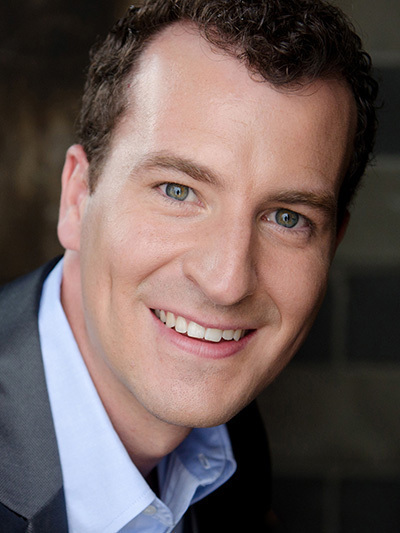
When the gilded gramophones are handed out on Feb. 4, Lancaster will be anxiously awaiting the announcement of the best choral performance award. Conductor Craig Hella Johnson is nominated for the album “,” performed by the large vocal ensemble Conspirare, which Lancaster joined in 2020.
The vocal ensemble won a Grammy in 2015 and has been nominated 11 times. For this album, the group rehearsed for several days and performed a live concert before making the recording.
“The more we rehearsed it, the more we loved the repertoire. And then the recording process went really well,” Lancaster said. “So, I think we all felt a sense of excitement that this was a satisfying project with music we felt strongly about. The music and poetry convey powerful messages about belonging that are meaningful to people today.”
Lancaster, who is a fellow with the , performs both as a soloist and as part of ensembles, primarily focusing on Western classical contemporary and sacred music.
Other notable Notre Dame connections to the Grammy Awards include music faculty member , whose vocal group Pomerium was nominated for best small ensemble performance in 1999; , whose album “The Caribbean Jazz Project, Afro-Bop Alliance” won a Latin Grammy for best Latin jazz album in 2008; and technology and production coordinator , who was a in the album “Canto América,” which was nominated for best Latin jazz album in 2017.
“It’s a major distinction for the department to receive this recognition,” said , the Keough-Hesburgh Professor of Music History and department chair. “As a department, we are committed to supporting and fostering creative work. These honors speak to the manner in which our faculty are leading the way in innovative and groundbreaking programming.”
Originally published by at .
]]>While the video and images told an immediate life-and-death story, Serafini’s thoughts later drifted to the next steps for the people on the plane who were about to arrive in a different country.
“They have to learn a language to lead a new life. Then I thought, there must be a need for foreign-language teachers,” she said.
That moment inspired Serafini to develop a new service-learning course that could offer a solution for refugees and empower Notre Dame Italian students to become educators themselves — by teaching basic Italian to African refugees before they relocate to Italy.
In the process, the Notre Dame students sharpened their Italian skills, learned how to teach others and developed global awareness and empathy for the refugee experience.
“Language is vital. It’s at the center of our beings. We need to communicate,” she said. “And if we speak different languages, we have to find a common way to communicate. What better way than to put your knowledge to the service of another person who is in need?”
She partnered with the to offer the online course, called Learning and Teaching Beyond the Classroom, and co-taught it last summer with Suzanne Shanahan, the Leo and Arlene Hawk Executive Director of the . Serafini plans to lead it again this spring and perhaps regularly going forward.
“We really need to rethink the teaching of foreign languages,” Serafini said. “We need to be thinking in terms of the social needs that we see arising in societies every day, more and more with all the wars and tumultuous situations we see in the world.”
Last summer, the course began with five undergraduates — including majors from the College of Arts and Letters, College of Science and Mendoza College of Business — and one graduate student engaged in experiential and service learning. Serafini and the students met with the refugees virtually in their African camp, and in three weeks, they covered a semester of Italian for beginners.
The refugees, who previously lived in the Congo, Nigeria and South Africa, were eager to learn the language and customs of the places in Italy they would go. For each lesson, the African students huddled around one screen in their refugee camp, about five students at a time, to learn the basics of introducing themselves, talking about their day and communicating in social settings.
The lessons were assisted by the fact that the students all spoke English, even though their native languages included Kiswahili, Lingala, Kinyarwanda and Swahili. Some also spoke French.
“We saw a tremendous amount of motivation,” Serafini said. “Whenever we hit a stumbling block, at least we were able to communicate in English.”
Eager to learn
The class attracted sophomore Gabe Biondo, who spent summers as a youth visiting grandparents in Sicily, where they lived near a refugee facility. This summer, he plans to work with physicians in northern Italy at a medical center for refugees.
Biondo said the class accomplishes Serafini’s goal of developing the global perspective while putting the refugees in a position to overcome language barriers when they reach their new homes.
“In communicating with the refugees, it was interesting to see how passionate they were about learning and asking for more sessions to increase their learning of Italian,” said Biondo, who is majoring in Italian and neuroscience and behavior. “They really are very happy to be given this opportunity to move to Italy and have a new life, which was really inspiring. You could see the effect of your work; it’s not being taken for granted. It’s really appreciated.”
That appreciation came during class questions and feedback that was followed by emails in which the refugees requested more sessions and talked about the class being well-organized.
“They were all really eager to learn,” Biondo said.
Tricia McCormack, a junior history major, said the experience demonstrated how crucial language is for human connection.
“This is an incredibly valuable experience because human culture, language and histories are the roots of personhood and are ultimately what bind people together across the world,” McCormack said. “I believe that widespread appreciation for other cultures, histories and languages would ultimately facilitate a more peaceful world.”
Globally speaking
To establish the connection between Notre Dame and the African refugee camp, Serafini collaborated with the United Nations High Commissioner for Refugees (UNHCR), Caritas Italiana (the charitable arm of the Italian Bishops Conference) and faculty from the University for Foreigners in Perugia and the University of Siena.
The UNHCR has coordinated Italian classes for refugees since 2019 with a consortium of 32 Italian universities. Notre Dame is the only American university working with the consortium.
After last summer’s course, Notre Dame students were surveyed about the experience and cited compassion as a transferable skill they acquired. They also reported developing empathy and social awareness, and that their confidence increased after working with refugees.
They all agreed that they are now able to identify and apply information from the class to address real-world problems — and several students wished the class had run even longer.
“I hope the students will appreciate that this course makes them go from the personal to the social to the global. It’s not just doing something for yourself; of course we want to do something for ourselves,” Serafini said. “But in an affluent society like the one we live in, we have the luxury to entertain the idea that we can help others, and I think it will make our life so much more meaningful.”
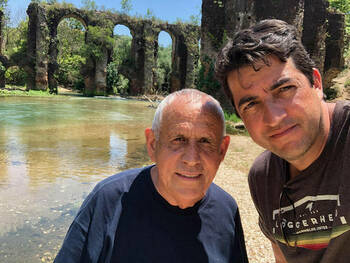
Located in Albania between Greece and Italy, the Roman forum at Butrint has attracted Hernandez and others for nearly 20 years. Researchers grab pickaxes, shovels and a water pump to reveal a town plaza and emerging technologies of the time, which are well-preserved because they stayed submerged underwater for centuries.
Noteworthy finds at the UNESCO World Heritage site have included an aqueduct that supplied spring water from nearly four miles away and outdoor spaces made of limestone and marble. The excavating team has unearthed buildings that handled civil disputes and criminal complaints. Other structures served as houses of worship to the gods and Augustus. More buildings fostered business deals in the form of loans and buying sharesof companies in the first version of the stock market.
The discoveries show the way of life during times presented in the Bible and the classics. They also present the greater context, Hernandez contends, for why Butrint is far more significant than scholars have previously recognized.
An associate professor and director of graduate studies in Notre Dame’s , Hernandez is now pouring his insight into a book about the Roman forum at Butrint. Supported by a at Harvard University, which he was awarded this spring, the book will further explore the relationship between the Romans and the Greeks by examining this understudied region.
“Butrint was a city at the northwest tip of Greece, closest to Italy, and rather than being marginal on the periphery, it played an important role in the creation of Roman Greece,” Hernandez said.
More than 2,000 years ago, Augustus ordered the build-out of the ancient Greek settlement of Butrint to serve as a practical and symbolic gesture of opportunity as a Roman colony in a new land — and the purported social and economic advancements that his empire could provide to the Greeks.
“Imagine an urban center paved entirely of gleaming white limestone with marble-veneered temples and public buildings in the Mediterranean summer — it was unbelievably brilliant. The sunlight reflected from it was an incredible force to contend with,” Hernandez said. “Augustus didn’t imbue the old cultural centers of Athens or Sparta in this way. He did this at Butrint to showcase Roman urbanism. It was a message of Roman imperialism.
“And the aim of the message was to co-opt the Greek elite into the Roman Empire and imperial system. It said to them, ‘If you cooperate and devote yourselves to the empire of Augustus, you too can be favored and experience these benefits.’”
Hernandez visited Butrint for the first time in 2003, and is now director of the , leading a team that includes scholars from Albania, Italy, the United Kingdom and elsewhere. The project is supported by and the . Hernandez has from the Woodrow Wilson National Fellowship Foundation, American Council of Learned Societies, Butrint Foundation and American Philosophical Society.
In 2005, excavators discovered the forum that was the town square of the ancient city — it’s preserved incredibly well because earthquakes caused the land to fall below the water table and remain inaccessible for generations.
The excavating team uses a machine that can pump 2,000 liters of water per minute, leading to discoveries both big and small at the dig site. There are a number of statues of Augustus and the imperial family. Any buried, submerged wood is free of bacteria, so a plow from the third century B.C. looks like it was cut in the present day. Larger finds have included theaters, public buildings, temples and a basilica. An aqueduct allowed the forum to have public baths, pools and fountains.
“The impact of an aqueduct on urbanism is enormous because it brings an abundant flow of natural spring water, the highest-quality water even today,” Hernandez said. “Used for drinking, bathing and urban amenities, it raised the standard of living considerably.”
Public baths were the after-work place to go where people would mingle for hours in and around pools of varying temperatures, ending with a revitalizing cold plunge. The marble buildings created an environment for commerce and trade, and people gathered to buy and sell food, clothes, wine, olive oil, meat and fish. The basilica wasn’t a church, but instead served as a place for justice and business.
Once developed, the city was unlike anything seen before in northwest Greece— this was the first city in the region with a paved urban center; in this case, one made of ornate, high-quality limestone.
“People at the time saw a new city that was gleaming white — and this would have been a profound experience for them,” Hernandez said. “When we excavate a small portion of this pavement at site, we have to wear sunglasses because the gleam of reflected sunlight is very intense.”
For Hernandez, history has always been a fascination. He studied physics as an undergraduate student at the University of California, Berkeley and was drawn to study the origins of the universe before ultimately pursuing a career path that mixes the classics with archaeology.
On an archaeological dig, adrenaline flows from the learning opportunities that never stop.
“Things like a simple pavement take on a whole new meaning when you think about what it meant to the people it was built for,” he said. “Things you take for granted in your own culture might become highly significant in another because of the importance they hold. It certainly expands your understanding of the human mind and how human beings think and the systems they create for themselves based on their own belief system.”
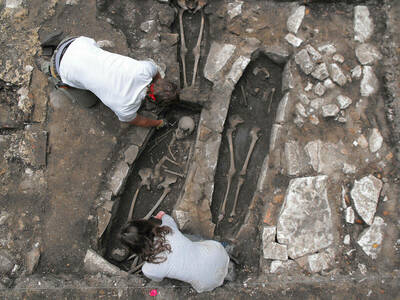
The effort also becomes personal when Hernandez and the team find burials at the site.
“There are few experiences on an excavation as poignant as discovering a burial, because they’re like time capsules,” he said. “And you know when you see a skeleton, there was a funeral that occurred 1,000 years ago, and it remained untouched, seemingly timeless, until you uncovered it. And you become part of that event.”
About 20 Notre Dame students have joined Hernandez on digs throughout the years, and he will keep coming back — his connection to the site supersedes anywhere else he has lived.
“There’s something magical about that process that leads to a very strong spiritual connection,” he said. “I never felt more closely bonded with an area, because of the amount of time, study and everything else that has gone into it.
“It’s a laboratory and a window into a small slice of history. We have no idea what we’re going to find when we dig it.”
Originally published by at on April 13.
]]>The three-year project, , is supported by more than $2.5 million from the National Science Foundation’s program, $1.1 million of which is directed to Notre Dame.
Led by the ’s — which uses technology and methods to address pressing issues in the South Bend/Elkhart area — the project also involves engineeringand faculty in the effort to understand how CCI’s model for community improvement projects functions in other cities under varying circumstances.
In the short term, such research and collaboration projects seek to make life better for residents by addressing key issues of concern. In the long term, the projects can foster strong connections between the students involved in them and the Rust Belt cities where they take place, spurring undergraduates to consider making their professional and personal homes there.
In both its short-term aim to improve the community and its long-term goal of building strong connections between students and Rust Belt cities, the effort strongly aligns with Catholic social teaching on seeking the common good for communities, Wood said.
“Rust Belt cities are the focus because they often struggle more with disinvestment — in neighborhoods, in people,” said , CCI’s associate director for research and the principal investigator on the grant. “As a Catholic university, we are called to be in solidarity and participate in our community — to be good neighbors. And neighbors take care of each other. They work together. They look out for each other.”
The interdisciplinary research team includes Wood; , director of the CCI and a ; , the College of Engineering’s assistant dean for student development; CCI managing director ; and , the ACE Collegiate Professor in the ’
After their collaborative learning model of community engagement is applied by researchers at Youngstown State University and the University of Louisville and additional South Bend/Elkhart projects are implemented, Notre Dame will share a replicable model that provides STEM-based experiential learning opportunities to address an array of public challenges such as access to health care, affordable housingand environmental sustainability.
“There are a lot of people who want to see this. There are a lot of people on this campus that engage heavily with the community, and not just through service,” Brockman said. “Whatever their discipline is, they bring their intellectual assets to do it. And we need to join forces more to have the most impact we can have.”
The Notre Dame team aims to identify the best ways to create a network of community partners to identify projects; recruit students and train them in project management, team leadershipand design thinking; and promote diversity, equity and inclusion. Lapsley, a developmental psychologist, will study differences in student disposition and their sense of connection to the place in which they work and study — and how that differs based on variables in each location.
All of the civic partnerships in the grant will prioritize listening to the community before taking action and fostering spaces where students of all social and economic backgrounds are welcome. Potential initiatives could include environmental remediation projects, connecting public school students to STEM programs, or partnering with the city of South Bend on creating energy-efficient and affordable housing.
High schools and colleges throughout the South Bend, Youngstownand Louisville regions will participate in the projects, exposing students to their academic peers and community members they wouldn’t otherwise meet — and, hopefully, forming connections that prompt them to consider staying in the Rust Belt.
“Creating that collaborative learning environment where educating youth and making positive community change is part of our ethos,” said Wood, who is alsoproject director of the . “It’s been happening, but more of a culture shift is needed.”
So how does a psychologist get involved in a civic-minded effort led by engineers?
Two years ago, Lapsley went to a presentation Wood and Brockman were giving about their community work and partnerships — and what they were saying sounded very familiar.
“I was really struck by the language they were using — ‘community assets’ and the ‘whole-systems perspective.’ The language they were using had deep resonance in the language developmental psychologists use,” he said. “I began to see connections between what they’re doing and what we do in developmental psychology.”
Wood and Lapsley met the next day to continue the conversation, and the synergy was clear. University-led community partnerships provide students the autonomy they need to develop ideas on community-identified issues while also generating a sense of attachment to the communities they serve.
In psychology buzzwords, it gives the students “voice” and “choice.” A greater sense of purpose emerges, and students gain a heightened civic identity that means they’re more likely to vote and engage with their community.
“The work Dan does is highly relevant here,” Brockman said. “There are far more important connections between the College of Engineering and the College of Arts and Letters than people realize.”
Beyond the psychological component, the underlying mission resonates with Lapsley — as a Pittsburgh native and son of a steel worker, he knows what it’s like for a city to lose its industry and redefine itself through other careers and research in medicine and technology.
And the energy at the intersection of expertise, mission, and service makes Notre Dame the perfect place to be advancing such efforts.
“We should be using our science, our engineering, our theology, and philosophy to help people so they have the context to flourish, for regions to contribute to the well-being of individuals,” Lapsley said. “This flows from our faith, alleviates distressand makes lives better for people.”
Originally published by at on Oct. 21.
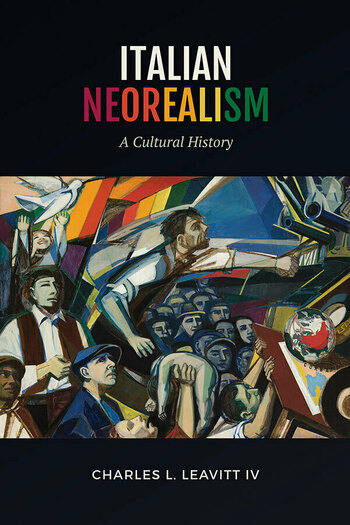
]]>“The short answer is, it’s everything,” said Leavitt, an associate professor of Italian in the University of Notre Dame's .
If it seems like a bold claim, consider the fact that after World War II, Italian filmmakers moved their scenes from indoor studios to the streets. Necessity drove the change because their studios became refugee camps for displaced Italians and other Europeans.
The filmmakers valued creating a sense of place by going into neighborhoods, especially devastated areas. They shifted away from filming outdoor scenes near landmarks that would easily identify a city such as Rome.
And they stirred audience emotions by crafting plots and casting actors that reflected their audiences. It’s a relatable feeling that Hollywood glamour and fascist propaganda couldn’t provide — and that influenced the work of Martin Scorsese, Jean-Luc Godard, Chloe Zhaoand countless other modern narrative and documentary filmmakers.
This movement became known as neorealism, and Leavitt’s book on it has received significant acclaim. “” has won the from the . It’s also one of five finalists in American nonfiction for .
In the 10-year process to complete the book, Leavitt traveled to the National Central Library of Rome in addition to other libraries and archives throughout Italy to review primary materials. But he also spent significant time reviewing works in the and the ’ , which has more than 2,000 Italian films in its archive.
“There’s really nothing else like it in North America,” Leavitt said. “Without having to leave campus, I got a very good start on research.”
Leavitt’s book examines the time period after World War II when Italians were recovering from 20 years of fascist dictatorship and two military occupations — Germany during the conflict, and British and American forces during the reconstruction.
“There was really widespread poverty,” Leavitt said. “The industrial production after the war went back to what it was in the middleto late 19th century. They were going back two generations in terms of industrial output. What’s so striking is that amidst all of this chaos, having had their political structures more or less destroyed and remade, they came to the forefront of global culture.”
Filmmaking played a lead role in the movement, emerging as a communal conversation about the past, presentand future of society. Italian cinema — led by Vittorio De Sica (“Bicycle Thieves”), Roberto Rosselini (“Rome, Open City”)and others — became the model for Hollywood, Europe, Indiaand South America.
Stories focused on realism in environment, costumeand character. Some films recreated war events so vividly that when filming, people nearby fled their homes. Others told the story of the refugees trying to travel to Israel.
“There are films about refugee camps where you have speakers of all different languages thrown together in chaos,” said Leavitt, who is also associate director of the Center for Italian 91Ƶ, a concurrent faculty member in the , and faculty fellow of the and the. “There was an attempt by Italian filmmakers to show other Italians and the world what their country looked like in this moment of turmoil.”
Published by the University of Toronto Press, the book is Leavitt’s attempt to understand how such a significant artistic movement developed amidst challenging circumstances.
“How is it that people living in these kinds of conditions and people dealing with these kinds of problems and pressures were able to create lasting works of art — masterpieces that have stood the test of time?” he said.
It’s clear those films maintained their relevance due to the impact and influence the neorealism movement had. But there’s a wrinkle — scholars don’t agree on the exact meaning of neorealism. Leavitt examined individual uses of the term to reach his conclusion.
“I argue in the book that the term signifies not a return to realism after the illusion of fascism, but a new form of realism, something fundamentally and radically new, looking at reality with new eyes,” he said. “Artistically speaking, it means trying to capture more of reality than anyone had been able to do before and to show that reality to people in new forms.”
Through fictional tales of individuals coping with a massive war, Italian writers, artistsand filmmakers told the story of history — and captured audiences’ attention.
“How do you bridge those scales — the scale of the individual and the scale of global total war? You make people understand the importance of those small individual events, and make people see how small individual events were part of a total global story,” Leavitt said.
As history knows, this story is one of rebirth. A decade after the period examined in Leavitt’s book, Italy joined the world’s wealthiest economies and became a major producer of industrial and artisanal goods.
“If there’s a lasting value in this age of neorealism,” Leavitt said, “if there’s a message that comes out of this, it’s the power of that collective conversation to reimagine the world and remake society for the better.”
Originally published by at on Oct.12.
]]>It’s 1890, so a copy of the mining and engineering publication leaves New York on a steamship to cross the Atlantic Ocean. The journal reaches the mine site via railroad and couriers on horses, mules or travelers' own two feet.
The engineer responds with a written letter mailed to the American publisher, providing details about the cyanide used to separate gold from ore, data on operational costsand his experience at the site. The letter is published for all to see on the printed page.
This exercise in information exchange takes four weeks. To say this is “lightning speed” is truth, not sarcasm — this is, after all, the late 19th century.
“And it’s something unthinkable to their parents’ generation,” said , a University of Notre Dame professor of history.
Entrepreneurial tycoons, inventorsand shop-floor workers are often celebrated throughout history, but the story of the engineer isn’t something that’s taught in school. Beatty aims to change that, thanks to a $250,000 research grant from the National Science Foundation that will fund a book, several articlesand an interactive database that will showcase the critical but often overlooked role engineers played in shaping society as we know it.
“Engineers are the central story of the modern world,” he said. “And yet they are generally anonymous and nearly invisible.”
The three-year project, “Blueprint for Modernity: A Global History of Engineering,” is a collaborative effort between Beatty and co-principal investigator Israel Garcia Solares, who received his doctorate from the Colegio de México and is currently a postdoctoral fellow at Notre Dame’s .
They seek to tell the story of the rise of engineers — not just at outdoor worksites and inside factories but also in corporate boardrooms and government agencies across the globe. Their rise to prominence in corporate and public planning is manifest in the alignment of political stars around 1930, when President Herbert Hoover and the leaders of Great Britain, Canadaand Mexico were all engineers or trained technicians.
The engineer’s mission was as simple as it was capitalistic: Locate, extractand refine the most metal for the lowest cost. The process is obviously more complicated, as it involved decisions in offices that affected workflows at mine sites and factories. The engineers also reviewed catalogs to order the machines they needed and determined how to set the gauges and maintain equipment.To measure the influence of the engineers of the late 19th and early 20th centuries, just look around. They created the processes that supply us with food and water. Their insight built American skylines, railroads, bridges and highways. Metals such as gold and silver were celebrated as jewelry and ornamental furnishings. Copper was needed to supply electricity. Iron and steel led to the construction of skyscrapers. Smartphones run on a cocktail of metals and rare earth elements that miners have pursued since the 1800s.
They also thought about the logistics of production to sort, crush, grindand process the materials for the products the companies sell, “in the same way Henry Ford is thinking about the assembly line, or meat packers in Chicago are importing, processingand packaging beef,” Beatty said.
With a focus on mining and metallurgic engineers, the project, which was initially supported through a , has already yielded a database of all known engineers who worked throughout the world in the time before, duringand after the profession ballooned in the early 20th century. It will be published for open access on the web and contains 60,000 names and 2.7 million data points — numbers that will continue to increase.
“It will never be complete. We’ll always be expanding it,” Beatty said.
It’s not common that a history professor receives an NSF award, but this is Beatty’s second. In 2004, an NSF grant funded the research that became his award-winning second book, “Technology and the Search for Progress in Modern Mexico.” It traces 19th-century technological changes in Mexico, with case studies of sewing machines, glass-bottle manufacturingand silver refining.
The collaborative nature of the database development and research has been a welcome change from his typical work, Beatty said.
Beatty and Solares are also analyzing and interpreting that data and have two journal articles near completion. One paper examines engineers’ role in corporations and their prevalence in managerial roles relative to strategic planning within firms. Another article explains globalization in the late 19th century through the lens of the engineer. “Historians tend to be loners. We prefer to sit quietly in the corner of an archive, and tend to think of ourselves as lone actors,” he said. “This project is very different, and it’s been fun in that way.”
In addition, a working group of 10 scholars will each focus on one country to present the story of engineering in places such as China, India, Chile, Mexico, South Africaand Great Britain. The group held a two-day workshop last year and will reconvene in December. Their case studies will form a book that will explain local responses to global engineering and explore engineers’ interaction with the private and public sectors.
Beatty, who is also associate dean for academic affairs at the and a Kellogg Institute faculty fellow, is bringing the research into the classroom, as well. Courses based on the project will be cross-listed between the , and Keough 91Ƶ in the fall and spring semesters. In last year’s , an initial version of the course drew students from the College of Arts and Letters, Mendoza College of Business, the College of Scienceand the College of Engineering.
“It’s a nontraditional course that combines data science with the history of engineering and capitalism through the lens of engineers,” Beatty said. “Students from both STEM and social science backgrounds who were used to more political and social histories really embraced it.”
Originally published by at on Sept. 1.
]]>